

Editor’s Note
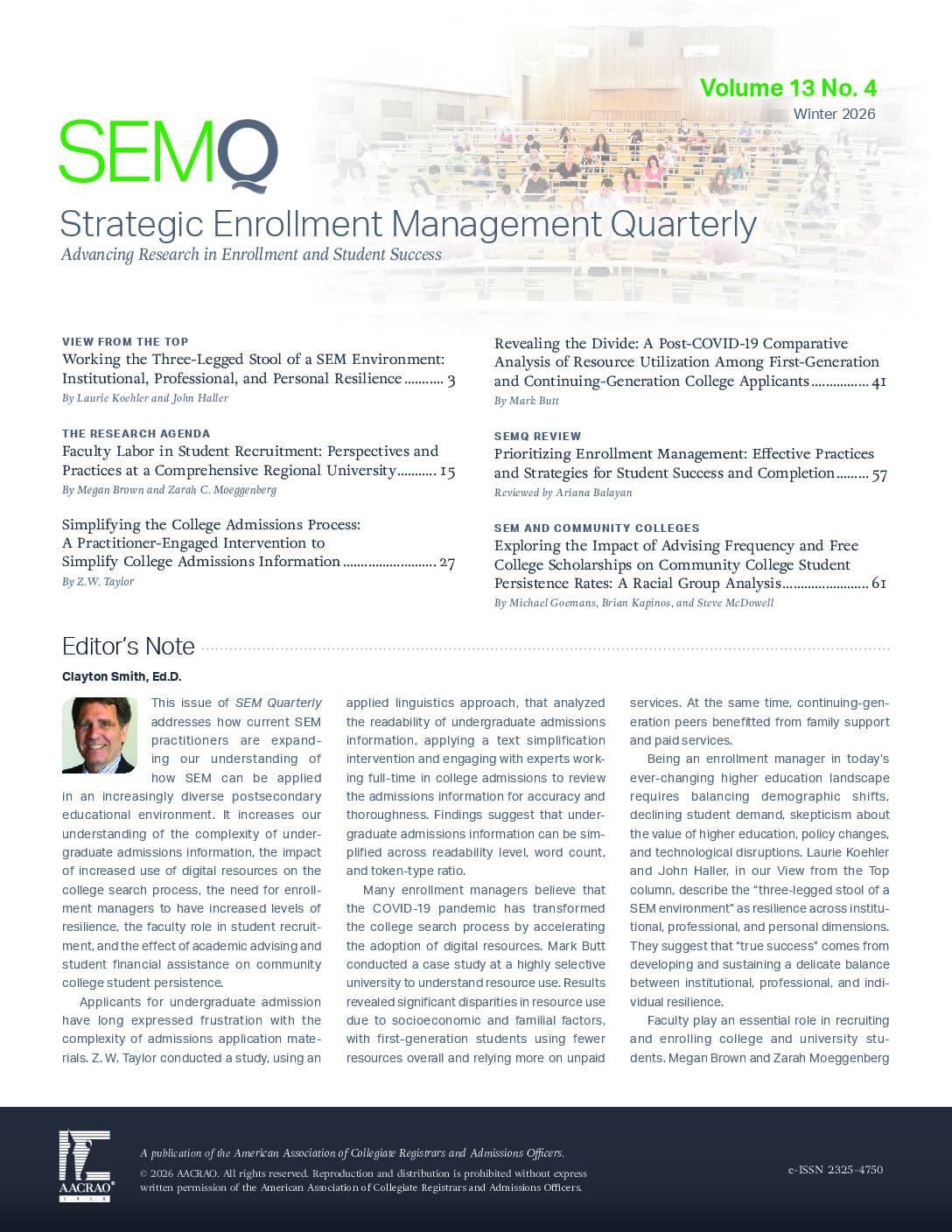
This issue of SEM Quarterly addresses how current SEM practitioners are expanding our understanding of how SEM can be applied in an increasingly diverse postsecondary educational environment. It increases our understanding of the complexity of undergraduate admissions information, the impact of increased use of digital resources on the college search process, the need for enrollment managers to have increased levels of resilience, the faculty role in student recruitment, and the effect of academic advising and student financial assistance on community college student persistence.
Applicants for undergraduate admission have long expressed frustration with the complexity of admissions application materials. Z. W. Taylor conducted a study, using an applied linguistics approach, that analyzed the readability of undergraduate admissions information, applying a text simplification intervention and engaging with experts working full-time in college admissions to review the admissions information for accuracy and thoroughness. Findings suggest that undergraduate admissions information can be simplified across readability level, word count, and token-type ratio.
Many enrollment managers believe that the COVID-19 pandemic has transformed the college search process by accelerating the adoption of digital resources. Mark Butt conducted a case study at a highly selective university to understand resource use. Results revealed significant disparities in resource use due to socioeconomic and familial factors, with first-generation students using fewer resources overall and relying more on unpaid services. At the same time, continuing-generation peers benefitted from family support and paid services.
Being an enrollment manager in today’s ever-changing higher education landscape requires balancing demographic shifts, declining student demand, skepticism about the value of higher education, policy changes, and technological disruptions. Laurie Koehler and John Haller, in our View from the Top column, describe the “three-legged stool of a SEM environment” as resilience across institutional, professional, and personal dimensions. They suggest that “true success” comes from developing and sustaining a delicate balance between institutional, professional, and individual resilience.
Faculty play an essential role in recruiting and enrolling college and university students. Megan Brown and Zarah Moeggenberg employed a cross-sectional survey design to collect data from faculty members at a comprehensive regional university, examining faculty understanding of college enrollment investment and activities, as well as faculty participation in enrollment activities. They found that when faculty have their work acknowledged and openly appreciated, they are more likely to engage in recruitment activities.
Academic advising and student financial assistance are widely regarded as key factors in enhancing student persistence. Michael Goemans, Brian Kapinos, and Steve McDowell conducted a quantitative study that investigated the relationship between academic advising frequency, acceptance of free college scholarships, and student persistence in a statewide community college system. They found that students who attended multiple advising sessions were more likely to persist than those without advising, and the combined effect of frequent advising and acceptance of free college scholarships resulted in the highest persistence rates.
We also include one book review. Ariana Balayan introduces us to Prioritizing Enrollment Management: Effective Practices and Strategies for Student Success and Completion (2025), written by Jason Meriwether. This timely and practitioner-focused contribution to the SEM literature, with its focus on practical strategies, should be beneficial for professionals in the early to mid-stages of their careers.
As the SEM community addresses today’s challenges while planning for the needs of a new generation of learners, we must continue to grow our scholarship and share best and promising practices. Hopefully, this SEMQ edition will provide research and insights to help us achieve enrollment success.
Happy reading.

Filters
Search
Department
-

Exploring the Impact of Advising Frequency and Free College Scholarships on Community College Student Persistence Rates: A Racial Group Analysis
This quantitative study investigates the relationship between academic advising frequency, free college scholarships (FCS), and student persistence in a statewide…
-
Faculty Labor in Student Recruitment: Perspectives and Practices at a Comprehensive Regional University
This paper examines faculty efforts in student recruitment at a comprehensive regional university. Survey data demonstrate faculty perspectives on practices…
-
Revealing the Divide: A Post-COVID-19 Comparative Analysis of Resource Utilization Among First-Generation and Continuing-Generation College Applicants
The COVID-19 pandemic transformed the college search process by accelerating digital resource adoption. This case study, framed by a Social…
-
Simplifying the College Admissions Process: A Practitioner-Engaged Intervention to Simplify College Admissions Information
Although the enrollment decline in U.S. higher education may be attributed to many factors, higher education practitioners should make every…
-
Working the Three-Legged Stool of a SEM Environment: Institutional, Professional, and Personal Resilience
Enrollment managers face a perfect storm of challenges—demographic shifts, declining student demand, skepticism about higher education’s value, policy changes, and…
share