AACRAO History
Since its early convenings in the early twentieth century, AACRAO has served as a professional home for practitioners responsible for the integrity, interpretation, and portability of academic and learner records. Scholarly work on the development of the student record places AACRAO’s formation in 1910, reflecting the growing need for cooperation and standardization across institutions as mobility and enrollment expanded.
A decade later, the community’s work continued to formalize. In 1920, fifteen collegiate registrars assembled in Detroit, Michigan to establish a permanent national conference, laying groundwork for the association’s durable role in convening the profession. Over time, AACRAO’s scope evolved alongside institutional structures and student needs, expanding from records and registration toward a broader focus on admissions, enrollment services, policy, and global learning mobility.
Highlights and milestones across the decades
1910s–1920s: Professionalization and early coordination
AACRAO’s earliest era reflects the rapid growth of higher education and the corresponding need to build shared approaches to documenting learning, evaluating preparation, and maintaining reliable records across institutions.
1925: A publishing and knowledge-sharing foundation
AACRAO’s long tradition of publishing is visible in the early Bulletin of the American Association of Collegiate Registrars, with volumes available as early as 1925. This emphasis on documentation and dissemination helped establish a professional record of evolving practice.
1940s–1950s: Expansion to admissions and a modern association identity
As institutions increasingly differentiated admissions and records functions after World War II, the association expanded its scope. In 1949, the organization added admissions officers to its membership and became what is known today as the American Association of Collegiate Registrars and Admissions Officers (AACRAO).
1960s–1980s: Broader institutional roles and governance of learner data
As higher education scaled and diversified, the registrar’s and admissions professions broadened beyond record-keeping to include enrollment services, institutional data stewardship, and systems leadership, reflecting the increasing operational complexity of learner records and mobility.
1990s–2010s: Globalization and the infrastructure of mobility
AACRAO’s work increasingly reflected global student movement and cross-border credential interpretation, with growing attention to comparability, trust frameworks, and consistent evaluation methods that support institutional decision-making and learner opportunity.
2010s–present: Public policy, advocacy, and global credential transparency
AACRAO’s policy and advocacy work has articulated the association’s role as a nonpartisan, member-informed voice on issues affecting academic and enrollment services, including the implementation realities of legislation and regulation. In parallel, AACRAO’s collaborations in Learning Mobility, credential transparency, and linked open data (including work involving AACRAO EDGE and Credential Engine) reflect a continued focus on trusted, interoperable learner data exchange in support of learning mobility.
A continuing convening tradition
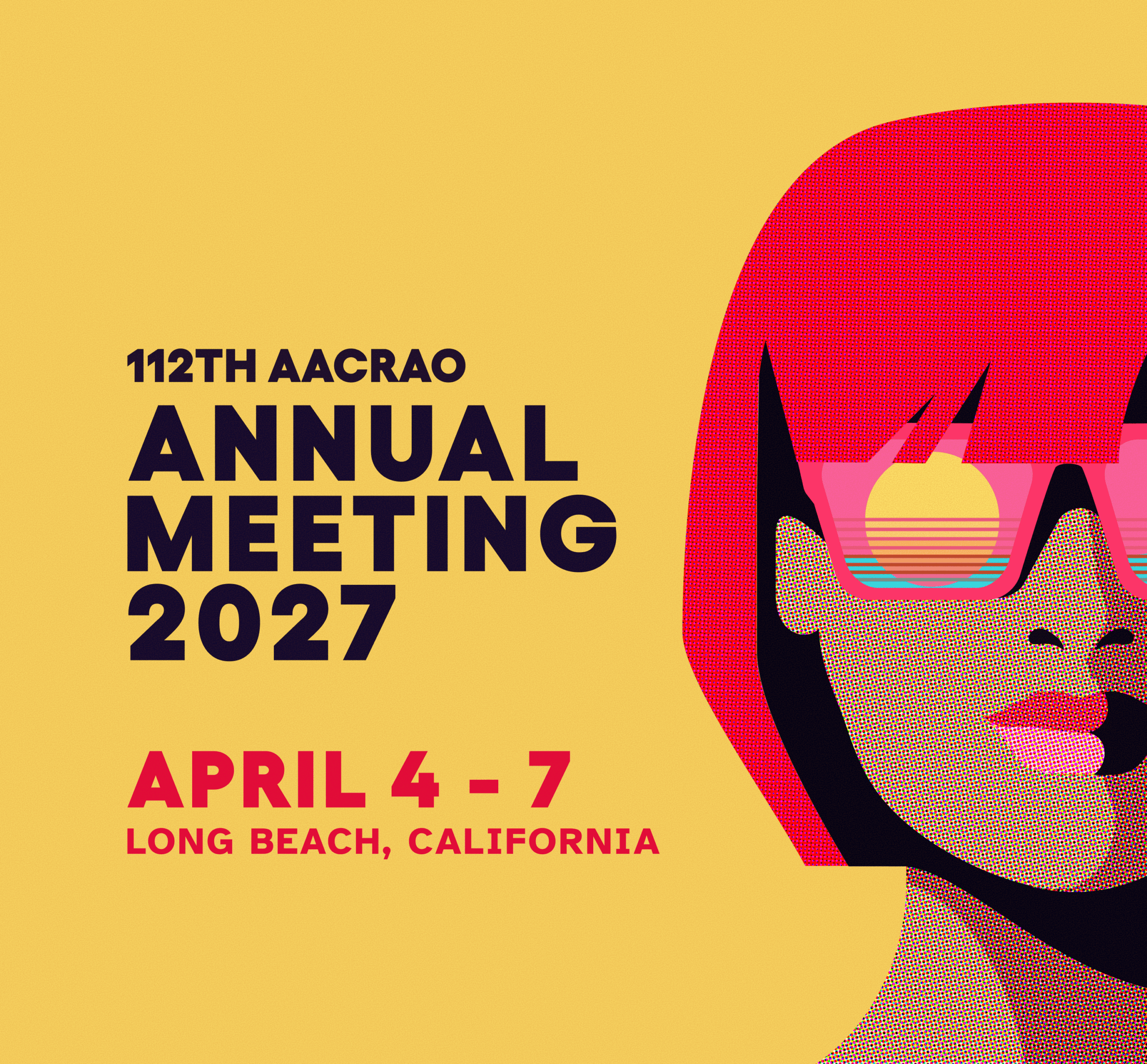
AACRAO’s annual meeting remains a visible marker of continuity and professional exchange; for example, the 111th AACRAO Annual Meeting is scheduled for April 19–22, 2026, in New Orleans, underscoring a long-running tradition of convening the field.
AACRAO Annual Meeting
The AACRAO Annual Meeting is an opportunity to learn, network, and advance higher education. Professionals from a variety of higher education disciplines gather together at the AACRAO Annual Meeting to engage and discuss the ever-changing landscape of higher ed.