

The Workforce Readiness Challenge
The college-to-career transition is one of the most significant events in the life of students. Current research reveals concerning gaps in workforce readiness among Generation Z graduates. Data indicates 3 percent of Gen Z lack or are “very unskilled” in soft skills; 37 percent struggle with traditional in-person communication and public speaking; 28 percent have difficulty bouncing back from setbacks; and 27 percent have challenges independently working through problems (CES 2024). Although the bachelor’s degree remains the most common credential to secure professional admission, employers are now showing more interest in the importance of evidenced skills, many of which are not captured on academic transcripts (Stein 2024). This growing focus on skills-based recruitment compels institutions of higher learning to articulate how students acquire essential competencies such as communication, critical thinking, and collaboration, skills often developed during internships, co-curricular activities, and campus jobs (Viano 2023). Consequently, colleges and universities are increasingly exploring alternative credentialing models capable of documenting and validating students’ applied learning experiences in ways that traditional academic transcripts cannot fully capture.
Texas Christian University’s Excellence in Career Skills Micro-Credentialing Program represents one such institutional approach. Grounded in the National Association of Colleges and Employers (NACE) Career Readiness Competencies, the program integrates student employment with structured professional skill development and digital badging. By embedding microcredential eligibility within institution-sponsored student employment, the initiative transforms campus jobs into intentional sites of competency acquisition and career preparation. This model is distinctive because it positions paid student employment not merely as financial support, but as a high-impact experiential learning opportunity through which students can develop, document, and communicate transferable workplace skills.
This article presents a case study of Texas Christian University’s Excellence in Career Skills Micro-Credentialing Program and summarizes current trends in academic microcredentials, workforce readiness, and skills-based credentialing while situating the initiative within broader national conversations surrounding career preparation and employer expectations. In doing so, the study addresses a gap in the emerging microcredential literature by examining how institution-sponsored student employment can serve as a scalable and replicable pathway to document career-readiness competencies. The integration of microcredentials into student employment offers a practical framework through which institutions may better support the student-learner-worker and enhance graduates’ professional preparedness in an increasingly skills-oriented labor market.
Defining Microcredentials
Microcredentials are short, focused certifications recognizing mastery of specific skills or competencies. Unlike traditional degrees, they emphasize speed, flexibility, and responsiveness to workforce demands (University of Maine System n.d.). They are particularly valuable for learners seeking opportunities to upskill or reskill in rapidly changing labor markets (Texas Woman’s University 2024). Consequently, higher education institutions and employers increasingly value flexible, workforce-aligned, digitally verifiable learning opportunities (Maina, et al. 2022).
While formats vary, microcredentials are typically offered online, assessed through performance-based tasks, and represented digitally through badges. Many are designed to be stackable, allowing learners to accumulate multiple badges that build into certificates or degree pathways (Strada Education Foundation 2023). This stack ability supports lifelong learning and gives students flexibility in pacing their educational progress.
Microcredentials have thus emerged as valuable tools for adult learners navigating technological change and evolving job requirements. They enable working professionals, career changers, and post-traditional learners with opportunities to acquire targeted competencies without committing to lengthy degree programs (Welding 2024). Their portability strengthens labor market signaling, as learners can demonstrate discrete, verified skills to employers through digital badges and transcripts (Coursera n.d.).
How do Microcredentials Work?
Microcredentials are primarily provided by universities, business schools, and colleges, as well as the relevant professional training centers. They are often listed alongside traditional degrees and are accessible to both students and working professionals. Professional organizations may also either select an academic institution or a licensed training provider to license and directly market microcredentials to employees.
Subject matter experts sometimes design and offer microcredential courses on professional development platforms, giving learners access to specialized knowledge. These programs are typically delivered in several formats:
- Online: To a great extent, most microcredentials are delivered in an online format and are broken into modules to allow learners to work at their own pace.
- In-Person: Certain classes have face-to-face classes to help with hands-on learning.
- Hybrid: A combination of online modules and in-person classes.
Ultimately, microcredentials complement traditional degree programs by helping learners develop targeted, market-relevant skills that enhance their adaptability and competitiveness in the labor market.
National Adoption in the United States
National adoption of microcredentials in the United States is accelerating, positioning them among the fastest-growing credential types in American higher education. Enrollment in short-term programs continues to rise, alongside the expansion of available offerings, and more than half of U.S. institutions now offer some form of microcredential, with many awarding academic credit for their completion (Hultquist and Murphy 2025). Across all 50 states and the District of Columbia, higher education institutions are integrating microcredentials into both credit-bearing and non-credit pathways, often aligning them with workforce and regional economic priorities (Williams 2022).
This growth is supported by national research emphasizing the value of experiential and career-connected learning. The National Alumni Career Mobility Survey conducted by Lightcast (2024) and the Gallup Experiences Report (2026) both highlight the significant relationship between high-impact collegiate experiences and graduates’ confidence, career mobility, and workplace success. These findings reinforce the broader movement toward credentialing experiential learning that builds transferable skills and suggest that institutions are increasingly adopting microcredentialing strategies consistent with their mission and educational philosophy.
The University of Texas System’s Texas Credentials for the Future initiative, developed in partnership with Coursera n.d., is a prominent example, providing students across nine academic institutions with free access to industry-recognized credentials in high-demand fields such as data analytics, cybersecurity, and project management (Stein 2024). Similarly, West Texas A&M University has expanded access for post-traditional and rural learners while responding to local labor market needs. Nationally, universities are adopting diverse strategies to integrate microcredentials, including online certificates, co-curricular badges, and short courses. Many microcredential courses are stackable credentials that align with degree requirements in high-demand fields, often developed in partnership with external platforms (Pettijohn 2025). To promote quality and employer recognition, institutions and consortia are also developing frameworks that emphasize transparency, consistent standards, and clear articulation of competencies, assessment methods, and credit value, thereby strengthening employer trust and supporting learner mobility (Maina, et al. 2022).
At the University of Colorado Boulder n.d., the microcredentialing program reflects this broader national trend while emphasizing institutional inclusivity and academic rigor. Sponsored through the university’s Financial Futures initiative and governed by a university-wide Microcredentials Advisory Committee (MAC), the program ensures consistency and quality across both credit and noncredit offerings available to students, faculty, staff, community members, and corporate learners. Upon completion, learners receive digital badges through the Credly platform, which contain verifiable metadata documenting program requirements and learning objectives, supporting the transparency and portability that employers increasingly expect. New microcredentials undergo a structured departmental proposal and MAC review process, ensuring CU Boulder’s offerings maintain the credibility and employer trust central to effective microcredential ecosystems.
Within this broader national movement, Texas Christian University’s Excellence in Career Skills Micro-Credentialing Program represents a targeted institutional strategy that integrates student employment with workforce readiness. Embedding the National Association of Colleges and Employers (NACE) career readiness competencies and issuing digital badges, the program enables student workers to document and showcase transferable skills, offering a replicable model for institutions seeking to enhance students’ professional preparation.
Benefits for Students and Institutions
Existing studies have found clear advantages of microcredentials for both students and institutions. Microcredentials serve as verifiable attestations of student competencies through digital badges, providing formal recognition of learning outcomes achieved in both academic coursework and co-curricular engagements (Clarkson University 2024). Furthermore, their comparatively low cost, online delivery, and modular design enhance flexibility and accessibility, making microcredentials particularly salient for post-traditional, part-time, and lifelong learners seeking to upskill or reskill.
For institutions, microcredentials contribute to an image of innovation and employer responsiveness, signaling a commitment to aligning academic offerings with labor market needs (Digital Learning Texas 2025). They also strengthen partnerships with employers by enabling institutions to respond more directly to workforce demands and skills gaps. In addition, by recognizing learning that occurs outside the traditional classroom, microcredentials can promote student engagement and retention, particularly among students who may benefit from incremental, skills-based recognition of progress.
Methods
This work uses a case study approach, which utilizes various institutional and program materials to address the design and implementation of the Excellence in Career Skills Micro-Credentialing Program at Texas Christian University. Data were collected from institutional reports, coalition meeting records, supervisor evaluations, program presentations, and Graduate Exit Survey data. The primary sources include:
- Program Design Documents — including program frameworks and executive summaries describing the microcredentialing initiative.
- Coalition Membership Records — describing the 24 cross-campus offices involved in program development.
- Supervisor Feedback — qualitative comments on student interaction and assessment outcomes.
- Student Reflections — artifacts provided as badge requirements, including cover letters, testimonials, and self-evaluations.
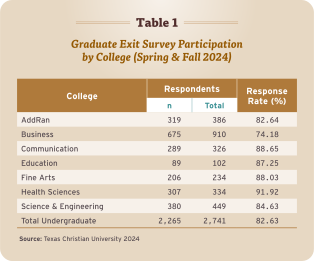
- Graduate Exit Survey Data — National Association of Colleges and Employers (NACE) competency analyses from undergraduate students (Spring & Fall 2024, n = 2,265, 82.63 percent response rate) (Texas Christian University Office of Student Life Analytics 2024).
- National Comparisons — peer institutional models and frameworks recorded in the literature.
This is a descriptive, exploratory analysis that aims to illuminate the program design, collaborative structures, and preliminary outcomes. The Graduate Exit Survey provided critical baseline data on how TCU students develop NACE competencies through various experiences, informing the program’s design and validating its focus areas.
Findings
Understanding TCU’s Context: Graduate Exit Survey Insights
Before examining the microcredentialing program specifically, it is essential to understand TCU’s broader context for competency development. The 2024 Graduate Exit Survey, administered to graduating undergraduates three weeks prior to one week after graduation, achieved a strong 82.63 percent response rate (2,265 of 2,741 students) with 95.50percent completion rate among respondents (Texas Christian University Office of Student Life Analytics 2024).
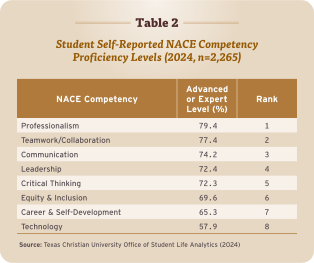
The survey revealed that TCU students rate themselves highest in professionalism, followed by teamwork/collaboration, communication, and other NACE competencies. These self-reported proficiency levels have remained relatively stable over the 2019–2024 period, with notable increases in technology (from 48.7 percent to 57.9 percent) and career and self-development (from 52.0 percent to 65.3 percent).
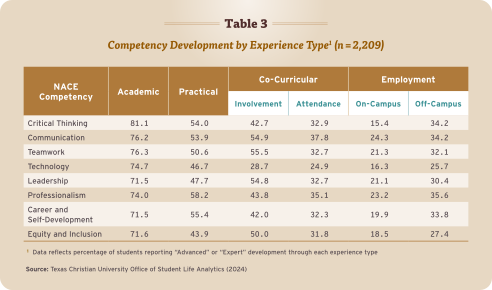
Critically, the survey illuminated where students develop these competencies through various developmental experiences. The data reveal distinct patterns in how different contexts contribute to competency development.
Most relevant to the microcredentialing initiative, on-campus employment shows modest but meaningful impact across all competencies, with the strongest contributions to communication (24.3 percent), professionalism (23.2 percent), and leadership (21.1 percent). These figures, while lower than those in academic or practical settings, represent a significant untapped opportunity for intentional competency development through structured programming. The data provide empirical justification for the Excellence in Career Skills program’s focus on transforming campus employment into a more deliberate career-readiness development experience.
Most relevant to the microcredentialing initiative, on-campus employment appears to be a promising setting for deliberate career-readiness development, but the Graduate Exit Survey data are self-reported and descriptive rather than predictive. The 2025 Exit Survey data demonstrated a significant correlation between self-reported scores and starting salary on three of the NACE competencies, technology (r = 0.131, p < 0.001), professionalism (r = 0.132, p < 0.001), and career and self-development (r = 0.104, p = 0.008). It is not due to the Excellence in Career Skills Program because it hasn’t been long enough to determine. The current study therefore shows that students who participated in the microcredential modules reported a stronger understanding of the NACE competencies; it does not yet establish whether those gains translate into employment, wages, or other first-destination outcomes.
Taken together, these findings suggest that the microcredential program functions as a leading indicator of competency growth rather than as evidence of confirmed labor-market impact. Future research should link participation data with first-destination outcomes, salary information, internship completion, or employment status to determine whether the self-reported learning gains are associated with measurable postgraduation success.
Program Design
The Excellence in Career Skills Program is structured around eight National Association of Colleges and Employers (NACE) competencies: career and self-development, communication, critical thinking, equity and inclusion, leadership, professionalism, teamwork, and technology (NACE 2021). These competencies were selected in response to national employer expectations and institutional data indicating the need for additional development opportunities beyond traditional academic coursework.
Program Structure
Students complete online modules through Brightspace D2L, engage in structured reflection projects, and receive supervisor coaching. The program follows a sixteen-week learning journey divided into four phases:
- Weeks 1–4 (Foundation): Students complete modules in the D2L platform, engaging with theoretical frameworks and best practices for each competency.
- Weeks 5–8 (Application): Students apply learned skills through written reflections and projects and an AI Career Development Plan connected to their campus job or classes, creating meaningful real-world connections.
- Weeks 9–12 (Assessment): Supervisors conduct evaluations using rubric-based assessments, providing structured feedback on competency demonstration.
- Weeks 13–16 (Recognition): Students earn LinkedIn-ready digital badges and receive recognition for their achievements.
Each badge requires approximately two to three hours to complete and is embedded within the student employment cycle. Supervisors evaluate student artifacts using a rubric that rates performance at commendable or superior levels, and students who meet the standard receive a digital badge that can be displayed on professional platforms.
Student Requirements and Assessment
Participation in the program entails a minimum sixteen-week commitment and an expectation of at least three hours of engagement per week. Students must be enrolled, in good academic standing, and oriented to expectations through coaching and goal setting at the time of hiring. Assessment includes an end-of-term supervisor evaluation, student self-evaluation, and submission of artifacts such as cover letters, papers, videos, infographics, or testimonials. Supervisor rubric evaluations are grounded in observable workplace behaviors.
The curriculum employs a scaffolded module framework that moves students from foundational understanding to advanced application. Embedded survey questions prompt reflection on professional and unprofessional behaviors, core professional values, required skills or training, and key self-discoveries after completing each competency.
Collaborative Model
The program is supported by a coalition that began in Fall 2024 with eight departments and has since expanded to include 24 offices, spanning academic affairs, administration, and student affairs. This collaborative structure is distinctive in its breadth, fostering institutional buy-in and resource sharing.
Academic affairs partners include admissions, alumni relations, Davis College of Engineering, College of Fine Arts, Department of Spanish and Hispanic Studies, Fashion Merchandising Program, Financial Aid, Karyn Purvis Institute of Child Development, several Neeley Professional Development Center, Neeley Suit Up Lead On, Office of the Registrar, Information Technology, Kelly Center, and Religion-Calm Studies. Administrative partners include advancement, athletics, human resources, Office of the Chancellor, Provost’s Office, and Title IX. Student affairs partners include Community Scholars, Housing and Residential Life, TRIO, Student Success Center, and University Events.
Supervisors serve as both mentors and evaluators, encouraging participation, creating opportunities for the authentic application of skills, validating competencies through rubric-based assessments, and modeling professional behavior. This collaborative structure promotes institutional buy-in and resource sharing.
Scale and Participation
At launch in Fall 2024, the program enrolled 75 students across eight departments; by Fall 2025, participation had expanded to 500 students across 24 departments. This measured growth reflects intentional design and a referral-based model that prioritizes motivated and engaged student workers, with plans to extend access to all student employees and, eventually, the broader student body.
Student reflections suggest increased confidence in articulating transferable skills and stronger connections between campus employment and future career goals. Participants report heightened awareness of professionalism and communication expectations in workplace settings. These qualitative findings are consistent with Graduate Exit Survey data, which indicate that while on-campus employment supports competency development, structured programming such as the microcredentialing initiative can further enhance these outcomes (Texas Christian University Office of Student Life Analytics 2024).
Student Impact
Student reflections indicate increased confidence in articulating transferable skills and an enhanced ability to connect campus employment experiences to future career trajectories. Participants reported heightened awareness of professionalism and communication in workplace contexts. Survey results show the program was highly rated by students, with representative comments including:
- “I become more aware of the soft skills in the workplace.”
- “Really beneficial, I realized that I have a lot of things to work on in order to be professional.”
- “I would rate this course very high as I felt it contained valuable information that will benefit me during my time here at TCU and in the real world.”
- “I discovered that maintaining professionalism will greatly change the way people view me and can be beneficial to making new connections.”
- “The AI Career Development Plan helped me connect my reflections to actual career goals and action steps. I liked that the prompts guided me through the process because it made using AI feel more intentional and less overwhelming. This assignment helped me better understand how my campus job and experiences relate to my future career.”
These qualitative insights are consistent with quantitative findings from the Graduate Exit Survey, which indicate that on-campus employment supports the development of NACE competencies but also reveal substantial room for further growth through structured, competency-based interventions such as the microcredentialing initiative Texas Christian University Office of Student Life Analytics 2024). Together, the survey data and student reflections underscore the program’s potential to augment existing experiential learning by providing a more explicit framework for career readiness development.
Institutional Recognition
The Excellence in Career Skills Program has elevated Texas Christian University’s national profile through presentations at venues such as the Badge Summit and the Texas Association of Collegiate Registrars and Admissions Officers (TACRAO) Conference, where its referral system, integration of NACE competencies, and coalition-based implementation model have been featured. This visibility positions TCU among peer institutions recognized for innovation in the design and deployment of career-readiness microcredentials.
Discussion
Success Factors
The TCU case highlights three primary success factors that may guide institutions developing comparable initiatives. First, alignment with effective national research establishes external credibility and relevance. Grounding the program in the NACE career readiness competencies links it to employer-recognized benchmarks and reflects TCU’s Graduate Exit Survey findings, which identify these competencies as key indicators of career readiness (NACE 2021; Texas Christian University Office of Student Life Analytics 2024). This dual alignment with national expectations and institutional data strengthens the program’s legitimacy.
Second, cross-campus collaboration serves as a critical structural asset. Engaging 24 offices across academic affairs, administration, and student affairs, the coalition model distributes ownership, sustains momentum, and embeds career readiness as a shared institutional responsibility rather than the purview of a single unit. This breadth creates multiple entry points for students and diversifies the resources available to support the program.
Third, integration with student employment enhances both accessibility and impact. Graduate Exit Survey data indicate that on-campus employment contributes to competency development but that the effects are modest when unstructured (Texas Christian University Office of Student Life Analytics 2024). In intentionally structuring student employment around the NACE competencies and linking workplace tasks to clearly defined learning outcomes, TCU reconceptualizes campus jobs as purposeful sites for career readiness development, thereby amplifying their educational value.
Challenges
Despite notable strengths, several challenges remain. Scalability is a primary concern as the program expands from 75 students to more than 500, with the potential to include all student workers. Sustaining quality in module delivery, supervisor training, and assessment rigor becomes increasingly complex at scale. The sixteenweek timeline and individualized supervisor evaluations demand significant coordination and robust quality control mechanisms.
Employer recognition also presents difficulties. Although NACE competencies are nationally acknowledged, digital badges vary in format and integration across industries. Ensuring that employers understand and value these credentials requires ongoing outreach and transparent communication regarding badge criteria and assessment rigor.
A further challenge involves assessment consistency. Supervisors must apply rubrics fairly across diverse workplace contexts, ranging from frontdesk operations to research laboratories and event planning. Achieving alignment in ratings across departments necessitates systematic professional development, calibration exercises, and clear assessment guidelines.
Opportunities
Future growth opportunities include several strategic directions. One involves expanding into faculty-led microcredentials, embedding similar frameworks within academic curricula. Faculty could design course-based credentials that certify discipline-specific competencies, producing transcript-ready documentation of learning outcomes.
Another opportunity lies in creating stackable pathways. Foundational badges could progress to intermediate and advanced credentials, ultimately culminating in a comprehensive career readiness certificate (Strada Education Foundation 2023). Such pathways would clarify student progression and encourage sustained engagement.
Strengthening employer partnerships is also critical. Advisory boards composed of regional and national employers could guide competency definitions, assessment criteria, and badge design, ensuring alignment with workforce needs and enhancing badge recognition in hiring processes.
A further opportunity involves leveraging existing institutional data to establish correlations between self-perceived skill growth and post-graduation outcomes. TCU has collected five years of exit survey data capturing self-perceived skill growth; however, it does not yet examine whether this perceived growth correlates with students’ first destination outcomes after graduation. The institution also maintains salary, employment, and internship placement data. Analyzing these datasets together could demonstrate tangible career impacts of microcredential participation, significantly strengthening the case for competency-based credentialing in career preparation. Future research should prioritize linking self-perceived competency growth to first-destination outcomes, including employment status, salary, and career advancement, to advance evidence-based practice in the field.
Finally, integrating microcredential planning into academic advising would normalize participation and help students connect academic programs, cocurricular experiences, and career goals. This integration would reinforce the program’s relevance and broaden its impact across the student body.
Implications for Practice
The TCU case offers several implications for institutions pursuing microcredentialing initiatives. First, programs should build upon existing structures by embedding badges within student employment or cocurricular activities. This approach ensures relevance while minimizing additional costs. TCU’s strategy of leveraging student employment as the vehicle for microcredentialing avoided the need for new programming while adding significant value to an existing institutional function.
Second, institutions can strengthen sustainability and alignment with institutional priorities by fostering coalitions and crosscampus collaboration. The 24-department coalition at TCU distributed both workload and benefits across the institution, creating shared investment in student success.
Third, adopting recognized frameworks such as the NACE career readiness competencies enhances credibility and transferability (NACE 2021). Aligning with effective national research ensures that badges are understood and valued beyond the campus context, avoiding the limitations of institution-specific models.
Fourth, scalability must be addressed early. Assessment tools, technology platforms, and supervisor training should be designed to support program growth. TCU’s expansion from 75 to 500 students highlighted the importance of robust technological infrastructure, clear communication channels, and standardized training protocols.
Finally, institutions should use data to inform program design. The Graduate Exit Survey provided valuable insight into where students currently develop competencies and where gaps exist (Texas Christian University Office of Student Life Analytics 2024). Targeting initiatives based on such data ensures maximum impact.
Tips for Implementation
Based on TCU’s experience, institutions beginning microcredentialing initiatives should consider the following practical guidance:
- Start small with pilot programs to test assumptions, refine processes, and demonstrate value before scaling.
- Engage diverse departments to form a coalition team and provide resources and training, distributing ownership across the institution.
- Identify challenges early and foster open communication among coalition team members to address issues proactively.
- Conduct regular assessment and adaptation, using feedback from students, supervisors, and employers to refine and expand initiatives.
- Develop comprehensive user guides to ensure consistent implementation across diverse contexts.
- Provide robust supervisor training that addresses both the technical aspects of assessment and the mentorship dimensions of the role.
Conclusion
Microcredentialing offers higher education institutions a transformative means of documenting student learning outcomes in verifiable ways. Texas Christian University’s Excellence in Career Skills program demonstrates how student employment can serve as a career-readiness laboratory, producing digital credentials that enhance employability, strengthen institutional reputation, and foster collaboration. The initiative addresses workforce readiness gaps among Generation Z graduates while leveraging existing structures and assessment data. Grounded in nationally recognized NACE competencies (NACE 2021) and supported by a broad coalition of campus partners, the program addresses workforce-readiness gaps among Generation Z graduates while leveraging existing campus employment structures and assessment data to create scalable opportunities for competency development.
Graduate Exit Survey findings contextualize the initiative, showing that intentional programming amplifies competencies developed through coursework, cocurricular involvement, and employment (Texas Christian University Office of Student Life Analytics 2024). Embedding structured reflection and assessment into campus student employment, the program transforms modest work experiences into credentialed pathways for career readiness. Institutions adopting similar approaches will be well positioned to meet evolving student and employer expectations.
Importantly, the Excellence in Career Skills initiative reflects a broader shift across higher education, in which career readiness is evolving from an optional student service to an institutionalized, ecosystem-wide responsibility. As Podany (2025) argues in The Career Ecosystem Era in Higher Education, colleges and universities are increasingly expected to integrate career preparation throughout the student experience rather than confining it to traditional career services offices. TCU’s model exemplifies this emerging paradigm through its intentional collaboration among academic affairs, student affairs, career services, institutional research, and campus employers. Its systemic design reflects a long-term vision ensuring every student can develop and document transferable career competencies. As the higher education landscape continues to evolve, institutions that can successfully integrate microcredentials into academic and co-curricular contexts will be well positioned to meet the expectations of both students and employers. The TCU case underscores the importance of intentional program design, collaborative partnerships, alignment with effective national research, and data-informed decision-making as critical elements in building sustainable and scalable microcredentialing initiatives.


share