

In an era of increasing digital transformation in higher education, the reliance on static PDF forms for managing academic requests presents significant limitations in efficiency, accessibility, and data integrity. Graduate education encompasses complex administrative processes for academic requests, ranging from course approvals to thesis/dissertation submissions, which often rely on manual form completion, email exchanges, and decentralized tracking. Use of PDF-based forms to facilitate academic requests can lead to large volumes of forms requiring manual processing, increasing burden and risk for errors (Young, Compton, Bullock, and Greer 2023). For example, the Vanderbilt University Graduate School processed 13,987 academic requests through PDF forms submitted through REDCap (Harris, et al. 2019; Harris, et al. 2009) since 2020. In 2022, the university processed 388 notification letters, 805 course enrollment forms, and 1,852 doctoral student academic requests, resulting in 3,045 individual PDF forms that each required manual review, file renaming, file moving, and file storage. This decentralized and manual PDF process created an environment that was high risk for potentially incomplete or incorrect information on forms, manual routing and notifications, and inefficient tracking. This article details the institution’s strategic initiative to modernize and streamline processes for graduate student academic requests by converting traditional PDF-based forms into dynamic, integrated electronic workflows. Specifically, it describes the university’s methods for successful development and implementation, challenges and solutions, and recommendations for the future.
Methods
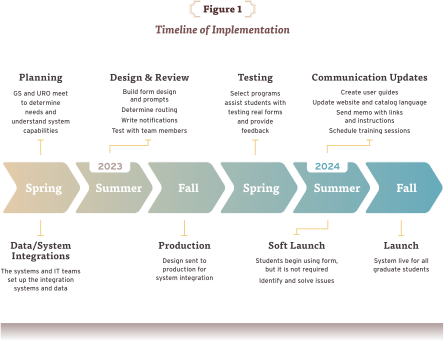
The Graduate School initiated a change management process to (a) convert the current PDF forms for graduate academic requests and approvals to electronic workflows using Kuali Build, a tool designed for higher education that allows users to create online forms and automate otherwise manual processes; and (b) implement the electronic workflows for academic requests for all graduate students at the university. A summary of the timeline and implementation is outlined in Figure 1. Key steps to develop the electronic workflows included the following.
- Planning: The Graduate School Academic Affairs team and University Registrar met to brainstorm and discuss the possibilities of workflows within the existing system, Kuali Build.
- Content Development: The Academic Affairs team developed and prioritized a list of forms used for current graduate academic requests. Using content from the current forms, the team provided the registrar with the information the electronic workflow would need to capture for each academic request.
- Approval Workflow Development: The Academic Affairs team developed and provided the approval routing structure to the registrar. The goal was to maintain the current approval process used with the PDF forms, but to develop a routing workflow that would be automated and equitable across all Graduate School students.
- Kuali Workflow Development: Using the content and approval workflows created by the Academic Affairs team, the registrar designed and produced the electronic workflows for each academic request in Kuali Build.
- Testing: With partnership among the Graduate School, registrar, and several graduate programs, the university piloted some of the first workflows to determine what worked well and what did not.
- Implementation: The Graduate School successfully launched electronic workflows. The Academic Affairs team educated all graduate programs, including staff, students, and faculty through email communications, verbal communication at standing meetings with program leaders and staff, shared user guides for each workflow developed by the registrar, optional Zoom training sessions, and ongoing education.
Results
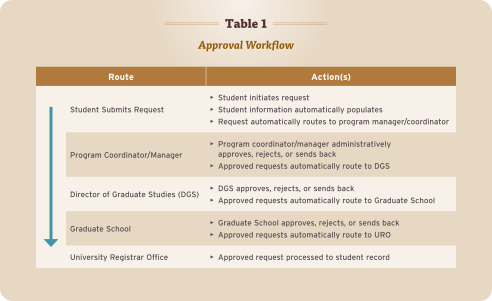
The one-year change management process resulted in electronic workflows for academic requests developed and implemented in 106 (100%) degree-granting and certificate graduate programs. Academic requests converted to electronic workflow included: appoint/modify Ph.D. committee; schedule or modify the qualifying exam; submit results of the qualifying exam; schedule or modify the dissertation defense; submit results of the defense; extend deadline to enter candidacy; extend candidacy to defend and graduate; request for graduate credit for undergrad and professional courses; permission to audit; appoint or change adviser; certificate program declaration; certificate program completion; transfer credit requests; declare master’s track (thesis/non-thesis); request independent study; and request course withdrawal. All workflows are initiated by the graduate student and routed automatically through the approval process: student, program coordinator/manager (program administrative approval), program director of graduate studies, Graduate School, and Office of the University Registrar (Table 1). When students access the link, their student ID, name, and email auto-populate, reducing the likelihood of errors. Students select their program from a dropdown menu, directing the form to the appropriate approvers. Students may select several actions simultaneously, facilitating coordinated administrative processing. User guides for each request were developed specifically for students, directors of graduate studies, and administrators and are available on the registrar website.
Discussion
Rigorous, research-intensive graduate programs require accurate and efficient processes to support graduate students. By leveraging digital tools and workflow automation platforms, the change management process resulted in the successful development and implementation of graduate education electronic workflows. The new workflows have enhanced the user experience for students, faculty, and administrative staff while ensuring compliance, transparency, and scalability across graduate programs. Benefits have included centralization (one location for receiving academic requests), integration (seamless integration of systems), automation (elimination of manual tasks), transparency (real-time insights to workflows), and accountability (automated routing). The success in graduate education workflows also laid a strong groundwork for broader institutional digital transformation.
One implementation challenge was Kuali Build’s inability to route to individuals outside the university. The Graduate School policy required signatures from committee members, including external members, on qualifying exam and final defense results forms. To overcome this challenge, a policy change was recommended to only require a signature from the director of graduate studies on the results forms for the qualifying exam and dissertation defense. The dissertation title page would still require and include committee member signatures. As best practice, the authors recommend that programs maintain documentation of committee member signatures. Another challenge was programs’ concern that they would not be able to determine the status of academic requests. This challenge was successfully addressed by granting program coordinators/managers and directors of graduate studies access to look up academic requests and view workflow status, including the current approval step.
Graduate School academic affairs teams are uniquely positioned to lead the development and implementation of innovative electronic workflow processes that streamline academic requests and enhance the recruitment and retention of top-tier graduate students globally. Achieving this vision requires sustained, radical collaboration among the Graduate School, the Office of the Registrar, and individual graduate programs. Future directions should prioritize increased automation—for example, by auto-populating dissertation committee member information from existing student records. Additionally, consideration could be given to tailored (“boutique”) workflow solutions to meet the specific needs of individual programs. Expanding electronic workflow systems beyond graduate education, such as into postdoctoral affairs, may also offer significant institutional benefits.
Acknowledgement
We thank our University Registrar’s Office staff for their partnership in this project, including Bart P. Quinet, Matthew L. King, Molly Thompson, Carol Dunne, and Joshua Caviness. We also thank our graduate directors of graduate studies, graduate program coordinators and managers for their collaboration.

share