

Juana H. Sánchez, Director of Beyond Transfer and staff to the LEARN Commission, Sova
We have all seen it: a prospective student jumping through hoops to obtain clarity on how their prior learning will be counted, in order to finalize their enrollment plans. Maybe it’s an entering community college transfer student anxiously waiting to hear which lower division courses will be applied to their major before they can register for the fall term. Or perhaps it’s a working adult trying to understand just how many courses and academic terms they’re looking at before they even submit their intent to register.
Learners increasingly want–and deserve–upfront clarity on how their prior learning will be counted and applied to their prospective program of study. But the institutional processes for evaluating credit and other types of prior learning are notoriously slow and poorly aligned to the timelines we set in admission, enrollment, and registration. This is not a recent phenomenon or even a hidden secret. AACRAO members have long grappled openly with these problems of practice, turning to our trusted member network to engage in collaborative problem-solving and to elevate innovative examples of what’s working.
But new research out of California underscores the urgency of overhauling status quo approaches to credit evaluation. In 2025, Sova researchers examined credit evaluation processes across five campuses of the California Community Colleges, California State University, and University of California, identifying common pain points for learners and for the faculty and staff engaged in credit evaluation:
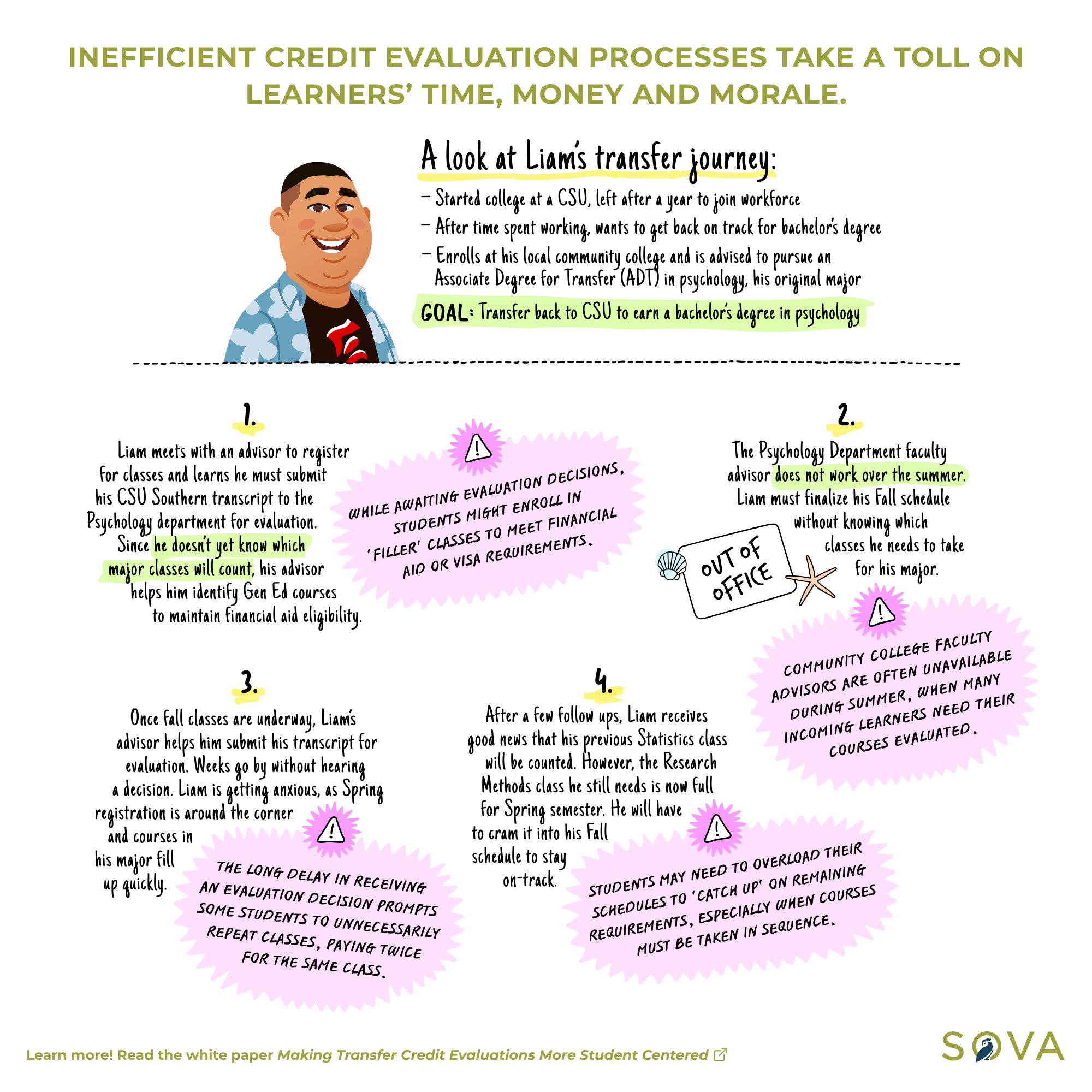
Because of diffused decision-making responsibility across departments and aging technology systems, learners experience prolonged wait times before receiving final credit evaluation decisions. In some cases, learners are told to expect a final decision to be reached in 24 weeks. For a learner on the fence about whether to enroll, this period of limbo can feel like an eternity.
These drawn-out timelines can position learners to make admissions decisions without critical information about whether and how their past coursework and other relevant college-level learning will be honored. Learners may make sub-optimal enrollment decisions and inadvertently choose a longer, more expensive road to graduation that does not maximize and apply their previous credit.
And if credit evaluation decisions are not communicated prior to course registration deadlines, learners may not be set up for academic success at their new institution. For example, without accurate information on how their prior learning will be counted, learners can end up in the wrong courses, take courses out of sequence, and need to enroll in high credit loads in subsequent terms to “catch up.”
What does this look like for an incoming learner? Consider the learner journey visually represented below. Liam’s story is not a singular experience but rather a composite informed by many firsthand student testimonials shared in focus group interviews and surveys. Liam’s journey makes clear that drawn-out credit evaluation processes not only harm learners but also jeopardize institutional goals related to student success, retention, and completion.
Fortunately, AACRAO and Sova have engaged the leading experts across the nation to ask: What can institutions do differently? In December 2025, the Learning Evaluation and Recognition for the Next Generation (LEARN) Commission released its final report with 14 actionable recommendations for institutions. The recommendations span such core issues as: defining the criteria that should be used to evaluate prior coursework and other college-level learning and ensuring the consistent application of such criteria; ensuring transparency in how learning evaluation policies are defined and communicated to current and prospective learners; leveraging technology and common transcription practices to shorten wait times for learners and free up staff time for other essential functions like transfer advising; and ensuring fairness and equity in student appeal processes, among other issues.
We invite you to access the LEARN Commission’s full report and, as an immediate next step, join us at the 111th AACRAO Annual Meeting in New Orleans to strategize together on how to implement these recommendations locally.


share