

May 2026, Eye on Research
Commentary
As Another Academic Year Closes: What AI Means for the Learners We Send Forward
Another academic year is winding down, and I find myself thinking about the learners who walked across stages this month and the questions waiting for them on the other side. Among the most pressing: what will entry-level work actually look like in an AI-saturated economy, and how well have we prepared learners for it?
This month’s blog includes a Strada Institute survey of nearly 1,500 talent leaders that gently pushes back against the prevailing doom narrative. More employers expect AI to grow entry-level hiring in 2026 than expect it to shrink—by a ratio of roughly 2.7 to 1. But the work itself is changing. Analytical and judgment-based responsibilities are shifting to entry-level roles, while routine administrative tasks are declining. Critical thinking and communication topped the list of skills employers want from new graduates. AI literacy, perhaps surprisingly, ranked last among the eight skills measured.
That last finding deserves a pause. It doesn’t mean AI fluency is unimportant; it suggests employers assume new graduates will pick up the tools and that what they actually need are the durable human capacities that make those tools useful. Read alongside the Tufts University AI Jobs Risk Index, also covered this month—which offers a more sobering picture of where displacement may concentrate—both reports point toward the same question for those of us in the field: are we helping learners build the kind of judgment, communication, and real-world experience that will hold up regardless of how the tools evolve?
These are the kinds of questions that benefit from our community’s collective wisdom. As you head into summer—to conferences, to planning sessions, or simply to some well-earned rest—I hope you find time to sit with them.
Thank you for another year of partnership in this work. The research we share is only as meaningful as the practitioners who engage with it, and you make it matter.
Calls to Participate
ERP System Conversions at U.S. Colleges and Universities
My name is Todd Deese. I am a Doctor of Education candidate in Higher and Adult Education at the University of Memphis and Senior Associate Registrar at the University of Colorado Denver. My dissertation research examines U.S. colleges and universities that have recently converted to a new Enterprise Resource Planning (ERP) system, with particular attention to the Student Module. The study seeks to determine whether participants report that their ERP conversion created value for their institution. Registrar office staff bring a distinctive functional end-user and technical perspective on ERP use, which is central to the significance of the findings.
The Institutional Review Board at the University of Memphis has approved this research study. Participation is voluntary, and the online survey should take approximately 20 minutes to complete. Responses will be kept confidential and anonymous. The survey will be available through June 19, 2026. A $10 donation will be made to AACRAO for every completed survey submission, up to a total of $300.
To review the consent statement and begin the survey, please use this link to the survey. If you have any questions, please reach out to me via email at tdeese@memphis.edu.
Emotional Labor, Organizations, and Higher Education Staff
My name is Alex Parker, and I am a doctoral candidate at the Johns Hopkins School of Education. On behalf of my co-author, Jordan Amor, Assistant Professor in the Department of Psychology at Eastern Illinois University, we are conducting a research study to examine how organizational culture affects the emotional labor experiences of women who work in professional staff roles at higher education institutions.
To explore this,we are collecting survey data from higher education staff. In total, the survey should take around 10 minutes. The responses will remain anonymous, the platform will “scrub” or remove your IP address, and taking the survey is voluntary. Please contact me (aparke70@jh.edu) or my faculty advisor, Dr. Olivia Marcucci (omarcucci@jh.edu), if you have questions about this survey or your participation. This study has been reviewed and approved by the Johns Hopkins University Homewood Institutional Review Board (IRB number: HIRB00023473).
Here is the link to the survey
AACRAO Research Updates
Academic Record and Transcript Practices Benchmark Report Forthcoming
A benchmark report will be released on June 24th.
Learning Mobility in Practice
Building on the LEARN Commission report, this brief survey aims to understand how the field is responding to the Commission’s 14 recommendations. It will deploy to all AACRAO members on June 8th.
Forthcoming Benchmarking
In late summer, we will deploy the Chief Enrollment Management Career Profile survey. In the fall, we will deploy two 60-Second Surveys. The subject of each is TBD.
Current Higher-Education Research and Related Topics
Community College Transfer Outcomes, 2018 Cohort
The Tracking Transfer report from the National Clearinghouse Research Center tracks how community college learners fare when they transfer to four-year schools, with this update covering learners who started in fall 2018. Researchers from the Clearinghouse Research Center, Columbia’s CCRC, and the Aspen Institute first built the series in 2016. They refreshed the metrics in 2025 to cover more learner characteristics, state-level data, and additional outcomes. The goal is to give colleges a way to benchmark transfer and completion rates and see where learners fall off.
Only 31.6% of first-time community college learners who began in fall 2018 transferred to a four-year school within six years, and just 48.7% of those transfers earned a bachelor’s degree.
Learners with dual-enrollment credit before starting community college performed better, with a 45.4% transfer rate and a 58.6% bachelor’s completion rate.
Most community college transfers (73.1%) landed at public four-year institutions, where bachelor’s completion reached 71.2% within six years.
Retention the year after transfer hit 81.8% overall, and learners who earned an award before transferring stayed enrolled at a higher rate (86.9%) than those who transferred without one (77.7%).
Wired Belts and the New Map of AI Job Risk
Researchers at Tufts University’s Digital Planet built the American AI Jobs Risk Index to map where AI displacement will hit hardest across U.S. occupations, industries, metros, and states over the next 2-5 years. The report argues that AI is breaking from past automation patterns by climbing the income ladder and targeting cognitive, white-collar work in innovation hubs rather than factory floors. Its big claim is that the so-called Wired Belts of knowledge workers face a real risk of displacement, and policymakers have a narrow window to act before the disruption fully hits.
Under the median scenario, about 9.3 million of 151 million U.S. jobs are at risk, with a plausible range of 2.7 to 19.5 million and income losses between $200 billion and $1.5 trillion a year.
Industry-wide vulnerability sits around 6%, but Information (18%), Finance and Insurance (16%), and Professional, Scientific, and Technical Services (16%) face the steepest risks.
Writers and Authors (57%), Computer Programmers (55%), and Web and Digital Interface Designers (55%) top the occupational vulnerability list, while roughly 38% of workers, mostly in the lowest-paid jobs, look largely AI-proof.
DC, Massachusetts, Virginia, Maryland, Washington, and Colorado are the most vulnerable by share of jobs. At the same time, California, Texas, New York, Florida, and Illinois will absorb the largest absolute losses, and university metros like Durham-Chapel Hill, Boulder, Ann Arbor, and Madison rank among the highest-risk cities.
Admissions Influencers and the Paywall Problem
An article in the Harvard Political Review examines how TikTok and Instagram creators have stepped into the college admissions advice space once dominated by pricey private consultants, with influencers like Daniel Lim of @limmytalks building large followings by predicting decisions and dishing out essay tips. The article examines whether this shift actually levels the playing field for low- and middle-income families or merely repackages the same old gatekeeping in a more relatable format. The author lands on a mixed verdict, with social media cracking open the door to elite admissions know-how while also creating new pressures and paywalls of its own.
Climbing application volumes (the share of learners applying to more than ten schools jumped from 8% to 17% between 2014-15 and 2021-22) and falling acceptance rates have pushed families toward consultants who charge anywhere from $85 an hour up to a $100,000 flat fee.
Algorithms reward engagement and relatability instead of credentials, so creators can reach huge audiences without screening, which speeds the spread of useful tips but also opens the door to inaccurate advice and fear-mongering.
Learners were interviewed for the piece, including a Harvard freshman and a high school senior. They argue that many influencers hide their best material behind paid essay courses or one-on-one packages, recreating the same income barrier in a new form.
Critics worry the influencer playbook nudges learners to chase a checklist of activities and stats rather than explore genuine interests, narrowing personal growth in the name of admissions strategy.
Course Availability Gaps Cost Learners Time and Money
Instructure’s national research report digs into a quieter problem in higher education: learners can’t always get into the courses they need, so they patch together schedules across multiple institutions. The data shows 53% of higher ed learners take courses at more than one school to stay on track, but 42% lose credit when they try to transfer that work back to their home institution. The report frames this as a real drag on progress, since these gaps push graduation dates back and pile on extra costs.
85% of surveyed learners said course availability affected them due to capacity limits or scheduling conflicts.
53% turned to another institution to keep their degree plan moving.
42% lost credit at some point along the way, undermining the point of taking the outside course.
72% said limited course availability likely added time and money to their path to a degree.
How Young People Are Actually Using AI
The Rithm Project surveyed 2,383 young people ages 13 to 24 to map how AI fits into their relationships and well-being, moving past the usual binary of “good or bad for teens.” Researchers identified four main clusters of users, ranging from those who barely touch AI to those who chat with AI characters, plus nine more detailed portraits within those groups. The core argument is that AI use and human connection shape each other, so the quality of a young person’s real-world relationships matters more than the amount of AI they consume.
The largest group treats AI as a tool for tasks and schoolwork, keeps clear lines between AI and people, and reports the strongest social and mental well-being in the sample.
Youth who rely on AI for emotional support or relationships with AI characters show greater dependence, attachment, and a higher risk of displacing human connection.
Feeling genuinely seen and safe with trusted people is one of the strongest buffers against high-risk AI use, while loneliness and weak relational trust raise the risk even for kids with busy social lives.
Lower-income youth are more likely to use AI rarely and also report greater social vulnerability. Most young people say parents and teachers seldom talk with them about AI beyond cheating and academic integrity.
Confusing College Prices Are Eroding Trust
Strada’s recent report draws on surveys of more than 5,000 learners, parents, adult learners, and members of the public to examine why confidence in higher education continues to slip even though most families still see college as worthwhile. Researchers Kathryn Blanchard and James Dean Ward argue that murky pricing and a tangled financial aid process leave learners unable to judge whether college is actually affordable, and that confusion fuels distrust of institutions. The report makes the case that clearer pricing alone won’t fix the problem and that real change requires structural reforms in how colleges model prices, package aid, and communicate costs.
Between 70% and 90% of respondents with a direct stake in college called it extremely or very important. Still, only about 60 to 70% of learners and families said it was actually worth the cost, with the general public well below half.
Cost and affordability ranked as the top consideration when picking a college, beating out career preparation, quality, and commitment to learners.
Only one-third of learners and parents said the financial aid process was straightforward, and the more confused respondents felt, the less they trusted colleges to charge a fair price.
Roughly two-thirds backed solutions like upfront cost transparency, four-year price guarantees, four-year aid guarantees, and a single all-in annual price.
Higher Ed Still Valued, but Out of Reach
The 2026 Lumina Foundation-Gallup State of Higher Education report draws on responses from more than 14,000 U.S. adults without a degree, nearly 6,000 graduates, and 2,000 employers to map a widening gap between belief in college and access to it. The core finding is that Americans, including employers, still see degrees as central to career success. Still, financial strain, mental health pressure, and shrinking perceptions of affordability are blocking enrollment and completion. The report frames the takeaway bluntly: the college case has been made, but making it attainable is the unfinished work.
73% of adults without a degree say earning a two- or four-year credential is at least as important today as it was 20 years ago, and 74% of employers expect degrees to stay equally or more important over the next five years.
Only 25% of adults without a degree believe all or most people can access a quality, affordable education after high school, down 10 points since 2023.
One in three currently enrolled adults considered stopping out in the past six months, with emotional stress and mental health leading the reasons, followed by cost.
Among graduates with outstanding student loans, 82% worry about repayment, and 52% say their loans have delayed major life decisions, such as saving for retirement or going back to school.
Strada Institute for the Future of Work surveyed nearly 1,500 executives and senior talent leaders across industries to figure out whether AI is eliminating entry-level hiring or just changing what those jobs look like. The findings push back against the negative narrative, showing that more employers expect AI to grow entry-level hiring than shrink it, while the work itself shifts toward higher-stakes thinking. The authors argue learners, schools, and policymakers should focus on durable skills and real work experience instead of trying to outrun automation.
The number of senior talent acquisition leaders who expect AI to increase entry-level hiring in 2026 outnumber those expecting decreases by about 2.7 to 1
27% of firms boosting hiring cited greater AI use as the top reason.
More than 40% of employers said AI has pushed analytical and judgment-based responsibilities down to entry-level workers, while a similar share reported drops in routine administrative tasks.
Critical thinking and communication topped the skills employers want in entry-level college graduates, and AI literacy ranked dead last among the eight skills measured.
When ranking candidate profiles, employers put direct work experience and industry internships at the top and a 4.0 GPA with no work history at the bottom. The related figure from the report is included below.
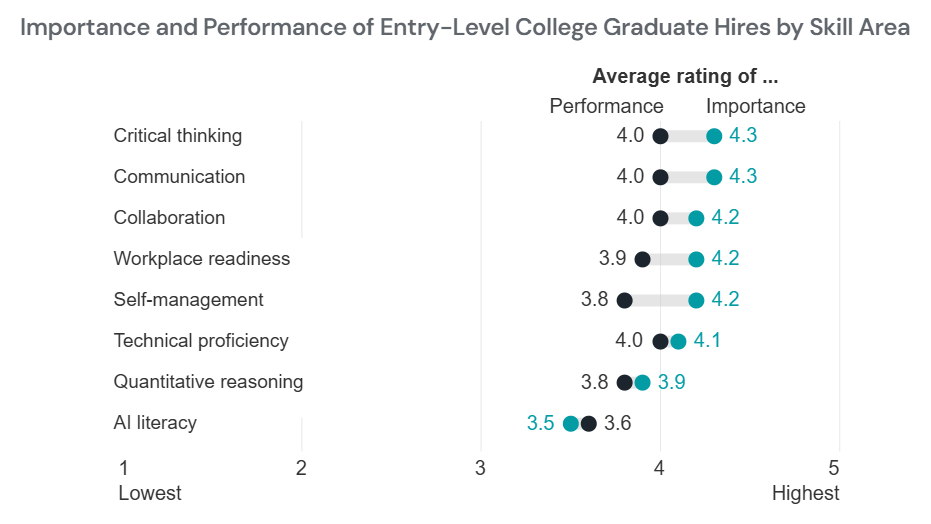
Source: Strada Education Foundation. (2026, May 19). Entry-Level hiring in the AI Era: What Employers are thinking (and doing). Strada Education Foundation. https://www.strada.org/news-insights/entry-level-hiring-in-the-ai-era-what-employers-are-thinking-and-doing

share