

By Jana Jaraysi Alvarez and Shelly Shaffer
This study explores the effects of a year-long professional development program on higher education professionals. Survey responses and interviews with participants from the program’s cohorts highlighted four major themes: mentorship, assurance, network, and professional growth. These themes provide insights into the program’s effectiveness and the benefits of professional development.
The relationship between professional development and the evolution of professions has been a longstanding topic of scholarly inquiry, dating back to the nineteenth century (Abbott 1988; Argyris and Schön 1974; Wilensky 1964). Wilensky (1964) examined the emergence of professions, the processes of professionalization, and the implications these developments have for institutional and societal structures. As professions became more clearly defined, professional associations and universities began to play a critical role in establishing and disseminating the specialized knowledge and skills required for practice, and functions came to be understood as forms of professional development (Abbott 1988; Wilensky 1964).
Specifically, within the field of college and university admissions and registrars, the American College Personnel Association (ACPA) and the National Association of Student Personnel Administrators (NASPA) both provide extensive educational programming and have defined core competency frameworks that shape the field’s professional discourse and practice (ACPA 2007, 2018; NASPA 2023). Associations such as the American Association of Collegiate Registrars and Admissions Officers (AACRAO) and the National Association for College Admissions Counseling (NACAC) play a crucial role in members’ professional development. Thousands of dollars are spent annually on conferences and workshops. A member of AACRAO pays approximately $845 in registration fees to attend the annual conference, whereas a non-member pays closer to $1,045, excluding travel expenses (AACRAO 2025). This study’s purpose is to investigate the impact of this investment.
Literature Review
Professional development in higher education, particularly in student affairs, is essential for career advancement and organizational growth. Wilensky (1964) and Hall (1968) identified key elements of professionalization, including specialized knowledge, formal education, ethical responsibility, and autonomy, which contributed to the establishment of professional associations, structured career development, and the establishment and maintenance of professional standards.
These early efforts set the stage for a framework that continues to influence how student affairs professionals engage in ongoing learning and development (Chernow, Cooper, and Winston 2003; Gerda 2006). Prior research highlights various forms of engagement, including formal programs, informal mentoring, and networking (Schwartz and Bryan 1998), which are recognized for their impact on professionals’ skills and career trajectories. Research suggests long-term involvement in professional development activities leads to more significant improvements in job performance and leadership capabilities (Boyle, While, and Boyle 2004; Gurley, Anast-May, and Lee 2013).
Mentorship and Networking
Mentorship and networking are integral to professional development, as they provide both career guidance and psychosocial support (Calhoun and Taub 2014). Mentorship enhances confidence and leadership abilities, with senior professionals guiding newer colleagues through challenges and helping them develop critical skills (Augustine-Shaw and Funk 2013). Networking, particularly within professional associations, offers new professionals valuable connections that contribute to career growth, as well as a sense of community and belonging, which are crucial for underrepresented groups (Tran 2014; West 2019). Ultimately, professional development, mentorship, and networking are interconnected factors supporting individual career progression and the broader goals of the higher education sector.
“Finally, professional development for institutional leaders must include a collegial network of support that promotes the exchange and discussion of ideas and strategies between leaders” (Nguyen 2018, 35). Professional development opportunities for student affairs professionals create a space for the exchange of ideas and for comparing and contrasting work situations, as per Gerda (2006). Networking emerged as the most significant outcome of member engagement in Kamen and Apple’s (2023) study. Respondents shared the benefit of meeting new people and growing professional references through networking.
Professional growth emerged from a mentor-and-mentee relationship, helping professionals feel confident, empowered to take another step forward in their careers, or able to become strong leaders (Augustine-Shaw and Funk 2013). Espinoza and Garfield’s (2023) work explored their mentor-mentee relationship. Through Espinoza’s early years of tenure, the mentor-mentee relationship was impactful and supported Espinoza’s confidence (Espinoza and Garfield 2023). Mentorship provides support from someone experienced who helps them through unique situations or challenges. An experienced professional guides a mentee so they feel capable of handling similar experiences in the future.
Professional Confidence
Henderson-Harr, Caggiano-Siino, and Prewitt (2016) and Gurley, Anast-May, and Lee (2013) found that the intentionality of a professional leadership program fostered a sense of empowerment or confidence in participants. With mentors’ support and guidance, participants experienced a noticeable boost in confidence and courage, preparing them for their work environments. Gurley, Anast-May, and Lee (2013) highlighted how pushing boundaries and taking risks led to heightened self-confidence and the ability to navigate various work environments and situations. Black and Earnest (2009) found mentees improved in various individual, organizational, and community-based areas, including “personal growth, self-confidence, personal power, creative thinking, valuing of time, business skill-building, and modeling behaviors” (191).
Imposter Syndrome
Imposter syndrome is a phenomenon in which individuals doubt their accomplishments and fear being considered frauds despite their success. It is characterized by feelings of inadequacy and a lack of belonging (Slank 2019). Slank (2019) researched whether imposter syndrome was connected to the environment or to how others were treated, and noted it was a growing research area in psychology. Espinoza and Garfield (2023) described the importance of mentorship and friendship, noting that Garfield supported Espinoza as she overcame imposter syndrome as a tenure-track Latina. Her mentor helped decrease thoughts of doubt and supported her tenure-track journey.
Professional Development Connected to Career Growth
Murphy and Calway (2008) found, “[…] attention needs to be given to individual professionals in relation to their career development, which is represented by their knowledge, skills, and understanding together with their ability to practise as professionals” (440). Participation in professional associations and meetings are important to career development (Mata, Latham, and Ransome 2010). Mata, Latham, and Ransome (2010) shared personal experiences of members of a health education association; they found common interests led to continuous collaboration and involvement in professional development opportunities, which supported their careers.
Gander and McInnes (2021) found that connecting with other professionals resulted in empowerment to change or advance careers. According to Gander and McInnes (2021), professionals can advance their careers and improve satisfaction through professional programs that provide opportunities and support continual learning. Coomber (2018) identified the need for early discussions around career pathways when developing professional training programs. Research overwhelmingly found participants gained in their professional and personal lives after participating in a professional development program (Coomber 2018; Gander and McInnes 2021; Mata, Latham, and Ransome 2010; Murphy and Calway 2008).
Study’s Purpose
This study explored professional development related to admissions and registrar professionals, focusing on learning about the experiences of professional association members involved in an association’s professional development program. The investigation focused on the following research question: What impact does a leadership program, Program L, have on admissions and registrar professionals in higher education?
Program L provided an opportunity for emerging professionals to engage in professional development opportunities through a purposeful, constructed curriculum that exposed participants to literature, mentorship, group conversations, guest speakers, and more. Members attended monthly virtual meetings, connected with mentors, read assigned texts, and attended the association’s annual conference. One of the goals of Program L was to encourage members to be formally involved and give back to the association and the profession as a whole. This study investigated participants’ experiences from the last five cohorts of Program L, specifically the program’s impact and participants’ overall professional development experiences.
Research Design
This qualitative study used an exploratory case study methodology to understand how Program L impacted admissions and registrar professionals, which allowed for an in-depth analysis of the phenomenon happening in Program L, following Creswell and Poth (2018) and Priya (2020).
Participants
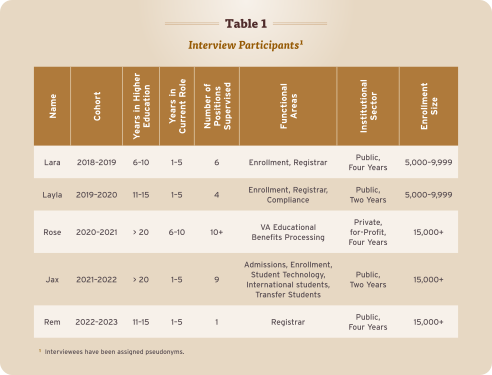
Most Program L cohort members were based in the Western United States, working at various colleges and universities. The cumulative collection of participants encompassed several states, institution sizes, and functional areas within admissions, enrollment management, and registration. Facilitators and mentors reviewed applications to select the top twelve to fifteen participants to join each cohort. Program L cohorts totaled 65 potential participants. Due to attrition, the initial email was sent to 60 past participants from the past five years.
From the survey data, interview participants were selected based on their willingness to participate and other criteria (e.g., year of cohort, size of university, experience) (Omona 2013). Selecting participants from each cohort and including participants who represented various institutional characteristics was important. Survey responses were anonymous, and each participant who was willing to be interviewed received a pseudonym.
Data Collection
Multiple sources of data were collected throughout the study. First, participants completed the survey, and then five were selected to be interviewed. Documents were also collected from participants and program information.
Survey Design
The sampling survey was loosely based on the survey designed by a previous student affairs study (NASPA 2022). The descriptive questions included the institution’s size, the participants’ functional area, and years in the profession. Short-answer, open-ended questions were developed to learn more about each participant. The final question was whether the individual was prepared to delve further into the subject matter by being interviewed in detail. The questions, the demographics, and open-ended/short-answer questions were all essential to targeting five respondents for the second portion of data collection. Once the survey was closed, 30 past participants had provided anonymous responses, a 50 percent participation rate. Fifteen participants offered to be interviewed for the second part of the data collection process.
Interview Design
Five participants were selected for semi-structured interviews. A semi-structured interview allowed participants to share their experiences, expand on their responses, or explore topics is greater depth.
Documents
Another data source was documents. Each participant was asked to provide a copy of the written portion of their application to Program L to learn more about their professional experience before participating in Program L. Documents from Program L’s publicly available online information were also collected. This included program descriptions and the list of literature used for each cohort, including titles of eight to ten books related to professional development or leadership development, and guided discussions throughout the year.
Data Analysis
Creswell and Poth (2018) provide step-by-step methods for interweaving and analyzing the collected data: survey, transcribed interview responses, artifacts, and documents. Utilizing their Data Analysis Spiral, managing and organizing data was the initial step (Creswell and Poth 2018). The open coding process began with reading and memoing initial codes on hard copy versions of the interview responses, with note-taking in the margins. This exact process occurred with the survey responses: all responses to short-answer questions were combined to identify common themes as well as similarities and differences among responses. Common codes and themes were compiled in a spreadsheet from the interview transcripts and survey responses. Patterns were identified from the initial review of the codes. There was a frequency of certain phrases and words, and many other codes paired with similar themes.
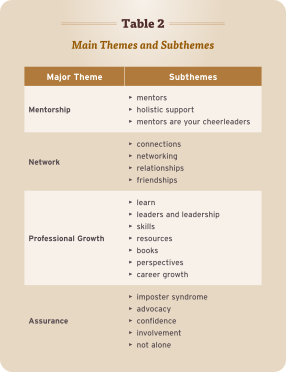
Creswell and Poth (2018) recommend “lean coding.” Detailed descriptions of what emerged from the participants’ responses aided in developing main codes or themes and subcategories based on the results (see Table 2). In total, 545 data points were developed through open coding, resulting in four codes that will be discussed in this article.
Results
Results illustrate many factors impacting the professional development of higher education professionals. The main themes discussed in this article are mentorship, network, professional growth, and assurance.
Mentorship
Mentors (Bozeman and Feeney 2007; Cooper and Miller 1998; Espinoza and Garfield 2023; Schreiber, Dunkel, and Jahr 1994; West 2019) played a significant role in the lives of Program L participants. The program’s mentors were experts in their respective fields who provided guidance, support, and a holistic approach to supporting participants professionally and personally (Bozeman and Feeny 2007; Calhoun and Taub 2014). Program L prepared participants by sharing an understanding of the mentor-mentee relationship on their association website (document accessed May 2024).After the year-long program ended, several past participants noted they continued to reach out to their mentors: “I think the most memorable is more the overall ability to have them [mentors] as a resource that to this day I still trust” (Jax interview March 11, 2024). His mentor and others in the program became trusted colleagues to help with problems, provide advice, and provide insight into what other institutions do, compared to leaning on consultants, as per Augustine-Shaw and Funk (2013).
Mentors helped Jax and Layla with career changes. Nguyen (2018) and Haley, et al. (2015) identified recommendations for professional development for different levels of professionals and emphasized the importance of tailoring professional development experiences to participants. Program L was not designed to give personalized mentorship; however, participants’ perceptions illustrate personalization throughout the program. “The mentorship I was given was personalized to me and about what I had going on in my work life. I felt heard, and supported” (Anonymous survey February 2024). Underhill (2006) found similar results regarding the impact of mentoring on mentees’ career development, showing the connection between mentoring and career success.
After Program L, the ability to move into a new career at a new institution was smooth and welcoming. In my new career, it was a transition; however, with the mentorship and connections to “refer-back” allowed the transition to be exciting. The decision to move into a new institution was also supported by [Program L] as my mentor assisted in the decision-making to accept a new position and how to best begin my new role. (Jax survey February 2024)
The importance of expertise in the field is reflected in the experience of leading others like Layla to become a faculty mentor and give back to the program and the profession.
Being involved in a year-long Program L with the same small group and mentors resulted in life changes as mentors were there for each part of the journey, as per Channing (2020) and Cooper and Miller (1998). Jax’s mentor was from a different state, which added a layer of trust. His mentor was able to advise him from an unbiased perspective, and even after the completion of the program, Jax still reaches out and trusts they’ll call back or email back to help. This continued support mirrors Nguyen’s (2018) findings.
Mentors Are Your Cheerleaders
Throughout all five participant interview responses, participants’ perception of their mentors was positive. For example, mentors were called “cheerleaders” and “literal sunshine” (Lara interview March 12, 2024). This illustrates the importance of the mentor-mentee relationship based solely on knowledge and experience. These mentors created an environment of acceptance and comfort for their mentees.
Network
Networking is a common theme among various empirical studies (Gerda 2016; Levrant, et al. 2021; Tran 2014; West 2019). Building connections is a powerful benefit to professionals participating in leadership development, in Program L. “It was networking with a purpose. Talking about real topics and issues, not just small talk. I’m not sure that is ‘surprising,’ but it is really valuable” (Anonymous survey February 2024). Through the design of the lessons, readings, and discussion topics, Program L allowed for in-depth conversations versus small talk or surface-level conversations. Networking and mentors in the program helped connect with others who have held similar roles or aspirations within student affairs.
Network and Connections
Building a network was an essential finding and a benefit across several types of professional development opportunities, such as one-day workshops (West 2019) and a two-year academy (Gurley, Anast-May, and Lee 2013). As the assistant principals in Gurley, Anast-May, and Lee (2013) experienced increased collaborations and less isolation, so did the participants of Program L. Rem’s ability to have contacts in almost every state on the West Coast or to make connections across the nation was a huge benefit for him. Similar to Jax, his network supported him through trying times and the creation of a new team at his new institution. Creating connections and networking were important elements to professional organizations, which holds for the professionals who experienced Program L (Gander and McInnes 2021).
Professional Growth
As a broad and encompassing concept, “professional growth” is an expansive umbrella code with various sub-themes such as learning from different perspectives, acquiring new skills, career advancement, and overall professional and personal growth. These all empowered participants to reach their full potential, achieve career goals, and contribute to their respective fields (Schwartz and Bryan 1998), highlighting the participants’ overall experiences, including the different levels of learning.
Perspectives
Differing perspectives emerged as a valuable sub-theme, shaped by participants’ experiences and the impact of seeing through others’ eyes. One member shared, “I believe that I’m more well-rounded. This is thanks to the experience which provided exposure to new and different perspectives, as well as insights from my mentors” (Anonymous survey February 2024). Different perspectives enriched personal and professional growth, leading to influencing others and continually improving as a professional.
Career Growth
Participants changed due to personal choices or institutional changes. This is related to other research focused on the impact of professional development (Chernow, Cooper, and Winston 2003; Underhill 2006). When asked whether professional development impacted career goals, one participant shared, “Yes, it influenced me to reach out for greater career opportunities. I got a new (better) position about a year after completing [Program L]” (Anonymous survey February 2024). Another participant “…was able to secure a promotion in [their] office shortly after completing [Program L]. [They] credit [Program L] as directly influencing the promotion” (Anonymous survey February 2024).
Rose recognized there were opportunities for continual growth and improvement. Through Program L, she experienced opportunities to grow her skills and plan for the future. Each participant experienced changes in their job roles, leadership opportunities, or direction due to the pandemic. The opportunity to participate in a leadership program, gain new knowledge and skills, and apply these insights within their respective institutions helped them grow.
Many Program L participants did not mention direct conversations about career development within the program; rather, they spoke about the program’s impact on their career journeys, leading some to new jobs or to gaining the confidence to set boundaries within their current institutions (Haviland, et al. 2011). Through networking (Calhoun and Taub 2014) and mentorship (Espinoza and Garfield 2023), participants’ career growth was evident.
Assurance
Many participants noted differences in the levels of confidence, assurance, advocacy, courage, self-awareness, and encouragement within the leadership program. Assurance related to confidence; both connected to self-belief, trust in self and others, knowledge, and judgment.
The assurance theme showcases self-discovery and empowerment. Layla, in her interview, exemplified this by acknowledging her evolving confidence and heightened awareness of her value and worth. Survey participants shared similar sentiments, detailing struggles with imposter syndrome. The program’s mentors and peers, who fostered a sense of belonging and shared experience, reduced those feelings. This discovery marked a transformational shift in mindsets through Program L’s experience for these higher education professionals.
Confidence
Participants experienced confidence through their Program L activities and lessons. As this theme emerged, it connected with studies in other disciplines that examined the impact of professional development on confidence-building (Haviland, et al. 2011; Purdy 2016). Survey responses showed increased confidence to become involved and take on challenges, such as board positions, joining regional associations, presenting at conferences, and tackling more substantial challenges.
Purdy’s (2016) study showed that alumni involvement increased participants’ performance, confidence, and self-perception. Prior studies found that participants were more confident in their ability to do their jobs, similar to Program L participants, because they trusted their support system (Packard and Jones 2015; Purdy 2016).
Individuals who doubt they belong at the table, in a space, or in a particular job experience imposter syndrome (Slank 2019). Three participants specifically mentioned they felt “imposter syndrome” in their career, and participating in a leadership program helped them overcome some challenging thoughts (Anonymous survey February 2024; Rem interview March 14, 2024). One survey participant responded to the question of what was most impactful from program involvement with an eye-opening statement: “Finding out that most black and brown folks, like myself, have impostor syndrome” (Anonymous survey February 2024). Discussions–centered on professionals of color–aided in participants realizing they were not alone. Rem battled imposter syndrome, but received reassurance from his mentor that he was in the right place at the right time.
Actions and modeling provided a sense of belonging and purpose, which countered feelings of imposter syndrome (Anonymous survey February 2024). Another participant shared how the program helped them realize they had all the skills needed within them: “The fact that [Program L] genuinely prepared me for a leadership role by boosting my self-confidence. Everything was already in me, I just needed to [sic] feel empowered, encouraged, prepared to take on a leadership role” (Anonymous survey February 2024).
The program’s space allowed one participant to share and feel safe doing so: “Yes, it gave me confidence and a format to explore and voice dynamics happening at my institution and my team” (Anonymous survey February 2024). Another participant shared:
The most impactful aspect of Program L, other than the relationships established, is that the faculty and some participants modeled and articulated so clearly for me what “your authentic self” is in the workplace. I knew it but to see people so open about their flaws, insecurities, and how unpolished they could be, even as the most senior or hierarchically “the top” of the Registrar’s office—was so so encouraging and refreshing and just kiboshed my struggles with imposter syndrome—totally fostered confidence in me. (Anonymous survey February 2024)
Recommendations and Conclusion
The research study’s findings provided valuable insights into this program’s effectiveness and the benefits of professional development. Four overarching themes encapsulated the practical benefits participants experienced, underscoring the program’s potential to foster professional growth and advancement.
This study found that professional development opportunities enhanced the growth, knowledge, and confidence of admissions and registrar professionals. This positively impacted their immediate teams and deepened their understanding of purpose within higher education. The findings offer valuable strategies for future development of professional programs and their impact. The selection of mentors based on their professional experience and willingness to contribute back to the community was essential to the program. Both mentors and mentees invested time in this process, resulting in expanded networks and support that extended beyond the program’s duration. Program L influenced how these professionals contributed to their institutions and how they made decisions about their work and future career paths. The professional growth enhanced existing skills and provided resources (e.g., notes, networking, books, and past activities) to lean on. Assurance reflected the confidence levels of professional staff and also shed light on the experiences of those grappling with imposter syndrome and questions of purpose. Importantly, it revealed that individuals, despite feeling isolated in their self-perceptions, were not alone in their experiences. The four major themes played a critical role in a professional development program that went beyond a single seminar, conference, webinar, or informal professional networking event. It changed the lives of the participants.
References
AACRAO. See American Association of Collegiate Registrars and Admissions Officers.
Abbott, A. 1988. The System of Professions: An Essay on the Division of Expert Labor. Chicago: University of Chicago Press.
ACPA. See American College Personnel Association.
American Association of Collegiate Registrars and Admissions Officers. 2025. Registration Fees. Washington, D.C.: Author.
American College Personnel Association. 2007. Professional Competencies: A Report of the Steering Committee on Professional Competencies. Washington, D.C.: Author.
———. 2018. Historical Snapshot. Washington, D.C.: Author.
Argyris, C., and D. A. Schön. 1974. Theory in Practice: Increasing Professional Effectiveness. San Francisco: Jossey-Bass.
Augustine-Shaw, D. and E. Funk. 2013. The influence of mentoring on developing leaders: Participants share their perspectives. Educational Considerations. 41(1): 19–26.
Black, A. M., and G. W. Earnest. 2009. Measuring the outcomes of leadership development programs. Journal of Leadership and Organizational Studies. 16(2): 184–196.
Boyle, B., D. While, and T. Boyle. 2004. A longitudinal study of teacher change: What makes professional development effective? Curriculum Journal. 15(1): 45–68.
Bozeman, B., and M. K. Feeney. 2007. Toward a useful theory of mentoring: A conceptual analysis and critique. Administration and Society. 39(6): 719–739.
Calhoun, D. W., and D. J. Taub. 2014. Mentor relationships for entry-level men in student affairs. Journal of Student Affairs Research and Practice. 51(2): 183–194.
Channing, J. 2020. How can leadership be taught? Implications for leadership educators. International Journal of Educational Leadership Preparation. 15(1): 134–148.
Chernow, E., D. Cooper, and R. Winston. 2003. Professional association involvement of student affairs professionals. Journal of Student Affairs Research and Practice. 40(2): 43–58.
Coomber, R. 2018. How do professional service staff perceive and engage with professional development programmes within higher education institutions? Perspectives: Policy and Practice in Higher Education.
Cooper, D. L., and T. K. Miller. 1998. Influence and impact: Professional development in student affairs. New Directions for Student Services. 84: 55–69.
Creswell, J. W., and C. N. Poth. 2018. Qualitative Inquiry and Research Design: Choosing Among Five Approaches. Los Angeles, CA: Sage.
Espinoza, K., and T. Garfield. 2023. “It’s me, do you have a second?” How testimonios and personal narratives of mentorship and friendship help a tenure-track Latina navigate the academy. Educational Studies. 59(3): 280–298.
Gander, M., and M. McInnes. 2021. Can a professional learning community deliver career development learning? Journal of Workplace Learning. 33(7): 523–533.
Gerda, J. J. 2006. Gathering together: A view of the earliest student affairs professional organizations. NASPA Journal. 43(4): 147–163.
Gurley, D. K., L. Anast-May, and H. T. Lee. 2013. Developing instructional leaders through assistant principals’ academy: A partnership for success. Education and Urban Society. 47(2): 207–241.
Haley, K., A. Jaeger, C. Hawes, and J. Johnson. 2015. Going beyond conference registration: Creating intentional professional development for student affairs educators. Journal of Student Affairs Research and Practice. 52(3): 313–326.
Hall, R. H. 1968. Professionalization and bureaucratization. American Sociological Review. 33(1): 92–104.
Haviland, D., S. Turley, and S. H. Shin. 2011. Changes over time in faculty attitudes, confidence, and understanding as related to program assessment. Issues in Teacher Education. 20(1): 69–84.
Henderson-Harr, A., K. Caggiano-Siino, and A. Prewitt. 2016. Evaluation of the pilot mentoring program at the research foundation for SUNY. Research Management Review. 21(1).
Kamen, S. M., and C. Apple. 2023. Establishing the value of AACRAO: Exploring member experiences and engagement opportunities. College and University. 98(1): 55–65.
Levrant, R. S., A. P. S. Loures-Elias, R. Nathanson, and L. G. Putney. 2021. Emerging professionals in the field of learning in retirement: A multiple case study. Journal of Ethnographic and Qualitative Research. 16(2): 119–138.
Mata, H., T. P. Latham, and Y. Ransome. 2010. Benefits of professional organization membership and participation in national conferences: Considerations for students and new professionals. Health Promotion Practice. 11(4): 450–453.
Murphy, G. A., and B. A. Calway. 2008. Professional development for professionals: Beyond sufficiency learning. Australian Journal of Adult Learning. 48(3): 424–444.
NASPA. See National Association of Student Personnel Administrators.
National Association of Student Personnel Administrators. 2022. Washington, D.C.: Author. The Compass Report: Charting the Future of Student Affairs.
———. 2023. History. Washington, D.C.: Author.
Nguyen, H. C. 2018. An investigation of professional development among educational policy-makers, institutional leaders, and teachers. Management in Education. 33(1): 32–36.
Omona, J. 2013. Sampling in qualitative research: Improving the quality of research outcomes in higher education. Makerere Journal of Higher Education. 4: 169–185.
Packard, T., and L. Jones. 2015. An outcomes evaluation of a leadership development initiative. Journal of Management Development. 34(2): 153–168.
Priya, A. 2020. Case study methodology of qualitative research: Key attributes and navigating the conundrums in its application. Sociological Bulletin. 70(1): 94–110.
Purdy, N. 2016. Impact of a leadership development institute on professional lives and careers. Nursing Leadership. 29(2): 10–30.
Schreiber, P. J., N. W. Dunkel, and P. K. Jahr. 1994. Competency-based developmental programs. College Student Affairs Journal. 14(1): 23–30.
Schwartz, R. A., and W. A. Bryan. 1998. What is professional development? New Directions for Student Services. 84: 3–13.
Slank, S. 2019. Rethinking the imposter phenomenon. Ethical Theory and Moral Practice. 22(1): 205–218.
Tran, N. A. 2014. The role of mentoring in the success of women leaders of color in higher education. Mentoring and Tutoring: Partnership in Learning. 22(4): 302–315.
Underhill, C. M. 2006. The effectiveness of mentoring programs in corporate settings: a meta-analytical review of the literature. Journal of Vocational Behavior. 68(2): 292–307.
West, N. M. 2019. By us, for us: The impact of a professional counterspace on African American women in student affairs. Journal of Negro Education. 88(2): 159–180.
Wilensky, H. L. 1964. The professionalization of everyone? American Journal of Sociology. 70(2): 137–158.
About the Authors
Jana Jaraysi Alvarez, Ed.D., is the Director of Admissions at Eastern Washington University and a three-time EWU alumna. With a career spanning back to 2008 in admissions and a recent Doctorate in Educational Leadership, she has dedicated her life to the “Eagle” community and the higher education community. She is fueled by the excitement of helping first-generation and underrepresented students navigate the complexities of college entry, firmly believing that witnessing a student’s success is what makes every day in admissions a great one.
Shelly Shaffer, Ph.D., is a Professor of Literacy in the School of Education and currently serves as Interim Associate Dean of the College of Professional Programs at Eastern Washington University. She mentors undergraduate and graduate students in their research endeavors. She teaches undergraduate and graduate courses related to literature, reading, writing, and research. Her personal research focuses primarily on using and studying young adult and children’s literature in elementary, middle, and secondary classrooms. She previously taught secondary English Language Arts in Mesa, AZ. Her current work focuses on social justice and criticality through the lens of literature. Her work has been published in several edited volumes and peer-reviewed journals, including Journal of Adolescent and Adult Literacy, Multicultural Perspectives, Voices from the Middle, and more. Her edited book Contending with Gun Violence in the English Language Classroom (2019) focuses on YAL and school shootings.

share