

By Mary C. McNamara
Admissions teams face a storm of challenges: changing student demographics, rapid technological advancements, shifting federal policies, intensifying competition, and ever-rising expectations regarding the applicant experience. In this environment, admissions professionals need fresh approaches to attract, evaluate, and enroll qualified students while ensuring a positive experience throughout the admissions journey.
Design thinking, a human-centered approach to innovation, has transformed how teams solve problems. Tim Brown, executive chair of IDEO, defined design thinking as “a human-centered approach to innovation that draws from the designer’s toolkit to integrate the needs of people, the possibilities of technology, and the requirements for business success” (Brown 2008, 84). While businesses and product developers have long embraced this methodology, its potential in higher education admissions remains relatively unexplored.
This article examines how one graduate business school’s admissions team applied design thinking in practice and reaped the benefits. Their experience demonstrates that specific design thinking principles and activities can lead to innovative solutions that both improve the applicant experience and foster a culture of collaboration and innovation. The case provides practical insights and adaptable activities for admissions professionals across various institutional contexts who seek to incorporate design thinking into their work.
Understanding Design Thinking
The roots of design thinking can be traced to the 1960s, with a seminal paper by Rittel and Webber (1973) introducing the concept of a design mindset to address complex, multidimensional problems, often referred to as “wicked” problems. They explored how a design approach could develop solutions to pressing societal issues such as public health and urban development. In recent years, Stanford University’s d.school has popularized design thinking as a methodology for innovation for organizations of all types.
At its core, design thinking encompasses five key phases (d.school 2018; Interaction Design Foundation n.d.):
Empathize: Understand the needs and perspectives of those for whom you are designing solutions.
Define: Articulate clearly the problem or challenge based on user needs and insights.
Ideate: Generate a wide range of creative ideas and potential solutions.
Prototype: Create simplified versions of potential solutions to test assumptions.
Test and Iterate: Gather feedback on prototypes and refine solutions based on what is learned.
Adopting a design thinking mindset involves embracing curiosity, collaborating with diverse perspectives, and committing to experimentation and continuous learning (IDEO U 2025). This approach proves particularly valuable in admissions contexts, where understanding the needs and experiences of prospective students becomes crucial to designing effective admissions processes.
Design thinking is well established in higher education, particularly in curriculum design, where studies show that it fosters creativity, collaboration, and problem-solving (McLaughlin, et al. 2022; Guaman-Quintanilla, et al. 2023; Alvarado 2025). It has also been applied in advising and student development (Mann 2020), often through a Designing Your Life approach popularized by Burnett and Evans (2016). Although much of this work originates in teaching and advising, its adaptability makes design thinking relevant to admissions practice as well, consistent with the call in the Handbook of Strategic Enrollment Management (Hossler and Bontrager 2014) for innovative, student-centered approaches.
Methodology
This paper examines the introduction of design thinking to a graduate admissions team through a full-day, off-site retreat, describing specific design thinking activities and examining both the process and outcomes of the activities. The case study draws on the facilitator’s experience as an assistant dean of graduate recruitment and admissions at a large private research university and builds on insights from her doctoral research on applying design thinking to mentoring entrepreneurs’ well-being (McNamara 2023).
Data collection for this case study included participant observations during design thinking activities, documentation of team outputs, and reflective analysis of subsequent operational changes and team performance. The case study illuminates both the immediate dynamics of the design thinking process and its longer-term organizational impact for practitioners.
The Design Thinking Offsite
To translate design thinking principles into practice, the admissions team stepped outside their routine operations to actively reframe their work through a human-centered lens. The design thinking offsite provided both the structure and freedom necessary for innovation—balancing intentional facilitation with open-ended exploration. Through a series of guided activities, the team moved from reflection and trust-building to generating and prioritizing solutions, setting the stage for creative collaboration and problem-solving that extended well beyond the day itself.
Creating a Collaborative Environment
The design thinking offsite provided a dedicated place and space for creative exploration, intentionally separate from the constraints and interruptions of daily operations. Recognizing that breakthrough thinking requires intentional groundwork, the facilitator established clear expectations and cultivated an atmosphere of trust and openness. The day began with reflective exercises that elicited individual team members’ observations, core values, and motivations, fostering psychological safety (Edmondson 1999) essential to the collaborative ideation and problem-solving that would follow.
Soliciting Team Feedback
The first activity used the “I Like, I Wish, I Wonder, What If” framework (Global Learning Partners 2020; Lewrick, Link, and Leifer 2020) to collect anonymous feedback from team members regarding leadership and team dynamics. Each participant received a worksheet with the “I Like, I Wish, I Wonder, What If” prompts to provide candid responses. This exercise served multiple purposes: providing valuable insights into team perceptions and needs, demonstrating a commitment to listening and improvement, and establishing a tone of openness and honesty for the day.
Team members provided thoughtful responses such as:
“I like…that you always think about us as a team and help us paddle together.”
“I wish…we didn’t rush through the topics in our weekly team meetings.”
“I wonder…if there are going to be any changes to my responsibilities.”
“What if…we had our own project management software so we can see what everyone is working on and even pitch in.”
This framework solicits feedback—especially on delicate or awkward topics—in a positive light, thereby enabling affirmation, constructive critique, and creative possibilities. The exercise proved valuable not only for prompting thoughtful responses but also for fostering an atmosphere conducive to the collaborative design thinking activities that followed.
Surfacing Personal Values
The next activity, “You Need a Manifesto,” adapted from the Stanford d.school (Burgess-Auburn 2022), guided team members in creating personal manifestos—statements of purpose that articulate an individual’s core values, goals, and principles in an actionable format. A manifesto can serve as a touchstone to summon one’s confidence and voice during challenging times.
As team members shared their manifestos, they revealed formative experiences and motivations, which deepened mutual understanding and established a foundation of trust. The vulnerability required to share personal values and aspirations created bonds that extended well beyond the workshop. Several team members later displayed their manifestos in their workspaces as daily reminders of the values and meaning that shape their work.
Understanding Customer Perspectives
Before moving into design work, the team used the “Jobs to Be Done” (JTBD) framework (Christensen, et al. 2016) to examine admissions processes from the applicant’s perspective. This framework focuses on understanding the tasks that customers—in this case, prospective students—are seeking to accomplish.
The JTBD template follows a Mad-libs format: “When I [situation], I want to [motivation], so I can [expected outcome].” The team applied this framework to understand what applicants try to accomplish at different stages of the application process. For example, an applicant might say, “When I do my virtual assessment, I want to understand the expectations, so that I can perform to the best of my ability.”
During this exercise, the team gained an important insight. While focusing on applicants as primary customers, they realized that the admissions committee (AdCom) could also be viewed through a customer lens. This epiphany led them to explore a secondary set of JTBD statements for AdCom members. For example, an AdCom member might say, “When I review an essay, I want to read more than a resume, so I can get a sense of how the applicant will contribute to our community.”
This dual perspective deepened the team’s understanding of the admissions ecosystem. By considering both the applicant’s perspective and the needs of the evaluators, the team gained a more holistic view of the process. This approach parallels Khanna, Jacob, and Yadav’s (2019) work on student journey mapping, which similarly emphasizes understanding student motivations at each touchpoint throughout their educational experience.
Having established an understanding of applicants’ needs, the team shifted its focus to the solution-generation phase of the design thinking process. The transformation from understanding problems to creating solutions benefits from intentional guidance—and the right frameworks can unlock creativity.
Framing the Challenge
The team developed a shared “How Might We” (HMW) problem statement (IDEO.org 2015; Lewrick, Link, and Leifer 2020) to guide their ideation process. The HMW framework is intentionally constructed: “How” implies multiple solutions; “Might” creates a safe space to propose ideas that may or may not work; and “We” emphasizes a collaborative approach.
After discussion, the team settled on “How might we create a positive admissions experience for our applicants?” This statement served as the north star for ideation and subsequent activities.
Generating Ideas
To generate potential solutions to the HMW problem statement, the team employed brainwriting (Lucid, n.d.), a technique that promotes equal participation among all team members. Unlike traditional brainstorming, where louder, experienced, or senior voices can dominate, brainwriting occurs in silence:
Each participant starts with a worksheet containing three vertical “swim lanes.”
In silence, each participant generates three ideas to address the HMW problem statement, writing each idea on a separate Post-it note.
After placing their three ideas, one in each swim lane, in a row on their worksheet, participants pass their sheet to the person on their right.
Each participant then generates three more ideas and creates a second row, either building on existing ideas or creating new ones.
The process continues for several rounds.
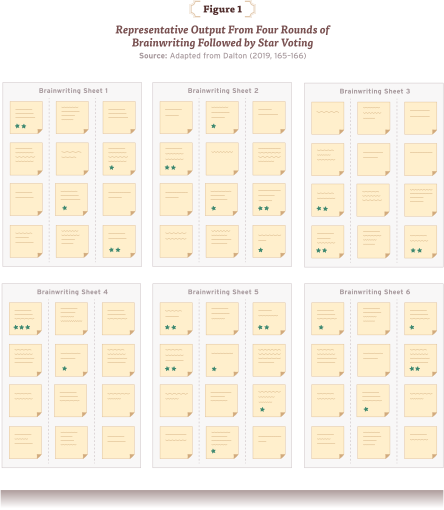
Through four rounds of brainwriting, the team generated dozens of ideas ranging from incremental improvements to bold innovations. The activity’s silent, structured nature encouraged contributions from all team members, including those who might typically hesitate to speak in group settings. What emerged was a rich tapestry of possibilities that no single person could have conceived alone.
Evaluating Options
With dozens of ideas in hand, the team needed a method to determine which ideas merited further development. The brainwriting sheets were posted on a wall for the team to consider using the star (or dot) voting process (Lewrick, Link, and Leifer 2020). Each team member received seven sticky stars to vote on their preferred ideas however they wished—putting all stars on one idea, voting for seven different ideas, or weighting their preferences with any distribution in between.
The star voting process remained silent to encourage independent judgment and reduce the influence of group dynamics. This democratic approach, represented in Figure 1 (on page 80), respected everyone’s opinions and surfaced ideas with broad support. The team’s star votes revealed 24 ideas for further consideration.
Prioritizing Solutions
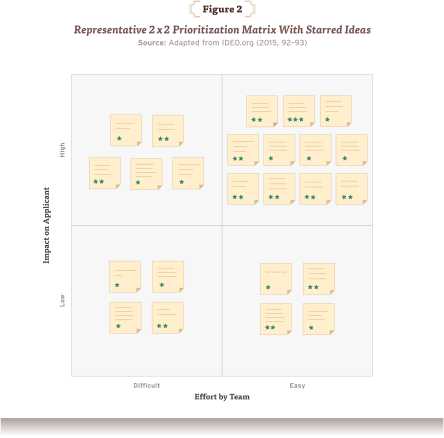
To evaluate the ideas that received votes, the group used a 2 x 2 matrix with axes determined in advance to provide a strategic framework for decision-making:
The X-axis reflected “Effort for Team” (ranging from difficult to easy)
The Y-axis reflected “Impact on Applicant” (ranging from low to high)
For each of the 24 starred ideas, the team reached a quick consensus on its placement in the matrix. While the team initially approached this as an evaluation and sorting activity, the strategic implications of the quadrants became apparent as the ideas were placed. Clear action categories emerged from this visual approach:
Upper-Right Quadrant (easy effort + high impact): These ideas naturally emerged as the team’s immediate priorities and formed the prototype for improving the admissions experience.
Upper-Left and Lower-Right Quadrants (difficult effort + high impact and low effort + low impact): These ideas were tabled for future consideration based on available resources and evolving needs.
Lower-Left Quadrant (difficult effort + low impact): These ideas were set aside, likely to be retired.
This systematic approach to prioritization, illustrated in Figure 2 (on page 81), ensured the team focused on solutions that would make a meaningful difference for applicants while intentionally leveraging the team’s bandwidth and strategically allocating its resources.
Impact on Team Dynamics and Admissions Processes
The design thinking offsite yielded both immediate and long-term benefits that extended beyond the specific solutions generated. The experience fundamentally transformed how the team operated and served applicants, resulting in lasting changes to its collaborative approach, problem-solving mindset, and admissions processes. These impacts manifested in several key areas.
Enhanced Team Dynamics and Culture
In terms of team dynamics and culture, the offsite catalyzed five transformative shifts in how team members interacted and approached their work together:
Inclusive Participation: The structured, silent nature of exercises like brainwriting and star voting promoted equal contribution from all team members, which particularly empowered quieter, newer, and junior team members.
Deepened Trust and Understanding: The manifesto exercise helped build connections among team members by sharing motivations and aspirations, creating empathy that carried over into daily work.
Collaborative Innovation: By suspending judgment and building upon each other’s ideas, the team generated solutions that no individual would have conceived alone, reinforcing the power of diverse perspectives.
Solution Orientation: In the months following the offsite, team members displayed heightened creative confidence and proactive problem-solving skills. They focused on possibilities rather than obstacles, creating a culture shift in which a shared solution orientation emerged as the team’s modus operandi.
Human-Centered Focus: Perhaps most significantly, the empathy at the heart of design thinking permeated the team’s work, with actions consistently prioritizing the needs and experiences of applicants.
Improved Admissions Processes and Applicant Experience
The solutions prioritized through the design thinking process yielded significant enhancements to the admissions experience:
Improved Application Prompts: The team employed the “Jobs to Be Done” framework to redesign essay questions and virtual assessment prompts, creating clearer expectations for applicants while generating more informative responses for the admissions committee.
Increased Process Transparency: New features, such as a customized real-time checklist, transformed how applicants navigated application requirements, reducing applicant anxiety and providing greater visibility into their progress throughout the process.
Strengthened Transition Support: The team improved communications and resources for admitted students, providing guidance on next steps and navigating the transition to campus.
Leveraged Platform Capabilities: The team activated dormant features of their admissions workflow suite, including interview scheduling, automated reporting, and predictive analytics tools, creating a more responsive and informed admissions operation.
These enhancements initiated the first phase of implementing the team’s design thinking solutions. The remaining high-priority ideas from the upper-right quadrant were tackled based on resource availability, fueling ongoing improvement of the admissions experience.
Discussion
SEM planning is both research-informed and iterative—principles Hutton (2021) emphasizes. Design thinking offers a practical approach to connecting insights to action. The lessons for admissions professionals that flowed from the offsite are organized into four areas: Implementation strategies, stakeholder engagement, mindset development, and institutional adaptation.
Getting Started with Design Thinking
The shift from traditional problem-solving to human-centered innovation requires intention—tools are accessible, and the path awaits. Admissions teams can begin incorporating design thinking through focused activities. Even a single hour-long session addressing one specific challenge can yield valuable insights while building comfort with the tools and techniques. Dedicated time and space for creative problem-solving, whether workshops or targeted team meetings, can spark meaningful innovation.
This incremental approach aligns with the iterative nature of design thinking. The methodology encourages experimentation, learning from successes and failures, and refining solutions for better user experiences. Admissions leaders should foster a culture in which team members feel safe taking calculated risks and where setbacks are reframed as valuable learning experiences that inform future activities.
While this case study featured specific techniques, such as “How Might We” statements and brainwriting, public design thinking resources offer abundant tools and activities that may better suit different team contexts or specific challenges. Teams should explore and adapt a design thinking approach to meet their unique needs, rather than feeling constrained by any single set of activities.
Expanding Beyond the Team
While this case study focused on an admissions team workshop, the design thinking approach would be strengthened by directly involving stakeholders in the process. Future iterations could include interviews with prospective students, observations of applicants navigating the admissions process, or sessions with current students to co-create solutions that more directly address applicants’ needs.
This expanded engagement would allow admissions teams to gather richer data on empathy and test assumptions with current or former applicants. For example, inviting recently admitted students to provide feedback on proposed communications improvements can reveal blind spots in the team’s understanding of the applicant journey. Similarly, involving staff and faculty who serve on admissions committees can open the aperture on stakeholder needs.
Cultivating a Human-Centered Mindset
Beyond the activities and innovations, the most valuable aspect of design thinking is the human-centered mindset it fosters. By consistently returning to questions about applicants’ needs, experiences, and perspectives, admissions teams develop greater empathy and create more effective processes—even outside formal design thinking sessions.
This shift in perspective positions teams to view their work from the applicant’s perspective, challenging assumptions and institutional traditions that may create points of friction and erect unnecessary barriers. Instead of designing based on institutional data architecture, organization charts, or jargon, asking “How might this feel to an applicant?” aligns with user-centered admissions design, which has been shown to yield higher satisfaction when institutions intentionally gather and respond to applicant feedback (Wolcott, et al. 2024).
Adapting to Institutional Contexts
To garner support, design thinking activities and focus areas must align with an institution’s mission and values and with its SEM aims, particularly enrollment goals and institutional culture (Green 2020, ix), as well as its priorities and resources. Manning (2017) notes that organizational structures vary significantly across higher education institutions, requiring thoughtful adaptation of any innovation framework.
Rather than full-day offsites, teams at resource-constrained institutions might start with a single “How Might We” session focused on their most pressing challenge. Teams with limited bandwidth might schedule brainwriting and star voting exercises that can be completed in 60-minute segments when schedules allow.
Institutions with complex, multi-departmental admissions processes might implement design thinking in stages, starting with a specific program before scaling. As Kezar (2018) notes in her research on collaboration in higher education, organizations with distributed decision-making often benefit from pilot implementations that generate success stories before broader adoption.
Different institutional missions can shape the design thinking approach. Institutions focused on access and inclusion might emphasize the “Empathize” phase of design thinking, conducting deeper research with prospective student populations, including first-generation college students, adult learners, and working students. Their “How Might We” statements might focus on removing barriers to application completion.
Institutions with distinctive values—whether based on a religious tradition, a specialized academic focus, or a unique pedagogical approach—can align design thinking with their core principles. For example, an institution with a strong values-based mission might incorporate reflection on its institutional values and create a team manifesto, inspiring innovation that aligns with its mission.
Conclusion
The power of design thinking lies not only in its methods but also in its ability to unlock creativity while channeling that energy toward human needs. For admissions teams, this means developing solutions that effectively support applicants while efficiently directing resources. This approach gives admissions teams a pathway to innovation—one that can harmonize institutional demands with genuine care for applicants.
What makes design thinking particularly valuable for higher education is its adaptability. While thoughtful preparation and facilitation enhance outcomes, admissions leaders can introduce design thinking tools and techniques incrementally, seeing meaningful benefits while building organizational capacity for human-centered innovation.
The future of admissions belongs to institutions that adapt quickly while deepening their commitment to understanding and serving applicants. Design thinking provides both the mindset and the toolkit to thrive in this environment. As this case study demonstrates, the team’s innovations began with a thoughtfully framed question: “How might we create a positive admissions experience for our applicants?” Beyond specific solutions, design thinking fostered a more collaborative, creative, and empathetic team culture. Ultimately, that transformation continues to guide the team’s work in creating positive experiences for applicants.
References
Alvarado, L. F. 2025. Design thinking as an active teaching methodology in higher education: A systematic review. Frontiers in Education. 10.
Brown, T. 2008. Design thinking. Harvard Business Review. 86(6): 84–92.
Burgess-Auburn, C. 2022. You Need a Manifesto: How to Craft Your Convictions and Put Them to Work. Berkeley, CA: Ten Speed Press.
Burnett, B., and D. Evans. 2016. Designing Your Life: How to Build a Well-Lived, Joyful Life. New York: Alfred A. Knopf.
Christensen, C. M., T. Hall, K. Dillon, and D. S. Duncan. 2016. Know your customers’ “jobs to be done.” Harvard Business Review. 94(9): 54–62.
Dalton, J. 2019. Great Big Agile: An OS for Agile Leaders. New York: Apress.
d.school. 2018. Design Thinking Bootleg. Stanford, CA: Stanford University.
Edmondson, A. C. 1999. Psychological safety and learning behavior in work teams. Administrative Science Quarterly. 44(2): 350–383.
Global Learning Partners. 2020. I Like, I Wish, I Wonder. Saratoga Springs, NY: Author.
Green, T. 2020. Foreword. In Holistic Admissions: Predicting the Likelihood for Student Success, edited by M. Sandlin and W. Sedlacek. Washington, D.C.: American Association of Collegiate Registrars and Admissions Officers.
Guaman-Quintanilla, S., P. Everaert, K. Chiluiza, and M. Valcke. 2023. Impact of design thinking in higher education: A multi-actor perspective on problem solving and creativity. International Journal of Technology and Design Education. 33: 217–240.
Hossler, D., and B. Bontrager. 2014. Handbook of Strategic Enrollment Management. San Francisco: Jossey-Bass.
Hutton, A. 2021. Putting “strategic” in strategic enrollment management. Strategic Enrollment Management Quarterly. 9(3): 23–31.
IDEO.org. 2015. The Field Guide to Human-Centered Design. San Francisco: Author.
IDEO U. 2025. IDEO Design Thinking. San Francisco: Author.
Interaction Design Foundation. n.d. Design Thinking. Tranbjerg, Denmark: Author.
Kezar, A. 2018. How Colleges Change: Understanding, Leading, and Enacting Change. 2nd ed. New York: Routledge.
Khanna, M., I. Jacob, and N. Yadav. 2019. Identifying and analyzing touchpoints for building a higher education brand. Journal of Marketing for Higher Education. 29(1): 75–91.
Lewrick, M., P. Link, and L. Leifer. 2020. The Design Thinking Toolbox: A Guide to Mastering the Most Popular and Valuable Innovation Methods. Hoboken, NJ: John Wiley & Sons.
Lucid. n.d. How to use brainwriting to generate ideas. Lucidchart Tech Blog. August 31.
Mann, C. 2020. Advising by design: Co-creating advising services with students for their success. Frontiers in Education. 5(2020): 99.
Manning, K. 2017. Organizational Theory in Higher Education. 2nd ed. New York: Routledge.
McLaughlin, J. E., E. Chen, D. Lake, W. Guo, E. R. Skywark, A. Chernik, and T. Liu. 2022. Design thinking teaching and learning in higher education: Experiences across four universities. PLOS ONE. 17(3): e0265902.
McNamara, M. C. 2023. Punching Above My Weight: Mentoring Entrepreneurs’ Well-Being (doctoral dissertation). Northeastern University, Boston, MA.
Rittel, H. W., and M. M. Webber. 1973. Dilemmas in a general theory of planning. Policy Sciences. 4(2): 155–169.
Wolcott, M. D., A. Pawar, H. Song, L. N. Hart, M. D’Souza, S. S. Owens, M. M. Pan, and R. I. Quinonez. 2024. Lessons learned from a non-traditional application process: Integrating user experiences to inform admission application design. Journal of Dental Education. 88(3): 333–341.
About the Author
Mary C. McNamara, Ed.D., is the former assistant dean of graduate recruitment and admissions at Northeastern University’s D’Amore-McKim School of Business. Now an executive consultant, she partners with universities to strengthen the candidate experience, streamline operations, and improve enrollment outcomes, drawing on leadership roles across finance, technology, and healthcare—including serving as a marketing executive, digital health COO, and managing director with Angel Healthcare Investors, LLC.
Dr. McNamara earned a Doctor of Education in Organizational Leadership from Northeastern University, an M.B.A. from the Tuck School of Business at Dartmouth, and a B.A. in mathematics and economics from Bowdoin College. Her professional interests focus on applying human-centered design to admissions and strategic enrollment management, and on fostering a culture of curiosity and confidence around GenAI adoption.

share