

As curriculum development in higher education becomes increasingly interdisciplinary and cross-school, traditional linear workflow models in many curriculum management systems reveal their limitations. Proposals often require sequential approvals across multiple departments and colleges, creating delays, version mismatches, and catalog inconsistencies. To address these challenges, this article explores the adoption of AI-assisted parallel workflows, leveraging artificial intelligence (AI) to automate routing, streamline approvals, and strengthen collaboration while preserving the integrity of shared academic governance (Zawacki-Richter, et al. 2019).
The Challenge
Most existing curriculum management systems rely on fixed, sequential approval workflows, which function adequately for single-department proposals but falter when programs span multiple disciplines. The increasing prevalence of interdisciplinary programs has heightened these inefficiencies (Bates 2019). Redundant or sequential reviews among multiple academic units lead to significant delays, while timing gaps between approval cycles often result in catalog mismatches or outdated course data. Manual routing introduces errors, bottlenecks, and a lack of transparency, making it difficult for faculty and administrators to track proposal progress.
Research has shown that higher education’s governance systems often struggle to adapt to complex, cross-departmental initiatives due to legacy administrative processes and siloed data management systems (Allen and Seaman 2017; Dahlstrom, Brooks, and Bichsel 2014). These inefficiencies not only delay course and program updates but also discourage innovation and interdisciplinary collaboration, two critical drivers of modern academic success (Educause 2023).
The Vision: Intelligent Curriculum Flow
To overcome these barriers, institutions can envision a curriculum management model that is both adaptive and data-informed. By analyzing catalog data and historical approval patterns, an intelligent system could automatically detect interdependencies between courses and programs across departments (Woolf 2021). It could identify all affected units, committees, and governance bodies in real time and trigger dynamic routing that launches parallel approval paths to all relevant reviewers simultaneously.
Once all approvals are complete, the system would merge the results into a unified proposal record, ensuring transparency and eliminating redundant review steps. Furthermore, process analytics could be used to track approval timelines, identify bottlenecks, and recommend optimized routes (Educause 2023). Proposals with major academic or policy implications could be automatically flagged for human review, while routine changes could move through pre-approved, accelerated workflows. This hybrid model of automation and oversight would improve efficiency while upholding the principles of shared governance and academic integrity (Parks and Platania 2024).
The Solution: AI-Enabled Parallel Workflows
Integrating AI-driven workflow intelligence into curriculum management would fundamentally change how institutions process and evaluate academic proposals. Rather than relying on static approval chains, AI could dynamically map dependencies between courses, programs, and catalog elements to identify every department or committee impacted by a proposed change. Once those dependencies are established, the system could automatically launch concurrent approval routes across all relevant academic units (Zawacki-Richter, et al. 2019).
Throughout the process, AI could monitor reviewer progress, merge comments and feedback into cohesive summaries for decision-makers, and track the status of all concurrent reviews through a unified interface (Woolf 2021). Historical workflow data could then be analyzed to detect bottlenecks and recommend optimized routing sequences, improving turnaround times and balancing reviewer workloads.
Additionally, the system could enhance communication by tailoring summaries for different audiences, providing faculty with disciplinary-level details while presenting administrators with concise overviews of high-impact items. Together, these capabilities would transform traditional curriculum systems from passive recordkeeping tools into intelligent decision-support platforms capable of real-time routing, data analysis, and adaptive process management (Educause 2023).
Expected Benefits
The adoption of AI-enabled parallel workflows offers a broad set of advantages that collectively strengthen curriculum governance and institutional efficiency. One of the most significant benefits is the potential for substantially faster proposal approvals. By replacing traditional sequential routing with simultaneous, parallel reviews, combined with automated identification of all affected units and intelligent routing and progress tracking, institutions may reduce review times.” This acceleration not only expedites decision-making but also minimizes the administrative lag that often delays the implementation of new courses, programs, or curricular revisions. The system also enhances data accuracy by reducing catalog mismatches and inconsistencies that frequently result from timing gaps, manual errors, or outdated information, ensuring a more precise and reliable academic record.
Beyond speed and accuracy, AI-enabled workflows improve transparency and collaboration across the institution. Parallel review structures consolidate all concurrent evaluations, comments, and feedback into a unified interface, giving faculty, staff, and administrators clearer insight into proposal status and eliminating the uncertainty that often accompanies manual routing. Interdisciplinary proposals, which typically require layered approvals across multiple schools, move more efficiently through coordinated, simultaneous review processes, strengthening cross-college collaboration. Finally, these systems promote data-informed governance by generating actionable analytics on proposal flow, reviewer workload, bottlenecks, and overall efficiency. Such insights allow academic leaders to identify structural barriers, optimize routing patterns, and allocate resources more effectively, ultimately leading to a more adaptive and responsive curriculum ecosystem.
Limitations, Risks, and Potential Failure Points
Despite the promise of AI-enabled parallel workflows, several limitations and risks warrant careful consideration before institutions pursue broad adoption. While concurrent routing can accelerate approvals, it may also compress the deliberate space that faculty governance depends on; simultaneous reviews risk duplicating questions, generating contradictory feedback, or encouraging rushed evaluations, potentially diminishing the rigor central to shared decision-making (Zawacki-Richter, et al. 2019). Furthermore, the accuracy of AI-driven dependency detection relies heavily on clean, consistent catalog data and well-maintained curricular records. Institutions with siloed or inconsistent data structures may encounter misrouting, overlooked stakeholders, or premature approvals, creating new catalog mismatches rather than resolving existing ones. These concerns are compounded by the possibility that algorithmic summaries may omit nuance or flatten complex disagreements, a risk noted in broader discussions of AI-supported educational systems (Woolf 2021).
Cultural and organizational resistance also present a substantial barrier to successful implementation. Faculty and governance bodies may perceive workflow automation as an encroachment on academic autonomy, reducing buy-in even when technological benefits are clear (Allen and Seaman 2017). Additionally, while long-term efficiency gains are expected, early implementation often increases workload due to system configuration, training, and iterative refinement of routing logic. Finally, the shift to parallelization does not eliminate bottlenecks outright; without mechanisms to balance reviewer workloads, multiple proposals may converge on the same committee simultaneously, simply relocating delays rather than removing them. Together, these limitations underscore the need for cautious, transparent, and data-informed implementation to ensure that the benefits of AI-enabled workflows do not compromise academic integrity or institutional trust.
Next Steps
Adopting AI-assisted parallel workflows within curriculum management represents a form of radical incrementalism, a small but transformative shift that modernizes academic governance (Parks and Platania 2024). This approach maintains the rigor and transparency of shared decision-making while enabling institutions to respond more quickly and effectively to evolving academic needs. By allowing systems to route, reconcile, and report on multi-branch workflows through adaptive intelligence, universities can build truly responsive curriculum ecosystems, ones that keep pace with interdisciplinary growth, technological innovation, and the expectations of 21st-century learners (Educause 2023).
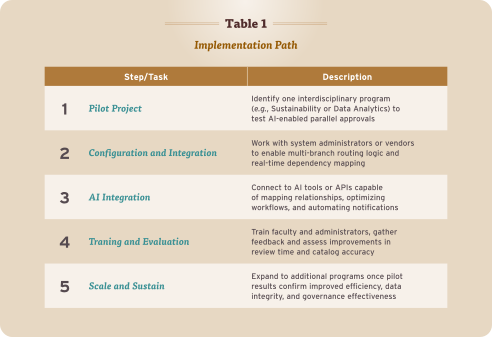
To move from vision to implementation, institutions should take deliberate, structured actions that align technical readiness with institutional culture. The first step is to establish a cross-functional task force composed of faculty, registrar staff, IT professionals, and governance representatives to guide planning and oversight (Dahlstrom, Brooks, and Bichsel 2014). This group should evaluate existing workflow systems, data quality, and governance policies to identify necessary upgrades and integrations. Once that foundation is in place, a pilot program should be launched using an interdisciplinary course or certificate to test AI-enabled routing and process optimization.
Early stakeholder engagement is essential to success. Faculty, department chairs, and academic leaders must understand how automation enhances transparency and efficiency rather than replacing governance oversight (Allen and Seaman 2017). Partnering with technology vendors to configure routing logic, dependency detection, and reporting dashboards will ensure the system aligns with institutional needs and decision-making structures. During the pilot, faculty and staff should receive targeted training and opportunities to provide feedback on workflow usability, communication, and data accuracy (Bates 2019).
Following the evaluation, institutions can refine workflow models based on measurable improvements, such as reduced approval times, greater process consistency, and improved catalog synchronization. Once validated, the model can be scaled widely. Through these steps, colleges and universities can establish a more agile, collaborative, and data-informed governance framework that reflects both the pace of academic innovation and the enduring values of shared decision-making in higher education (Zawacki-Richter, et al. 2019).

share