

By Terrell L. Strayhorn
As colleges across the nation face declining enrollment and shifting student priorities, the question is no longer just about recruitment—it’s also about retention, student success, and creating a campus culture where all people, especially students, feel a true sense of belonging. This was the central theme of my keynote address at the New England Association of Collegiate Registrars and Admissions Officers (NEACRAO) Annual Conference in Portsmouth, New Hampshire. The annual conference provided standing-room-only, sanctioned space to address an audience of collegiate registrars and admissions officers grappling with these most urgent challenges that threaten the present and future of higher education. During my address, I posed several critical questions for our collective consideration, such as: What’s driving student interest in pursuing college degrees today? And how can institutions best respond to declining student interest in attending college? As my research shows, the answers, in part, lie in one of the most powerful drivers of student success—fostering a deep sense of belonging on campus (Strayhorn 2019). In this article, I highlight relevant trends, explain sense of belonging in college, and recommend several evidence-based practices for boosting belonging on college campuses in ways that align with the important work of collegiate registrars and admissions professionals.
Current Issues: Public Interest in Higher Education
Several headwinds shape today’s students’ aspirations and interests in higher education. For instance, with looming economic uncertainty, rising tuition costs, and emerging alternative pathways to career success such as specialized trade schools and on-the-job training, many students and families are questioning whether higher education is the right choice. Widely-circulated estimates of college returns on investment (ROIs) give reasons for concern. About 60 percent of top jobs of the future require some postsecondary education, but less than a college degree, according to the Bureau of Labor Statistics. The average cost of private college is approximately $45,000, more than the median starting income for most people with a high school diploma or less. Consequently, college enrollment rates have steadily declined, as students seek alternative educational pathways and question the long-term value of a college degree. It’s important to note that, still today, the average projected starting salary for someone in the United States with a bachelor’s degree is $68,680, according to the National Association of Colleges & Employers.
Declining enrollments and shrinking financial support have several significant consequences for the higher education enterprise. For instance, enrollment declines and revenue shortfalls have led to the consolidation or closure of some colleges in recent years. Ursuline College has merged with Gannon University (Unglesbee 2025). Clarks Summit University and the University of the Arts ceased operations in 2024, due to financial issues. And both Eastern Nazarene College and Pierce College closed in summer 2025. So as college costs rise and workforce opportunities change, fewer students enter higher education, and even when they do enroll, too many abandon their educational goals prematurely or leave college before completing their degree—a process known as attrition, stopout, or dropout (Tinto 2012). To remain competitive and address this problem, postsecondary institutions must rethink their recruitment and retention strategies. The question is no longer simply how to attract students (recruitment), but how to hang on to current students (retention) and ensure their success.
Sense of Belonging: A Key to Educational Success
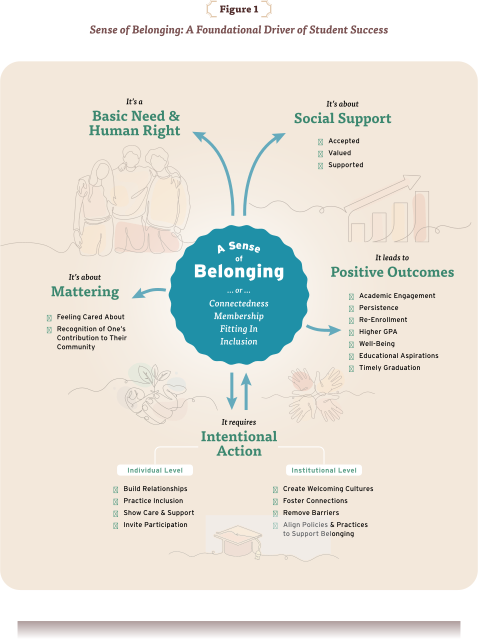
One factor that powerfully predicts college student success is sense of belonging. Belonging is one term with many different definitions. Generally, belonging refers to “students’ perceived social support on campus, a feeling or sensation of connectedness, the experience of mattering or feeling cared about, accepted, respected, valued by, and important to the campus community or others on campus such as faculty, staff, and peers” (Strayhorn 2019, 4). Previous scholars have shown that college students’ sense of belonging is positively correlated with co-curricular engagement, course grades, culturally-affirming environments, academic satisfaction, meaning in life, and overall well-being (e.g., Lambert, et al. 2013; Mayhew, et al. 2016; Museus, et al. 2017; Strayhorn 2008). When students feel like they belong as bona fide members of a supportive learning community—whether on campus, in a classroom, online, or in a laboratory—they excel academically, thrive socially, stay in school, and graduate.
My research and scholarship examines the importance and impact of belonging on students’ success. For instance, in the second edition of my full-length book on the topic, I outline the contours of a theory on belonging. Sense of belonging, I argue, is a basic need and a human right. It takes on heightened importance at certain times, in particular situations, and under stressful conditions, especially for groups vulnerable to (pre)judgment, invisibility, or mistreatment such as racial/ethnic minorities in predominantly white institutions (PWIs), women, and People of Color in science, technology, engineering, and math (STEM) fields, or LGBTQIA2S+ students on campuses that subscribe to heteronormative practices and policies, just to give a few examples. To be sure, belonging is also shaped by one’s social identities; it relates to mattering (Schlossberg 1985) and produces positive short- and long-term outcomes such as good attendance, friendship, and even financial generosity among alumni (Goh and Kim 2023).
For all its worth and what it does for students and institutions, belonging doesn’t happen automatically on its own. It takes intentional effort to boost college students’ sense of belonging. It’s important to remember—belonging is a feeling; thus, true belonging cannot be faked or forced. It must be built, cultivated, facilitated, or nurtured—it requires strategic action(s). Cultivating conditions for belonging requires work at both the individual and institutional levels. For example, belonging stems from positive, supportive relationships among faculty, staff, and students, such as those developed through purposeful engagement in first-year experience (FYE) programs, undergraduate research experiences, intrusive advising huddles, and near-peer mentoring programs (Strayhorn 2019). Institutionally, however, belonging depends on other core dimensions such as campus climate, accessibility of support services, and honest reckoning with the institution’s oppressive history, structures, and policies (Johnson 2022). Figure 1 (on page 64) presents a visual summary of the points made in this section.
The Power of Belonging: Insights from My Latest Research
As an equity-minded researcher and social scientist, I have dedicated much of my career to exploring the concept of belonging—what it means to feel connected, supported, seen, heard, valued, and included in a world that all-too-often divides us. Higher education is a microcosm of broader society—despite its many virtues, it can be hostile, unwelcoming, and divisive, rigidly separating academic from student affairs, curricular from extracurricular, and on- from off-campus, in ways that confound collaboration, complicate cross-listing of courses, or compromise town-gown cooperative agreements, for instance.
Contrary to these false dichotomies, students don’t experience college like that. It’s not that learning occurs only in the classroom and socializing is restricted to lounges, cafeterias, or social networking sites like Facebook, MySpace (remember that?!), Instagram, and X (formerly, Twitter). No, college student learning and development occurs in every nook and cranny of the institution, and some first-year students’ sense of belonging in college can be boosted through frequent interactions with others on social media (Strayhorn 2012). Indeed, some students become friends in class while collaborating on scientific projects. They strengthen their scientific reasoning skills by studying abroad, writing poetry, and doing community service with sorority sisters. Students learn important lessons about democracy, civility, and coexisting peacefully with people who are different from them by living together in campus residence halls, joining campus clubs, and playing sports, whether intercollegiate or intramural (Mayhew, et al. 2016). A consistent line of evidence suggests that making friends, learning alongside others, and engaging actively through campus clubs or sports facilitates college students’ sense of belonging (Strayhorn 2019).
Belonging can buffer against the forces that divide us, especially in higher education. For example, college can be stressful at times, and this is true for most students. College stress can have a deleterious effect on students who enter college academically underprepared. Stress can also compound and/or compromise the success of students whose racial identity differs from the numerical majority and/or those who lack dominant forms of cultural capital that are all too often valued in school settings, such as first-generation, low-income, and disabled students. Providing comprehensive, wrap-around support to such students can reduce anxiety, nurture confidence (or self-efficacy), catalyze growth-minded thinking, and improve success rates by way of boosting belonging—meeting students where they are (just as they are), lending a helping hand, and providing the assistance they need, when they need it.
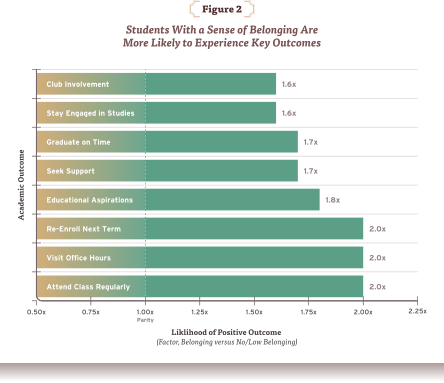
Recently, I interviewed and surveyed more than 1,000 college students to examine how their sense of connection with peers, faculty, and the institution at large affected their academic performance, mental health, and likelihood of persisting through challenges. The findings are abundantly clear: students who felt a sense of belonging were significantly more likely to stay engaged in their studies, seek support when needed, re-enroll in the next term, and graduate on time. For example, college students who reported a strong sense of belonging were two times more likely than their peers to attend class regularly, visit instructors’ office hours, re-enroll in the spring term, and expect to graduate on time. Figure 2 (on page 66) presents a summary of results from this analysis, noting that students with high(er) belonging scores also tended to report higher educational aspirations, frequent interactions with faculty, active involvement in clubs, and more college friends.
Of course, belonging isn’t just about friendships—it’s about feeling valued and supported in the academic community. Students tend to feel supported when faculty provide constructive feedback on assignments or academic advisors reach out to them proactively, well before it’s too late to “course correct” an academic setback. Students may also feel valued and cared about when campus policies and programs help ease their adjustment to campus, remove (or reduce) barriers that inhibit their academic progress, or simplify the registration process. When students perceive that they matter to their institution and its key personnel, they are more resilient, motivated, and willing to invest time and energy in completing their education.
Recommendations for Practice: Fostering Belonging on Campus
To combat declining interest in college, shrinking enrollments, and budget shortfalls, institutions must prioritize fostering a sense of belonging for all students. Here are some key strategies—what I like to call “promising practices” for those working as collegiate registrars, admissions officers, and their collaborators:
Streamline and humanize the registration experience. Administrative hurdles like confusing course catalogs, sudden registration holds, or clunky digital platforms can make students feel like outsiders in a system not built for them. Feeling “lost in the process” erodes a sense of belonging. Registrars should partner with IT and student services to simplify and personalize the process. Implement jargon-free interfaces with step-by-step checklists. Proactively flag common errors with plain language explanations. Offer live registration support via chat, Zoom, or AI chatbots during peak times.
Train frontline staff to recognize and respond with care. Remember, belonging isn’t only shared by big events, pep rallies, and warm hugs—it’s often forged in brief interactions: a student who’s unsure if they submitted the right form, a returning adult who feels “out of place,” or a prospective student who’s confused about transfer credits. Admissions staff, registrars, and retention specialists should receive micro training on how to turn everyday interactions into “belonging boosts.” Learn to recognize signs of self-doubt or alienation and ways to combat it. Use affirming scripts: “That’s a great question,” “Glad you asked,” or “I’m here to help.” Be clear, warm, and student-centered in every exchange, whether on phone, email, social media, or face-to-face. When institutional representatives respond with empathy, students internalize the message: I matter. Somebody’s here for me. This is a place where I can succeed.
Redesign orientation and support services. From day one, students should feel that the institution is invested in their success. An engaging, comprehensive orientation program can lay the groundwork for belonging. Continuing support services such as mental health counseling, academic advising, and peer mentorship further strengthen students’ ties to the campus.
Enhance communication and transparency. A student’s sense of belonging begins before they set foot on campus. The tone, language, and imagery used in outreach materials shape students’ expectations of whether they’ll be welcomed, seen, and understood. Clear, consistent communication about resources, policies, and opportunities is essential. Admissions and recruitment staff should audit and revise materials to be more inclusive and affirming. Feature different student voices and stories in brochures, campus tours, and social media—not just photos, but experiences. Highlight support systems early: mental health services, mentoring programs, affinity groups, and first-generation resources.
Conclusion: Belonging as the Key to Enrollment Management
As we look toward the future of higher education, fostering a sense of belonging is more than just a feel-good initiative—it’s a critical tool for recruitment and retention. When students feel that they are part of a supportive and inclusive community, they are far more likely to invest in their education and persist through challenges. As registrars, admissions counselors, and higher education professionals, we must champion initiatives that make belonging a top priority.
References
Goh, J. X., and S. Kim. 2023. Sense of belonging and alumni engagement. Philanthropy and Education. 6(2): 17–39.
Johnson, R. M. 2022. A socio-ecological perspective on sense of belonging among racially/ethnically minoritized college students: Implications for equity-minded practice and policy. New Directions for Higher Education. 2022(197): 59–68.
Lambert, N. M., T. F. Stillman, J. A. Hicks, S. Kamble, R. F. Baumeister, and F. D. Fincham. 2013. To belong is to matter: Sense of belonging enhances meaning in life. Personality and Social Psychology Bulletin. 39(11): 1418–1427.
Mayhew, M. J., A. N. Rockenbach, N. Bowman, T. A. Seifert, G. C. Wolniak, E. T. Pascarella, and P. T. Terenzini. 2016. How College Affects Students: 21st Century Evidence That Higher Education Works (Volume 3). San Francisco: Jossey-Bass.
Museus, S. D., V. Yi, and N. Saelua. 2017. The impact of culturally engaging campus environments on sense of belonging. The Review of Higher Education. 40(2): 187–215.
Schlossberg, N. K. 1985. Marginality and Mattering: A Life Span Approach (presentation). Los Angeles, CA: Annual Meeting of the American Psychological Association.
Strayhorn, T. L. 2008. Sentido de pertenencia: A hierarchical analysis predicting sense of belonging among Latino college students. Journal of Hispanic Higher Education. 7(4): 301–320.
———. 2012. Exploring the impact of Facebook and MySpace use on first-year students’ sense of belonging and persistence decisions. Journal of College Student Development. 53(6): 783–796.
———. 2019. College Students’ Sense of Belonging: A Key to Educational Success for All Students (2nd edition). New York: Routledge.
Tinto, V. 2012. Completing College: Rethinking Institutional Action. Chicago: University of Chicago Press.
Unglesbee, B. 2025. Gannon University and Ursuline College announce official merger deal. Higher Ed Dive. January 3.
About the Author
Terrell L. Strayhorn, Ph.D., M.B.A., is Professor of Education and Psychology at Virginia Union University, where he also serves as Associate Provost, Interim Dean of the School of Education, Director of Research in the Center for the Study of HBCUs, and Director of the Center for Transcendent Leadership. An internationally recognized scholar, he researches student success, institutional effectiveness, and belonging in education and work settings. Strayhorn is also an author, speaker, and thought leader committed to advancing inclusive excellence across colleges and universities.

share