

By Christopher W. Tremblay, Ed.D., Executive Director of Enrollment Management at the University of Michigan, Editor-in-Chief of AACRAO College & University Journal, Director of AACRAO Strategic Enrollment Management Endorsement Program
I have been a lifelong fan of Frank Lloyd Wright’s work—a passion ignited further through an “Art and Architecture” undergraduate course at Western Michigan University and deepened ever since. Today, I bring that passion into my professional life as a college admissions professional for architecture and urban planning degrees at the University of Michigan’s Taubman College, where I am daily inspired by faculty shaping the next generation of architects.
Thus far, I have visited nearly 30 Frank Lloyd Wright structures and have been very fortunate to stay overnight in 18 of them throughout the United States. But my most recent visit to a Frank Lloyd Wright house was where my two worlds of architecture and college admissions collided.
As part of visiting Alexandria, Virginia for the recent AACRAO Leadership Meeting, social media informed me as I was landing in the DC area that there was a Frank Lloyd Wright house nearby, known as the Pope-Leighey House. I remember vaguely hearing about this particular house (remember, there are 400+ FLW structures still standing today so there are a lot to keep track of). On the spur of the moment, I bought a tour ticket the night before and took an Uber to southern Alexandria, where the Pope-Leighey House had been moved in 1965.
I arrived 30 minutes before the 10 am tour, excited to see one of the smallest Frank Lloyd Wright homes (2nd smallest existing FLW structure in the world, actually!). Little did I know that I would soon be making a new discovery. It was a small tour of 9 of us, which nearly filled the living room of this 1,200 square foot home! We had a great docent, who was very informative, including giving us the history of the original owners of the house, Loren and Charlotte Pope. Loren was a copy editor for the Washington Evening Star.
In short, Frank agrees to design the home, which back in 1940-41 would cost between $7,000-$8,000. According to our docent, the home started at 1,800 square feet and nearly double the cost, but with Loren’s modest salary, the dream house had to be scaled back.
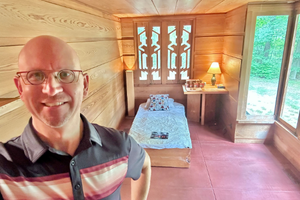
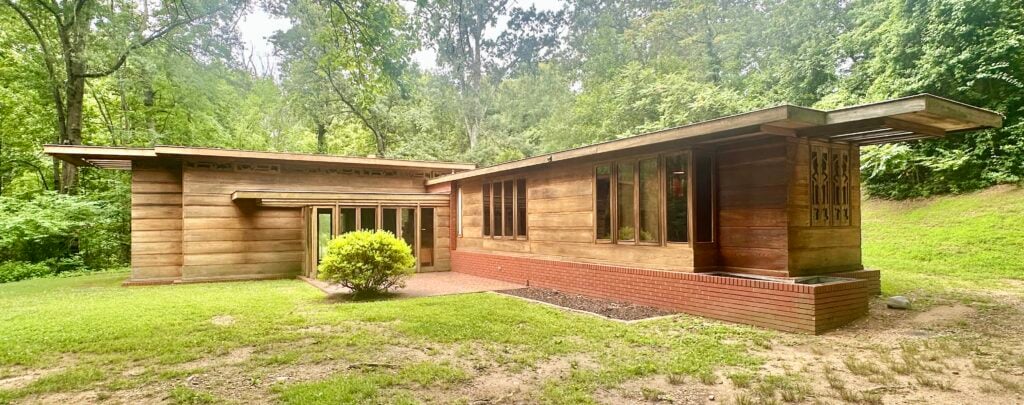
In visiting the last room of the house, which was Loren’s study (or as Frank referred to us the “sanctum” on the floor plans, I had my a-ha moment and this was where my two worlds collided! On the table, I saw the book, “Colleges that Change Lives” and that’s when I realized this was that Loren Pope! I had been familiar with “Colleges that Change Lives” since it had been published in 1996, two years after I joined the college admissions profession. I had no idea that Loren had been a Frank Lloyd Wright fan like me!
If you’re not familiar with “Colleges That Change Lives,” let me give you an introduction.
Colleges That Change Lives: The Book, the Movement, the Fairs
In 1996, as a retired New York Times education editor turned independent college counselor, Loren Pope published “Colleges That Change Lives: 40 Schools You Should Know About Even If You’re Not a Straight-A Student.” The book argued against the prevailing obsession with brand-name prestige in college admissions, contending that many lesser-known liberal arts colleges produced more capable, confident, and successful graduates than the Ivy League schools dominating the cultural conversation. Pope identified 40 colleges that are great choices for students. The colleges he selected received no payment for inclusion; the selections were based solely on Pope’s independent judgment and expertise.
The book struck a nerve. Since its first edition, it has sold tens of thousands of copies and become required reading for many school counselors. Pope revised it twice more in his lifetime, with editions in 2000 and 2006. After Pope’s death in 2008, a fourth edition was produced in 2012 by education journalist Hilary Masell Oswald, who took over the franchise and continued updating the list—which had grown to 45 colleges as of 2024.
In 1998, two years after the first edition, Colleges That Change Lives, Inc. (CTCL) was formally organized as a nonprofit, independent of Pope and his publisher, though with his blessing. The organization’s mission, as it describes today, is “dedicated to the advancement and support of a student-centered college search process,” built on the conviction that fit matters more than rankings. Many of the colleges featured in the book began working together to further promote this philosophy of student-centered college search, and the organization is now governed by a voluntary board of college counseling professionals.
That collaboration evolved into the now-familiar CTCL college fairs—large multi-school events where representatives from member colleges travel together to meet prospective students and families as a unified group rather than as competitors. CTCL hosts a multi-day college fair in the Los Angeles area each summer, with speakers addressing students about discovering their passions and showing their value to colleges, and representatives from each school answering questions from the hundreds of students who attend.
Notably, the list of member colleges isn’t frozen in time. Schools have occasionally dropped off—Marlboro College in Vermont, a member since the early editions, ceased independent operations in 2020 after merging with Emerson College—and new ones have joined, keeping the coalition a living reflection of Pope’s original mission rather than a static relic of 1996.
Thank you, Loren Pope, for bringing both a Frank Lloyd Wright house to life and a set of colleges that remind us of the impact that colleges have by offering your collegiate wisdom.
(Note: The Popes sold the house to the second owners, Robert and Marjorie Leighey, who purchased the house in 1947 for $17,000. Those were the only two owners until Marjorie donated the house to the National Trust for Historic Preservation for people like me to enjoy for decades to come.)
Final Thoughts
Standing in that small sanctum, surrounded by built-in bookshelves and Cherokee red concrete, I could not help but marvel at the layers of this discovery. Loren Pope sought out Frank Lloyd Wright because he believed that thoughtful design should not be reserved for the wealthy—that a modest budget and a modest salary still deserved a home built with intention and care. Decades later, Pope turned his attention to higher education and made a strikingly similar argument: that a school’s name and ranking matter far less than whether it actually serves the student in front of it.
Two seemingly unrelated chapters of my professional and personal life—architecture admissions and the broader mission of college access—turned out to share a common author and a common philosophy. I left the Pope-Leighey House that morning with a renewed appreciation for both Wright’s vision and Pope’s, and a reminder that sometimes the smallest spaces hold the biggest revelations.
Learn More
Christopher is also organizing a professional network of architecture admissions directors. If you’re interested in joining this community, email him at cwtrem@umich.edu.




share