

By Kimberly McNair, Ed.D., Associate Senior Vice President for Student Affairs/Enrollment Management, Montgomery College, Live from #SEM2026
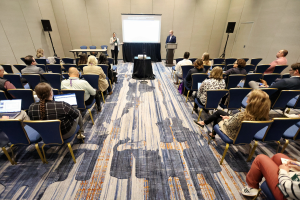
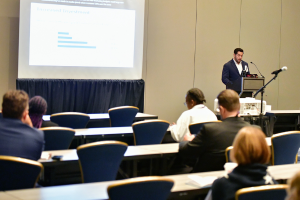
At the 36th Annual AACRAO Conference on Strategic Enrollment Management Opening Plenary, Dr. Freeman A. Hrabowski, III, President Emeritus of the University of Maryland, Baltimore County, challenged attendees to think differently about resilience, leadership, and the role institutions play in helping learners navigate an increasingly uncertain world. His session, “Leading with Resilience: Building Adaptive, Student-Centered Institutions in Times of Change,” was both deeply personal and profoundly relevant for enrollment and student success professionals.
Throughout his remarks, Hrabowski emphasized that each of us is a product of our childhood experiences, relationships, and personal stories.
“Stories make up who we are,” he noted, reminding attendees that understanding the experiences of others helps us better understand ourselves. To illustrate this point, he shared powerful stories from his own life.
As a twelve-year-old growing up in Birmingham, Alabama, Hrabowski participated in the Children’s March during the Civil Rights Movement and was jailed for his involvement. Within months, he witnessed events that would shape his generation and the nation: the bombing of the 16th Street Baptist Church that killed four young Black girls and the assassination of President John F. Kennedy. For many Americans, these events created an overwhelming sense of fear, uncertainty, and social upheaval.
Yet Hrabowski’s purpose was not simply to recount history. Instead, he challenged the audience to consider whether today’s students may be experiencing similar feelings. While the circumstances differ, many young people are coming of age amid political polarization, misinformation, public health concerns, global conflicts, economic uncertainty, and questions about the value of higher education itself. Increasingly, students are not simply asking where they should go to college. They are asking whether college is worth pursuing at all.
That reality has significant implications for enrollment management and student success professionals.
Hrabowski suggested that institutions can no longer rely solely on traditional approaches to engagement.
Metaphorically, he argued, we must move beyond the lectern. Information alone is not enough. Students are searching for connection, belonging, and a sense that they are seen as individuals.
A central theme throughout the plenary was the importance of relationships as a foundation for resilience. Students are more likely to persist and thrive when they experience meaningful connections with faculty, staff, peers, and the institution itself. For enrollment and student affairs leaders, this means creating opportunities to learn students’ stories and understanding the unique motivations, challenges, and aspirations they bring to campus.
Hrabowski also highlighted three capabilities institutions must cultivate to effectively serve today’s learners.
- First, institutions must develop systems and processes that are relational in nature. While efficiency remains important, enrollment and student success strategies should be designed to strengthen human connection rather than replace it.
- Second, leaders must use data through an equitable lens, ensuring that information is used not only to identify trends but also to remove barriers and improve outcomes for historically underserved populations.
- Third, institutions must adopt an adaptive mindset when addressing complex challenges, recognizing that solutions that worked in the past may not meet the needs of today’s students.
The message extended beyond institutional strategy. Hrabowski reminded attendees that resilience is also a personal practice. The habits we cultivate influence our thoughts, words, actions, and ultimately our character and destiny. For higher education professionals navigating rapid change and increasing demands, resilience is not simply an organizational competency; it is an individual responsibility.
Perhaps the most important takeaway from the plenary was that student success begins with human connection.
As colleges and universities confront shifting demographics, enrollment challenges, and growing public skepticism, Hrabowski’s message serves as a timely reminder: understanding the stories of our students may be one of the most powerful tools we have for helping them succeed. In an era marked by uncertainty, relationships, belonging, and empathy remain among higher education’s greatest strengths.

share