

By Autumn Walden, Editor, AACRAO Connect, Content Strategy Manager, AACRAO
The number 100 has taken on special resonance for our association in 2025. Not only did we celebrate the 100-year anniversary of our College & University Journal, but 2025 also marked the 100th graduate of our Strategic Enrollment Management Endorsement Program. Dr. Necia Martins, Associate Registrar, Student Finance & Client Services at Wilfrid Laurier University in Waterloo, Ontario, has the honor of being the 100th recipient of the AACRAO SEM Endorsement and is among an elite group of 100 individuals worldwide—the 12th person from Canada to earn this endorsement. She is receiving the SEM Endorsement Badge through Credly, and her name is now listed in the SEM-EP Global Registry.
“Professionally, the program gave me a deeper understanding of the theory behind SEM, and the site visits translated theory into practice. Working within the Canadian context, it offered a strong foundation to reflect on my role at my institution and strengthened my confidence in my knowledge,” said Dr. Martins. “Personally, the experience prompted meaningful reflection on how I can contribute to SEM initiatives. While I’m not directly involved in planning or reporting, I’ve come to recognize the influence I hold and the ways I can support SEM goals. This realization has inspired me to focus my energy on identifying internal strategies within my area and sharing them with my leader. Redirecting my efforts toward my circle of influence to drive better outcomes has been both empowering and motivating.”
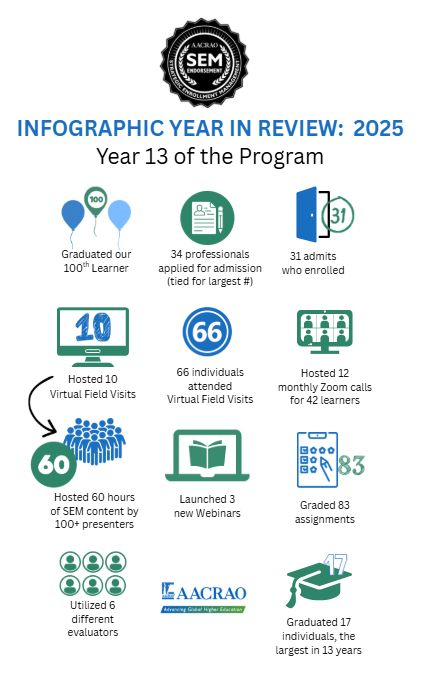
2025: A SEM-EP Milestone Year
We also commemorate the highlights of SEM-EP in 2025, which reflect the durability, discipline, and evolving expertise of a profession grounded in academic integrity, administrative rigor, and strategic leadership. Reaching this milestone at the close of a year in which 17 practitioners graduated—the largest SEM-EP class in 13 years—speaks to both growing demand and sustained excellence.
“Each graduate strengthens the profession, but milestone moments like this remind us that our work is both cumulative and enduring,” said Dr. Christopher W. Tremblay, Director of the SEM-EP.
Meet the 100th Graduate
In the interview that follows, we reflect on Dr. Martins’ capstone research, professional community engagement across the U.S. and Canada, and the perspectives she is carrying into 2026, along with what she is intentionally leaving behind.
What insights from your capstone research most changed how you approach SEM in practice?
Dr. Necia Martins: I chose to complete the literature review with a specific focus on SEM in the Canadian context. This approach allowed me to reflect on how the concepts and strategies I had learned throughout the program could be applied within the Canadian higher education context. My review centered on Canadian case studies, which provided valuable insights into the unique challenges and opportunities in the Canadian landscape.
This focus also aligned with my professional interests in change management and organizational development, both of which are critical to advancing SEM initiatives. Exploring these themes through Canadian examples deepened my understanding of how institutional culture and governance shape strategic outcomes.
Completing the program, combined with the experiential learning from field visits, gave me a fresh perspective on what is possible in practice and where adaptation is necessary. While many SEM principles are transferable, they often require thoughtful modification to fit Canadian realities, regulatory frameworks, and institutional priorities. This realization reinforced the importance of flexibility and innovation when applying SEM strategies in diverse educational environments.
What ideas, skills, or perspectives are you carrying forward or intentionally leaving behind in 2026?
Dr. Martins: I often fall into the trap of being very ambitious with multiple goals, seeking renewed strategy alignment, and translating it to specific operational upheaval. Through this course and the literature review, I recognize that a shift to intentional SEM activity requires purpose and clear direction. While strategy and operational evolution will be required, it will be more fine-tuned, honed in, and provide a clear vision of where my work is heading. As a leader, I’m looking to draw more regular connections between our team’s work and SEM outcomes.
I’ve let go of my previous expectations of mirroring U.S. practices directly to the Canadian landscape. From the readings and site visits, the application of theory to practice also showcased the differences in data available, priorities, and compliance needs. The complex and robust SEM planning I’ve learned more about is different in the Canadian context and by Canadian institutions. In reflection on SEM in practice, I will be more curious and open to how strategy is developed and how goals are established and measured.
How have your professional communities shaped your growth and informed your collaborative leadership approach?
Dr. Martins: My involvement in professional communities has played an important role in the growth and refinement of my collaborative leadership approach. The value of joining provincial and national professional communities is having a forum to work alongside like-minded people. These networks allow for the exchange of ideas, the ability to learn from my peers, and gain insights into best practice across the sector.
The Ontario University Registrar Association has provided the opportunity to engage with colleagues from various functional backgrounds. I have grown in broadening my perspective beyond my immediate role, as well as developed strong connections with colleagues across the province. Through the Canadian Association of Student Financial Aid Administrators, I have been able to deepen my functional knowledge, advocate for national resource development for membership, and have a seat at the table for conversations with our federal government.
These associations foster collaboration as I have a strong network of colleagues that I can lean into for collective problem-solving. I am a strong believer that sharing is caring in the context of our work. Diverse perspectives and working collaboratively support better outcomes for both administrators and students. These interactions encourage me to be curious and lead with openness; both approaches support collaborative leadership and serve as reminders that we are stronger together.
For practitioners considering a similar career path in enrollment management, what advice would you offer about pursuing professional credentials?
Dr. Martins: When I consider committing time to a new learning initiative, I start by reflecting on how the program aligns with my career goals. Programs like SEM-EP offer a unique opportunity to dive deeply into material that is directly relevant to my work. What makes it valuable is the clear connection between the program content and my day-to-day responsibilities. The combination of coursework and site visits creates an engaging experience that bridges theory and practice, making the learning immediately applicable.
That said, pursuing a professional credential is a significant commitment. It requires time, energy, and a willingness to fully engage in the process. For that reason, it’s important to choose a program that aligns with your personal growth objectives and can clearly demonstrate its impact on your development. When the connection between the program and your goals is strong, the investment becomes not just worthwhile, but transformative.


share