

Colleges and universities face growing application volumes and increasing credential complexity amid stagnant or shrinking administrative budgets. While artificial intelligence (AI) is often presented as an enterprise-scale solution requiring significant financial investment, this article argues that meaningful gains in strategic enrollment management (SEM) can be achieved by investing in the AI literacy and technical capacity of administrative staff. Drawing on a case study from a public sector university operating in Sindh province of Pakistan, this article demonstrates how a large language model (LLM) was integrated into everyday Google Workspace tools to accelerate faculty recruitment screening while preserving institutional policy, transparency, and human oversight. Developed by a management officer rather than a technical specialist, the workflow illustrates how low-cost, do-it-yourself integrations can strengthen policy execution without enterprise software. The same architectural model is shown to be transferable to admissions screening, transcript evaluation, and registrar operations. By reframing AI as a means of executing—not replacing—administrative judgment, the article offers registrars and enrollment leaders a practical, capacity-building pathway to adopt AI responsibly under constrained resources.
The Budget–Innovation Paradox
Across higher education, registrars, admissions offices, and enrollment managers are confronting a growing paradox. Application volumes are rising, credential complexity is increasing, and expectations for speed and transparency are higher than ever—yet institutional budgets and staffing levels remain flat or, in many cases, are shrinking. SEM has become more analytically sophisticated, but the operational capacity to execute SEM strategies has not kept pace.
Recent national evidence suggests that this tension is widespread. A 2025 research brief published by The Chronicle of Higher Education (Tugend 2025), based on a survey of 93 campus technology leaders, found that a majority of institutions are moving cautiously with generative AI, selecting only limited areas for early adoption. Budget constraints were cited as the single largest barrier to meaningful implementation, followed closely by concerns related to privacy and cybersecurity.
In response, institutions are often presented with a false binary choice: either continue manual, labor-intensive processes or invest in expensive enterprise “AI-powered” platforms that promise automation at significant financial and contractual cost. For many small, regional, or public institutions, the latter option is simply not viable.
This article argues for a third path. Strategic use of large language models (LLMs), integrated into tools universities already use—such as Google Sheets, Google Forms, and cloud document storage—can dramatically accelerate administrative decision-making at near-zero additional cost. Rather than purchasing enterprise software, institutions can build lightweight, auditable, human-governed AI workflows that preserve existing policies and committee oversight.
This argument aligns closely with Bontrager’s foundational articulation of SEM. In his SEM Pyramid, Bontrager emphasizes that enrollment success depends not only on strategy and institutional mission, but on the technical and operational capacity to execute policy reliably and consistently at scale (Bontrager 2004). From this perspective, administrative bottlenecks are not peripheral concerns; they directly undermine SEM effectiveness. The workflow described in this article should therefore be understood not as a departure from SEM theory, but as a practical mechanism for strengthening its execution layer—closing the gap between policy intent and day-to-day administrative practice. Rather than framing AI adoption primarily as a procurement challenge, this article suggests that a more durable and equitable strategy lies in upskilling administrative leaders to design and govern low-cost, policy-aligned workflows using tools already embedded in everyday institutional practice.
Technical Focus: Integrating the Gemini API (Optional Deep Dive)
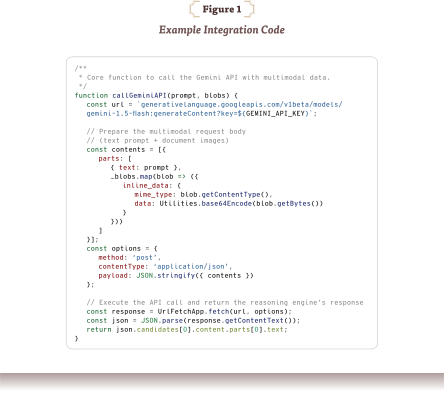
While this article is written for administrators rather than developers, it is useful to briefly illustrate how little code is required to connect institutional data to a large language model. The Google Apps Script function shown in Figure 1 represents the core logic that bridges applicant documents stored in Google Drive with the Gemini reasoning engine.
This function demonstrates how institutional rules (encoded in the prompt) and applicant documents (passed as image or PDF data) are combined into a single request. The output is a structured textual response that can be further parsed and summarized for administrative review.
Key Technical Takeaways (for Administrators)
- Multimodal Input: Documents are converted into encoded binary objects, allowing the AI to analyze visual elements such as stamps, signatures, and transcript layouts—capabilities
that go beyond traditional text-only OCR workflows.
- Standard Infrastructure: The function relies entirely on native Google Apps Script services, requiring no external servers, custom security configurations, or additional software beyond an institutional API key.
- Structured Output for Workflow Integration: The AI returns a predictable text response that is subsequently interpreted by summary and classification logic. This ensures that AI output feeds directly into existing spreadsheets and committee review processes.
It is worth noting that functions such as this can themselves be drafted, refined, and documented through careful prompting of large language models. In this sense, AI not only supports administrative workflows but also lowers the barrier for administrators to prototype and maintain their own automation logic.
Case Study: High-Speed Faculty Recruitment at a Public University
Institutional Context
A public sector university in Sindh province of Pakistan is operating under resource constraints common to many universities worldwide. During a recent lecturer recruitment cycle, the university received a high volume of applications, each consisting of multiple documents: curriculum vitae, academic transcripts, degree certificates, and supporting credentials.
Institutional policy required that each application be screened against clearly defined eligibility criteria before being forwarded to statutory selection committees. Traditionally, this screening was conducted manually by administrative staff, who reviewed documents line by line to verify degree equivalence, minimum qualifications, and required experience.
The Bottleneck
While application volume alone posed a challenge, the most persistent bottleneck emerged in the evaluation of international credentials. Applications included degrees from Chinese universities using GPA-based systems, a Belgian Ph.D. assessed on a pass-with-distinction basis (for example, grande distinction for scores above 80 percent on a 0–20 scale), and German master’s degrees graded on an inverted 1.0–5.0 scale.
Local policy required equivalence to a “first class” master’s degree—defined domestically as 60 percent or above overall—along with verification through an equivalence certificate issued by Pakistan’s Higher Education Commission (HEC) for all foreign qualifications. Manually interpreting these varied grading systems, confirming scale conversions, and checking for required equivalence documentation significantly slowed the screening process and increased the risk of inconsistent judgments across files.
The Intervention
Rather than altering evaluation standards or committee authority, the intervention focused on how eligibility checks were performed. The approach aligns with what campus technology leaders describe as a prudent entry point for AI adoption: starting with routine, document-heavy, and rule-based processes rather than high-risk instructional or evaluative uses. In the Chronicle survey, respondents reported early AI use in administrative areas such as document processing and applicant screening—functions closely analogous to preliminary eligibility scrutiny in recruitment and admissions.
A lightweight workflow was created using tools already in institutional use:
- Google Forms for application intake
- Google Sheets as the central processing and review interface
- Google Drive for document storage
- Google Apps Script to connect the workflow
- Google Gemini LLM to read and structure document content
When an application was submitted, applicant data and document text were programmatically passed to the LLM. A carefully designed prompt instructed the model to evaluate the applicant strictly against the university’s published eligibility criteria and to return a structured summary indicating whether requirements were met or missing.
Results
The impact was immediate and measurable. Processing time for preliminary screening was reduced from weeks to hours. Committees received organized, standardized eligibility summaries rather than unstructured document bundles. Most importantly, the rigor and integrity of the evaluation process were preserved: every final decision remained firmly in human hands.
The innovation lay not in changing policy, but in accelerating policy execution.
The Zero-Budget SEM Stack: Anatomy of a Zero-Budget Automation
To move from manual review to AI-assisted screening, the institutional “stack” relies on three interconnected layers: the data environment, the automation bridge, and the reasoning engine. Framed this way, the system is less a piece of software than a controlled workflow that applies institutional logic at scale.
The Stack and Services
The solution is built entirely within the Google Workspace ecosystem, requiring no new software procurement or vendor contracts. It relies on tools already familiar to most university administrators:
- Google Sheets and Google Forms serve as both the database and the user interface. Each row in the spreadsheet represents an applicant and provides a live dashboard for review.
- Google Apps Script acts as the automation layer—the “glue” that moves data between the spreadsheet, document storage, and the AI service.
- Google Drive (via its API) enables the script to programmatically access uploaded
PDFs and images associated with each application.
- Gemini 1.5 (Flash or Pro) API functions as the reasoning engine, capable of multimodal analysis of documents and application of institution-defined rules.
Together, these components form a coherent administrative stack that operates entirely within the institution’s existing cloud environment.
The Workflow: From Blob to Insight
For each applicant, the script follows a disciplined, repeatable sequence designed to mirror—and accelerate—traditional screening practices:
- File Retrieval: The script identifies the document links submitted through the application form, retrieves each file from Google Drive, and converts it into a binary object that can be processed by the AI.
- Multimodal Analysis: Instead of relying solely on traditional optical character recognition (OCR), the workflow sends the actual document images to the Gemini API. This enables the model to analyze complex transcript layouts, seals, stamps, signatures, and other visual indicators often critical in credential evaluation.
- Policy-Encoded Prompting: The instructions sent to the AI are not generic. They explicitly encode institutional rules—such as required degree titles, completion dates, age limits, and mandatory attachments (for example, proof of fee payment). In effect, the prompt functions as a written version of the institution’s screening checklist.
- Structured Output: To ensure usability and consistency, the script requires the AI to return results in a predefined structure. Eligibility findings and missing items are separated into clearly labeled fields, allowing staff to review outcomes quickly and confidently.
Human-in-the-Loop Logic
A critical design feature of the workflow is its summary and categorization logic. Rather than allowing the AI to generate long, narrative responses, the script applies keyword-based rules to translate AI findings into three administrative statuses:
- Eligible: Fully meets all defined criteria.
- Potentially Eligible: Meets core requirements but requires confirmation or submission of a specific document.
- Not Eligible: Fails a non-negotiable requirement, such as age limits or incomplete submission.
This structured classification mirrors existing administrative practice and ensures that human reviewers remain the final arbiters of eligibility.
Security and Administrative Control
From a governance perspective, the workflow remains firmly under institutional control. A dedicated API key, role-based Google Drive permissions, and built-in duplicate-check logic ensure that:
- Applicant data is processed only once
- Unnecessary API usage (and cost) is avoided
- The spreadsheet remains a single source of truth for committees and administrators
Because all processing occurs within the university’s cloud environment, the institution retains ownership, oversight, and auditability of the entire process.
From Faculty Recruitment to SEM: Transferability Across Admissions and Registrar Functions
The faculty recruitment workflow described above is not unique to human resources. Its underlying logic—high-volume intake, document-heavy evaluation, rule-based screening, and human adjudication—mirrors core processes in SEM.
This alignment is reflected in national perceptions of AI’s likely impact. While teaching is expected to experience the most visible effects of generative AI, the Chronicle research brief reported that 11 percent of technology leaders identified admissions as the operational area most likely to be affected over the next five years, with additional respondents pointing to registrar functions and retention as emerging use cases. These findings place enrollment management squarely within the category of data-driven administrative processes where AI-assisted workflows are most likely to deliver early value.
Admissions Screening: From Sorting to Strategizing
Admissions offices routinely process thousands of applications that must first be validated against basic requirements: completion of prerequisite coursework, minimum grade thresholds, standardized test scores (where applicable), and submission of required documents. Traditionally, this work is clerical and repetitive, yet it consumes substantial staff time before higher-order review can begin.
By adapting the same LLM-enabled workflow, admissions staff can automate the initial checklist phase. Application data and uploaded materials can be passed to the LLM with prompts aligned to institutional admissions policies. The model returns a structured summary indicating which requirements are met, which are missing, and which fall into discretionary or borderline categories.
The practical impact is a shift in staff effort. Rather than sorting applications into piles, admissions professionals can focus on interpretation, outreach, and yield strategy. Applicants who clearly meet requirements move forward quickly, while those requiring special consideration are flagged early for human review.
Transcript and Credential Evaluation
Transcript evaluation—particularly for international or nontraditional applicants—represents one of the most resource-intensive registrar functions. Variations in grading systems, course nomenclature, and credential formats require careful reading and consistent application of equivalency rules.
Within the zero-budget SEM stack, the LLM serves as a document interpreter rather than an evaluator. Transcripts are converted to text and analyzed against predefined equivalency rules supplied in the prompt. The output is a concise summary of coursework, grades, and potential matches to institutional requirements.
Importantly, the registrar retains final authority. The AI-generated summary accelerates review but does not replace professional judgment. In practice, this approach reduces time spent extracting information and increases time available for resolving complex or ambiguous cases.
Registrar Operations and SEM Integration
Beyond admissions decisions, the same architecture supports downstream registrar functions central to SEM, including transfer credit articulation, prerequisite verification for course registration, and degree audit preparation.
Because the workflow is built on common productivity tools, outputs can be easily shared across offices. Admissions, advising, and registrar staff can work from a single, structured view of applicant or student data, improving coordination and reducing duplication of effort.
Ethics, Governance, and the Human-in-the-Loop Model
Any discussion of AI in enrollment and academic administration must address ethical use, transparency, and governance. The zero-budget SEM stack is explicitly designed around a human-in-the-loop model that preserves institutional accountability.
Concerns expressed by campus technology leaders reinforce this cautious design. In the Chronicle survey, nearly half of respondents identified cybersecurity as the primary risk associated with generative AI adoption, followed by concerns related to student learning and academic integrity. These findings underscore the importance of keeping AI use bounded, auditable, and embedded within institution-controlled environments rather than external platforms.
Data governance and privacy considerations require particular attention for U.S. institutions. While the case study presented here is situated in Pakistan—where FERPA does not apply—the technical architecture was intentionally designed to mirror governance standards familiar to AACRAO member institutions. Specifically, the workflow relies on an institutional Google Workspace environment and the Gemini API, rather than consumer-facing generative AI tools. Under enterprise API terms, content submitted through authenticated API calls remains under institutional control and is not used to train underlying models, a distinction that is critical for registrars and compliance officers.
This distinction matters because governance risks are often less about the presence of AI than about where and how it is used. Consumer AI interfaces frequently obscure data retention, reuse, and ownership practices. By contrast, API-based integrations allow institutions to extend existing FERPA-aligned controls—such as role-based access permissions, audit logs, and retention policies—into AI-assisted workflows. In this model, AI does not introduce a parallel data ecosystem; it operates within the same governance framework that already regulates student and applicant records.
In this model, AI performs reading and structuring tasks, not decision-making. It handles routine extraction and comparison work, allowing staff to focus on relational, contextual, and judgment-intensive responsibilities. Final authority remains with academic and administrative committees, who review AI-generated summaries rather than delegating judgment to the system itself.
Maintaining human oversight also requires acknowledging the cognitive risks associated with decision-support technologies. Emerging research on generative AI use in professional settings suggests that over-reliance on machine-generated summaries may reduce active engagement, recall, and independent judgment over time. For this reason, effective human-in-the-loop design must include not only review authority, but intentional practices that preserve professional attention and expertise.
In practical terms, this workflow incorporates periodic manual audits and randomized double-checks, where staff review original application materials alongside AI-generated summaries. These practices mirror long-standing administrative quality-control techniques and help ensure that AI functions as an aid to judgment rather than a substitute for it. By formalizing such safeguards, institutions can retain the efficiency gains of AI-assisted screening while protecting against cognitive complacency and erosion of professional skill.
Conclusion: From Technology Consumers to Institutional Builders
The experience of implementing a low-cost, AI-assisted screening workflow at a public sector university in Sindh province of Pakistan illustrates a broader lesson for higher education. Meaningful AI adoption does not require large budgets or enterprise platforms. It requires clarity of policy, willingness to experiment, and investment in staff capability.
National evidence suggests that many institutions are still searching for practical entry points into AI use. If, as the Chronicle research indicates, most campuses remain cautious due to budget and governance concerns, then targeted, zero-budget workflows offer a viable path forward. By applying AI to routine, document-intensive processes that technology leaders already recognize as ripe for improvement, institutions can begin building internal capacity without overextending resources. In this case, the most consequential investment was not financial but developmental: time spent by a management officer learning to translate institutional policy into executable logic using familiar, low-cost tools. As institutions adopt these tools, equal attention must be paid to preserving professional judgment, through practices such as periodic manual review and randomized double-checks that ensure efficiency gains do not come at the expense of staff expertise or engagement.
The call to action for registrars and enrollment leaders is therefore straightforward: rather than waiting for comprehensive enterprise solutions, identify one process where policy is clear, data is structured, and human oversight is essential. In doing so, administrators can move from being consumers of technology to builders of systems that reflect their institutional values.
Recommendations for Implementation
Rather than framing AI adoption as a software procurement decision, this case study suggests that institutions should treat administrative AI capacity as a professional development issue. The most effective investment in this workflow was not financial, but educational: targeted upskilling of a management officer through short, low-cost online courses in data analytics, cloud tools, and applied AI. These learning opportunities—many of which are already subsidized through government, consortial, or vendor-supported programs—enabled the translation of institutional policy into executable logic without reliance on external vendors or IT development teams.
For registrars and enrollment leaders, a practical implementation strategy is therefore incremental. Institutions can begin by identifying one document-intensive, rule-based process; ensuring policies are clearly articulated; and designating a small number of administrators to experiment with low-code or no-code automation using tools already embedded in institutional workflows. This approach minimizes financial risk while building durable internal capacity.
Lessons for Peer Institutions
Three lessons from this experience may be particularly relevant for similarly resourced institutions. First, complexity does not require complexity in tooling. Even highly nuanced tasks—such as international credential evaluation or eligibility screening—can be operationalized using everyday productivity platforms when institutional rules are explicit. Second, human oversight scales better when routine work is structured. Committees made better and faster decisions when presented with standardized summaries rather than unprocessed document bundles. Third, AI adoption is most sustainable when it strengthens, rather than bypasses, existing governance structures. By embedding AI within familiar systems and approval pathways, the workflow reinforced trust rather than disrupting it.
These lessons suggest that smaller public institutions are not disadvantaged in the AI transition. In many cases, their reliance on standardized processes and clear policy frameworks may position them to adopt lightweight, auditable AI workflows more effectively than institutions pursuing large, centralized platforms.
Calls to Action
For registrars, admissions leaders, and enrollment managers, the immediate call to action is not to acquire new technology, but to reassess existing processes through an execution lens. Identify one workflow where policy is clear, data is structured, and review is repetitive. Pilot a small, human-governed AI assist using existing tools. Document the results. Adjust the prompts. Involve committees early.
Equally important is investing in people. Encouraging administrative staff to develop foundational AI literacy—through professional learning rather than technical specialization—offers a scalable and equitable path forward. As institutions adopt these tools, intentional safeguards such as periodic manual audits and randomized double-checks should be formalized to preserve professional judgment. Taken together, these steps allow institutions to move from being consumers of enterprise technology to builders of systems that reflect their academic values and operational realities.


share