

An Unlikely Path to Academic Leadership
Tremblay: Welcome to this conversation, Joe. Tell us a little bit about yourself, your current role, your responsibilities, where you’re at, and what you do.
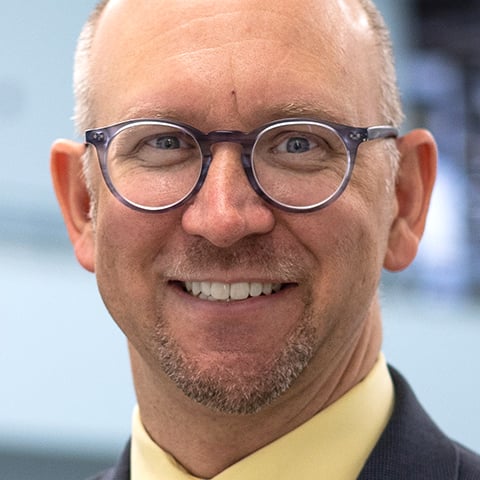
Paris: I am the Dean of the School of Graduate and Professional Studies at Delaware Valley University in Doylestown, Pennsylvania, located outside of Philadelphia. In that role, I’m responsible for all of the academic programs at the graduate level including master’s and doctoral degrees, and more than 20 graduate certificate programs, but also the continuing and professional studies area of the university as well, which includes dual enrollment at the high school level for college credit, to a lifelong learning program for retirees and semi-retirees who have an interest in personal enrichment and building community and engaging and learning. And I’ve done everything in between, from summer camps and youth programs to career training and workforce development, summer courses for undergraduates, and courses for visiting undergraduates from other colleges and universities who live in the area.
I also serve as my university's Accreditation Liaison Officer and find myself on a number of university-wide committees. One is the AI task force. I’ve been heavily involved in helping the university establish guidelines, both for students, but also for faculty and staff, for their use of AI. I also chair the Institutional Assessment Advisory Committee. That is our institutional peer review of assessment plans. Every unit on campus, both academic programs and administrative units, have to assess their effectiveness. On the administrative side, we have objectives for each of our units and they have objectives that they need to complete that map onto the strategic plan of the institution and the mission of the broader university. And so units assess the effectiveness of the work that they do.
Tremblay: Thank you for that comprehensive overview. Give us some insight about your current college, Delaware Valley University.
Paris: DelVal is a comprehensive university located outside of Philadelphia. We are known for our agricultural roots and our experiential learning mission. We started as a farm school back in 1896, but today we’re a comprehensive university with a doctoral program, business programs, digital media and communications, etc. but we still are known for our strength in the animal, environmental and agricultural sciences. Our mission underscores science with practice. So blending scientific methods in each of those respective disciplines with how they’re actually applied in the field.
Tremblay: Very interesting. The other thing I want to go back to is you mentioned about the university-wide committee working on AI, artificial intelligence. What are some of the hot topics that you are chatting about? I’m curious.
Paris: The most obvious one is: how should students be using it? To what extent are faculty comfortable supporting students’ use of AI? We polled our faculty using a very simple rudimentary gauge (green light, yellow light, red light) to reflect how comfortable they feel allowing AI’s use in their courses. Unsurprisingly, there was hesitation. I think that is why guidelines are so necessary, but there’s still so much uncertainty and AI is evolving so fast.
Tremblay: So speaking of that, let’s talk a little bit about your thoughts on artificial intelligence (AI) in enrollment management. Where do you see it fitting? Where do you think the challenges are going to be?
Paris: There’s this oxymoron in enrollment management: “mass customization” or customizing and personalizing at scale. That’s one of the benefits of AI in enrollment management: the ability to personalize at a greater scale. We know more now than ever before about prospective students. They are expecting very personalized types of information at very specific points during their decision-making process; that’s really difficult to do at scale. AI allows enrollment managers to be able to leverage the data that we have, and then tailor our communication, messaging, and outreach to students at the right moment in time. There are also some drawbacks to AI in enrollment management. For example, AI dehumanizes an inherently human process.
For me, I was trained in admissions with a counseling philosophy as opposed to admissions serving as a sales or purely recruitment focus. I’ve always held that admissions counseling, by its very nature, is a human-to-human process. Are we dehumanizing what has been historically such a human-centered process?
The idea “admissions counseling” is a process of helping students find their pathway and make an informed decision for arguably one of the most important decisions that an individual may make at that point in their lives. And so we’re taking the human element out of that for the purpose of efficiency; does that sit right? That’s certainly a question that could be widely debated. I think it’s an interesting question for the field of enrollment management to grapple with.
Tremblay: Thank you for those insights on AI and counseling. Let’s go back to your high school days since you brought that up. What was your college search and application process like?
Paris: I have a learning disability and I struggled immensely during my time in high school. You may be surprised to know that I graduated in the bottom fifteen students of my graduating class in high school, with a 2.1 high school GPA. I say this very candidly and openly because it’s part of my journey.
I was admitted to Fairleigh Dickinson University (FDU) through its learning disability program, which is renowned for supporting college students with learning disabilities. I was fortunate to have parents who were informed about college and they were very encouraging. We visited campuses and we got a feel for what the admissions process would be like. I met with an admissions counselor at FDU, and I think it was that conversation that afforded me an opportunity to go to college. On paper, you’d likely “see” an applicant who would struggle and not be prepared for success in college.
I wasn’t the most exceptional college student as an undergraduate, but because of the support and my personal development, I was able to be successful. It also was when my journey to working in higher education began. During my sophomore year I went to my resident assistant and said, “How can I get an on campus job?” She said, “Well, it so happens that I’m the lead student ambassador on campus and you’re going to come join my team.” And I said, “No, no, no. I think I’m looking for a position where I could check people into, like the ‘rec center’ or the student center.” And she said, “Nope. You’re going to become one of our campus tour guides.”
And so I joined the tour guide program in sophomore year. And with that, I began to understand the kinds of decisions families were confronted with when they were making a decision about college and where to enroll. It was also between my sophomore and junior year summer when I was asked if I wanted to stay for the summer to lead campus tours, but also to work in the undergraduate admissions office. That was a very instrumental summer for me. I took a summer course to keep on track, which helped with my progress academically, but also I got that firsthand view into what admissions is like and led tours to families from all over the country. On a side note, my girlfriend at the time (now my wife) was also a tour guide and that’s how we met.
I worked closely with the undergraduate admissions team. By my senior year, my director asked how my career search was going, recognizing that graduation was a couple months away. At the time, I had been looking for jobs in the food and beverage industry. I liked that Snapple had the little messages under the lid and how that served as a product differentiator, but ultimately I decided that the food and beverage industry was not for me.
My director said, “I want you to consider joining our admissions team full-time.” There was an opening, so I joined the undergrad admissions team at Fairleigh Dickinson and became an undergraduate admissions counselor.
I worked for five years and completed my master’s degree in business administration at Fairleigh Dickinson. I was then confronted with an opportunity to diversify my higher education background. So I joined Temple University as Director of Enrollment Management and Marketing in the College of Education and Human Development. I later became Assistant Dean of the College.
I worked at Temple for eleven years and completed my Doctor of Education in Higher Education there. The day of my dissertation defense, my committee asked me, “Have you ever thought about becoming a faculty member?” At Temple I was a full-time administrator and a part-time doctoral student; never once had I considered becoming a full-time faculty member. Every so often for the next year, they would ask me that question.
Eventually they had an emergency opening for a full-time faculty member in the higher education program. So they tapped me to do that. I joined the faculty full-time. In my second year as a full-time faculty member my administrative background came calling right away, and I became the associate program director in my second year as a faculty member, and then the full program director in my third year as a full-time faculty member leading the higher ed program at Temple including two doctoral programs, a master’s program, several graduate certificates, and an undergraduate general education course.
After eleven years of working specifically in a college of education I realized that in order for me to continue on my academic leadership trajectory, I needed experience working with a variety of academic disciplines and programs. So that led me to West Chester University, another public research university, and the largest university that is part of the Pennsylvania State System of Higher Education (PASSHE) system.
So I led all of graduate enrollment there including programs in business, health sciences, music, etc. That was an opportunity to step outside of a college of education, and work with a variety of disciplines, program directors, and deans. I managed enrollment for more than 80 graduate programs at West Chester across the entire university.
Tremblay: Wow, what a career path. Let’s switch gears. You recently co-edited the first book on graduate enrollment management. So how did that project come to be and what prompted it?
Paris: NAGAP (The Association for Graduate Enrollment Management) initiated the project. NAGAP had an editor selected before me, and COVID happened, and things obviously got delayed. At the time, I had submitted a chapter to the book under the prior editor, and eventually he said, “What do you think about becoming the new editor?” And I said, “I’ve never edited a book before.” And he said, “Would it make you feel any different if Stanley Kania joined you as co-editor?” Now, Stanley was somebody that I knew very well through NAGAP. He became a really good friend. Stanley was someone I could partner with and someone whom I really respected.
It so happened that soon after becoming co-editor Stan joined my team at Temple. And so not only were we co-editing a book, but we were also working together. Stan and I would ride the train to Philadelphia every day. So I told him, “You have the longest workday because you ride an extra hour each way with me and we talked shop, we talked about life and we talked about the book and everything else in between.”
We did a pretty hard reset on the book project including issuing a new call for proposals. And we also had to do a lot of calibration and accuracy checks because of the pandemic and the subsequent U.S. Supreme Court ruling on affirmative action in admissions. We needed to ensure the book was accurate given the changing landscape.
When selecting chapters, we were really intentional about topical coverage as well as to include a wide range of authors who represent a broad landscape of higher education. While we wanted broad topic coverage and institutional representation, we recognized that we couldn’t do it all in one book, so there’s certainly still topical gaps that require another edition one day.
Tremblay: Thank you for bringing that book to fruition. What advice would you give to rising professionals in the field?
Paris: Do not be hesitant to reach out to scholars in the field, whether that’s on LinkedIn or through their email address and ask them, are there projects that you’re currently working on that I might be able to get involved with? Do you have a research group that I might be able to potentially join?
Of course, if someone’s interested in research and they don’t have a doctorate degree, I encourage them to think about enrolling in a doctoral program as a way of getting involved with graduate education and research. A doctoral program should offer a learning environment and the support of faculty and classmates so you can learn about the research process and how to blend research with practice.
Also consider professional organizations and associations—do they have research committees that you can join or research directors you can reach out to? I think about Wendy Kilgore (AACRAO Research Director) as a great example. She’s always willing to talk to someone about how they can get started with research or how they might be able to take the research that AACRAO conducts and apply it back on their campuses and have informed conversations about what research findings mean for practice.
There’s also a lot of institutional research opportunities. In fact, my dissertation topic came about after a conversation with the VP of institutional effectiveness at Temple. She said, “You know, we’re sitting on this pile of data about our new test optional policy. If only we could get to the data and really analyze it and determine how it’s working and how it is expanding access to the university?”
And I said, “Well, that sounds like a good dissertation topic. Count me in.” She really became the sponsor and champion of my dissertation project. While she wasn’t on my dissertation committee, she and the director of institutional research met with me throughout the development of my dissertation research. I share this example because institutions have a wealth of data and rarely the bandwidth to do as much as they wish with it.
Tremblay: When you think back to either the early part of your career or currently in your career, who are the scholars in the field that you admire and why?
Paris: The very first scholar that comes to mind for me is Don Hossler. To me, he is one of the most influential scholar-practitioners in the field. I aspired for the book that I edited to have the type of impact the Handbook of Strategic Enrollment Management has had in undergraduate enrollment management. I’ve also always been impressed by the research Robert Kelchen has conducted. I appreciate Kelchen’s work on institutional finance in particular, because for me, a lot of my recent work brings together enrollment management and institutional finance.
Robert Kelchen has been really instrumental in that particular space. John Braxton, who I’ve come to know a bit too, we’ve been in touch over the years, has been really impressive to me. And David Kalsbeek is a tremendous scholar-practitioner who I’ve gotten to meet. He wrote an endorsement of the book. Julie Posselt, who wrote the foreword in the book that I co-edited—she’s done amazing work on graduate education and access to STEM, access to doctoral programs, and student success in doctoral and STEM-related graduate programs. Julie is also an incredible scholar in this space. Those are some shout-outs to scholars who I’ve always looked up to.
Tremblay: I value the work of those scholars and practitioners as well. Time for a more light-hearted question. What’s your favorite spot on the Delaware Valley University campus?
Paris: Lake Archer for me. And there’s a lot of beautiful places on campus, a lot of really great places to quiet little escapes. For me, Lake Archer is one of those. Right behind the building where I work on campus (Lasker Hall), there’s this beautiful lake, there’s a trail you can use to walk around the lake. I don’t get to Lake Archer nearly enough, but every day if you’re quiet and I’m walking out to my car after a long day, I can actually hear the water…The sound reminds me of the fact that we’re privileged to work on this historic beautiful campus that’s so deeply connected to nature.
Tremblay: Lake Archer sounds like a special place. If you could have a magic eight-ball give you the answer to something that you are challenged in trying to solve either on your campus or you think the field could benefit from, what would that be?
Paris: Resources—the lack thereof in most cases. I’ll be the first person to admit this on my campus, and have said it publicly many times, the most important student population for me is our undergraduates. They generate the majority of the revenue for the institution. They represent by far the largest student population. And with that said, I understand and fully support the notion that there should be more resources dedicated to our undergraduate students compared to our graduate students. However, at the same time, there has to be the appropriate balance. One of the challenges is having enough budgetary resources and personnel to meet enrollment goals across every academic program, not just those that are in high demand.
At DelVal, we have some graduate programs with very robust enrollments, and we have graduate programs for which we are focused on enrollment and revenue growth. For me, it’s about making sure that every program has healthy enrollment and revenue streams, not just the select few or the ones that have very significant demand, that I could populate five times over with highly qualified and very likely successful students if I could.
Tremblay: I agree with you 100 percent about resources! Is there one final thing that you’d like readers to know about you that we haven’t talked about?
Paris: Two things come to mind that are completely unrelated to higher ed. One is that I’ve visited more than 130 breweries around the world and co-authored a research article on why people are motivated to attend craft beer events (think beer festivals).
Tremblay: 130 breweries! I love it. Joe, this has been a fantastic conversation. Thank you so much for your time, your insights, and for letting us peek behind the curtain at you and your work.

share