

Fraud, unfortunately, can be found infiltrating every aspect of education, with examples from essay mills, which enable students to misrepresent their writing skills, to diploma mills and accreditation mills that give fake schools a deceptive air of legitimacy. There are also reference houses that provide false educational and employment references, as well as “ghost students” created through identity fraud to steal financial aid. This article is centered on the world of educational credential fraud, encompassing both domestic and international study.
Diploma Mills and Accreditation Mills
Known as a billion-dollar industry, one diploma mill alone can earn between $10 and $20 million a year (Bear 2021). Diploma mills are fake schools that have no degree-granting authority in any location or country. Yet they are able to make plausible claims, often by saying they are online schools and by asserting recognition from what is otherwise an accreditation mill, or fake accrediting body.
These schools lure customers in, stating that they can be awarded an academic credential with little to no study, due to their life experience. Sadly, diploma mills continue to thrive, thanks to the internet, which allows them to remain elusive and difficult to catch. For example, there are many diploma mills operating in the United States or pretending to be located in the United States, as degrees here are popularly sought by students around the world. Loopholes in U.S. law and the separation of federal and state regulation enable these businesses to persist with little consequence (AACRAO 2021; Cohen and Winch 2011).
Deception is also easy when accreditation and degree-granting authority in the United States are confused. Degree-granting authority is most commonly conferred by the state, whereas accreditation, a quality assurance process, is entirely voluntary. Accreditation can be at the institutional, national, and programmatic levels, further fueling public misunderstanding. It is even more challenging to determine the recognition status of educational institutions outside the United States, as there is usually unfamiliarity with regulatory frameworks abroad. These all create the ideal environment for diploma mills to operate.
Fraudulent Evaluation Agencies
There are many contexts for which candidates must demonstrate that they meet certain requirements, ranging from university admission and transfer credit to professional licensure, employment, and immigration. As such, credential evaluation work, when conducted for educational purposes, may be performed in admissions offices and registrar’s offices, or it may be outsourced to evaluation agencies. Credential evaluation reports reflect the assessment of transcripts, certificates, and/or examination results of studies completed abroad.
Just as diploma mills make use of accreditation mills to create an appearance of legitimacy, they can also use fake evaluation agencies to establish a false sense of credibility for the credentials they issue. In most other countries, credential evaluation services are centralized under the government. However, since the U.S. government disbanded its evaluation service in the late 1960s, credential evaluation became decentralized in the United States. The work is performed by numerous private agencies without government oversight. So, the public must rely on associations such as the National Association of Credential Evaluation Services (NACES) and the Association of International Credential Evaluations (AICE) to determine the likelihood of an agency’s reliability. Fake evaluation agencies have also become part of the con, compromising the work of evaluation providers who do their due diligence and offer legitimate services (Popovski 2021).
Fraudulent Academic Records
Educational credentials are represented by such artifacts as transcripts, diplomas, and examination certificates. These records are experiencing a period of transformation, as many institutions make a switch from paper documents to digital and electronic documents, such as PDFs and machine-readable data. The COVID-19 pandemic accelerated the pace of this change; however, it is progressing at varying rates at different educational institutions and countries. Historically, credential evaluators detected fraud by ensuring that paper documents had the appropriate information, seals, and signatures. To be able to detect fraud today, admissions officers, registrars, and credential evaluators must now also understand the various forms and delivery methods of digital records, their availability across countries, and their valid issuers, as this function is often relegated to an external vendor by the educational institution.
Just as credentials issued by diploma mills constitute one category of fraud, fake academic records form another: these fake credentials may hijack the legitimacy of an unsuspecting, valid institution of study. Fraudulent academic records can also come in various forms. For example, the information on existing, legitimate credentials may be altered, such as the name, grades, or area of study. Alternatively, fraudulent credentials may be fabricated entirely from scratch, purporting to be awarded by valid educational institutions. The arrival of generative AI tools has exacerbated this problem, allowing for the effortless creation of deepfakes or hyper-realistic academic credentials. There are even fake QR codes and online verification sites that credential evaluators must be cautious of.
In response, there are also AI-enabled tools emerging to help combat and detect fraud. Examples include software programs that analyze application patterns and identify anomalies, as well as those that specialize in image forensics. For instance, they will assess PDF metadata to reveal timestamps and edits, as well as differences in pixel density and sudden changes in color gradients. Each of these is a potential marker of fraud.
These examples of AI being used, in some cases, to commit fraud and, in others, to combat it reveal the arms race that is unfolding in this field. There is no one technology that can guarantee the determination of fraud, illustrating the need for a human-in-the-loop approach to credential evaluation and a series of robust, defensive checkpoints. The work of technology and humans must complement each other, integrating both the ability to analyze patterns as well as a high level of understanding of world educational systems. Resources and training in educational systems can be found from AACRAO and TAICEP, The Association for International Credential Evaluation Professionals. AACRAO, for instance, provides on-demand online training modules and in-person workshops in credential evaluation, as well as publications on fraud. TAICEP offers its certificate program in credential evaluation and an extensive wiki or knowledge base, including its digital credential providers hub, which helps evaluators navigate issuers of digital records by country of study.
Falsified Evaluation Reports
It will come as no surprise that, if legitimate academic records can be distorted and falsified, so too can the credential evaluation reports of legitimate agencies. Past instances were discovered when institutional recipients who are frequent users of a provider detected report aberrations and followed up for verification. Examples include inconsistencies in font, paper type, and logos, similar in fashion to how fraudulent academic records are detected. In one instance, 500 falsified reports for barbering and cosmetology licensure were uncovered. That particular state board requires that all application materials be submitted together by the candidate. It eventually came to light that these fictitious reports were created from the basis of one legitimate report.
The audacity of falsifying 500 reports, meant to validate candidates’ education and training, highlights how fraud has infiltrated every aspect of education. Instances such as these formed the impetus for agencies to meet and discuss how the integrity of evaluation reports can be protected. Such a meeting took place over breakfast during the 2022 conference of the Groningen Declaration Network (GDN), an organization that is devoted to supporting student data portability and student mobility and was celebrating its tenth anniversary at the time. This meeting subsequently led to the formation of the Working Group on the Digital Delivery of Credential Evaluations (WGDDCE).
One of the first actions the member agencies took, in 2023, was to release a position paper highlighting the importance of protecting student data. For data security purposes, credential evaluation reports should be treated similarly to transcripts. Not only should colleges and universities move away from accepting paper reports and photocopies from students, but such institutions should take the further step of requiring that evaluations be sent directly by the respective agencies. In this way, opportunities for tampering are substantially minimized (WGDDCE 2023). Andrew Hannah, the senior associate registrar of the University of Chicago, once stressed, “Paper transcripts are an invitation to fraud” (COE 2023, 68). Credential evaluation reports should be part of the digital evolution and transformation of transcripts. However, such a move would also require that colleges and universities who are the recipients accept these new realities and adopt new approaches.
Combating Credential Fraud
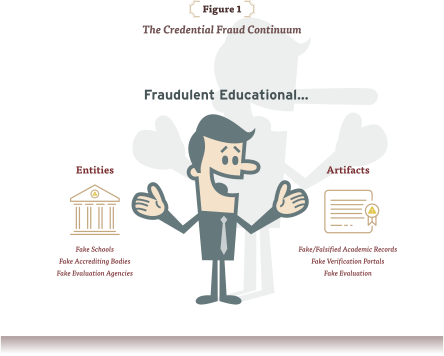
When considering the credential fraud continuum, there exist two parallel strains—(1) fraudulent entities, such as diploma mills, accreditation mills, and fake evaluation agencies, and (2) fraudulent artifacts, such as fake and falsified academic records, fake online verification portals, and fake and falsified evaluation reports (see Figure 1). The most effective defense is the creation of an ecosystem that eliminates opportunities for tampering and fraud. However, such a system would require extensive cooperation and resources.
To create such a system, recognition bodies could regularly issue publicly available lists of approved and unapproved institutions of study. Archived versions would also be accessible, so that information regarding any withdrawn or expired approvals would be easily available as well. In this regard, a searchable and regularly maintained database would be ideal.
Awarding bodies could then issue verifiable digital credentials, and evaluation agencies would issue reports in a similar form as well. Verifiable digital credentials are cryptographically secure, tamper-proof credentials that also enable immediate verification. Receiving institutions, in turn, would require and accept only digital records, either issued from the digital wallet, or directly from the primary source. Issuing bodies could also cooperate and promptly respond to verification requests through officially publicly available means. Knowledge would be shared by all stakeholders, at conferences, on listservs, and in publications.
Until such an ecosystem is fully implemented, combating fraud will require the combined efforts of humans and technology, casting a wide net to catch fraudsters and creating a series of checkpoints. These include analyzing patterns within and across applications, including but not limited to checking:
- Biodata
- The recognition status of the school by the appropriate body
- Document features that exhibit evidence of tampering
- Inconsistencies in educational system features (e.g., incorrect formatting, terminology, grading scale…)
This strategy applies to both physical and digital records of study.
With AI’s emergence and disruption in the field, it will also be important for those who do evaluation work to become AI literate. A number of organizations are addressing the critical need in some way. TAICEP recently formed the Committee for Digitalization and Artificial Intelligence to provide guidance and resources, and AACRAO’s International Education Standards Council’s (IESC) 2025–26 fellows conducted a research project and environmental scan of AI. The Council of Europe also recently launched a three-year project on AI and the recognition of qualifications, looking at how AI can support evaluation work while also assessing its impact from a human rights perspective.
Fraud is not new, but the ways that fraudsters can cheat the system have become more diverse and more convincing. It is now easier than ever to create fraudulent artifacts and to simulate fraudulent entities. The global educational community can rise to meet this growing challenge by building a new, more secure system. As recognition bodies, awarding bodies, receiving institutions, and credential evaluators collaborate to create this defensive ecosystem, we can take immediate steps by enhancing AI literacy, combining the power of emerging AI tools with human expertise, and creating multiple layers of security.


share