

Enrollments of students from low-income families and communities are on the rise (Kavaal 2024; Taylor and Turk n.d.). In January 2025, the National Student Clearinghouse Research Center reported that in 2024 enrollment in college from the lowest-income localities grew by 7.3 percent (NRCHRC 2025). As more students from low-income families and communities enroll in college, higher education leaders increasingly recognize the need for additional services such as academic advising, mentoring, counseling, and career development to support comprehensive success for admitted students, beyond financial aid (Christensen, Grunden, and Walters 2024). However, research demonstrates that most universities lack effective integrated and comprehensive approaches to address the unique needs of college students from historically marginalized backgrounds (Kezar and Kitchen 2020). Although enrollment, retention, and graduation formularies are important for administration, recent enrollment management scholarship affirms the critical need for human connection, understanding, support, and care to actualize and maximize the promise of higher education opportunities (Cheng 2004; Henderson and Pollock 2021; Secore 2018).
Emerging research on success reveals that the most effective university enrollment efforts aimed at low-income students address financial, social, and academic barriers in an integrated manner (Kezar and Kitchen 2020). To this end, colleges and universities might consider increasing coordination and collaboration between financial aid, admissions, academic affairs, and student affairs teams to enroll, support, and retain students (Christensen, Grunden, and Walters 2024). Furthermore, universities have been called upon in recent years to demonstrate an ethos and practice of care both to better serve students and to advance positive outcomes (Dall’Alba 2024). This is especially important for low-income and other historically marginalized students, who may feel disconnected from the university and, indeed, from the very services designed to promote their success (Henderson and Pollock 2021).
The authors believe that higher education professionals should adopt a collaborative, caring approach to supporting college students from low-income families as part of an evidence-informed, integrated, strategic enrollment management strategy. This article shares one approach from the University of North Carolina at Chapel Hill (UNC), facilitated through the Carolina Covenant Scholars Program (CC), called the Carolina Covenant model of care (CCMC). Originally developed in 2004 as a strategy to remove enrollment barriers for admitted students from low-income families, the CC now serves approximately 2,000 students annually and has grown beyond financial support into a holistic model of care for undergraduate students.
The CC is a financial aid package and a network of support that provides an opportunity for admitted students who qualify for financial aid to graduate debt-free. CC Scholars are automatically offered this financial aid package and support after first earning admission to the university and then being reviewed via the FAFSA for financial need. CC Scholars are from families with total income at or below 200 percent of the poverty guideline and who meet additional economic criteria. The program meets full financial need for the cost of attendance through grants, scholarships, and work-study—no loans. The program combines state and federal grants, work-study opportunities, and privately supported scholarships to cover students’ total cost of attendance until they graduate from the university.
The CC also offers a comprehensive array of critical support: financial aid; community networks of mentors, alumni, and peers; career development; and well-being resources, all delivered in an integrated, cohesive manner. Individuals responsible for facilitating these supports are trained to do so with empathy, care, and a deep commitment to student success. This approach includes strategies informed by promising practices in care, drawn from the fields of health care and education. This article shares the theoretical foundations and practical components of this model to guide enrollment management (EM) professionals and partners in implementing effective student support from enrollment through degree completion.
What Is a Model of Care?
Care is defined by how people relate to others, including their interpersonal communication, relationships, and concern for others, and involves providing support and assistance to individuals or groups (Spielberger 2004). Originating in health care practice, a model of care is a conceptual framework that defines how care services are delivered (Davidson, et al. 2006). Specifically, models of care are represented in graphics that highlight the interactions among care providers, recipients of care, and resources for care within the contexts of macro-systems of institutions designed to deliver care (Davidson, et al. 2006). Models of care should address system deficiencies that overlook the needs of individual people and be multidimensional, including a wide range of supports and services organized into a network and integrating care planning and management (Davidson, et al. 2006). Effective models of care are reinforced by a supportive infrastructure and have philosophical and theoretical underpinnings as well as evidence-based practice (Stroul 2002). Models of care inform the delivery of services and serve as quality enhancement tools to ensure that individuals’ needs are met. These characteristics are among Davidson and Elliott’s (2001) nine components of effective models of care. Davidson and Elliott also emphasize consideration of the needs and experiences of the person receiving care, as well as those of health care providers, in addition to equitable access, equity, and inclusion.
In the health care domain, models of care can provide a visual concept map of interconnected ideas that may serve as a “standard of comparison” for practice in care provision (Davidson and Elliott 2001). They are diverse and evolving, outlining best practices for managing patient care across various stages of a condition or event. The goal is to ensure that patients receive “the right care, at the right time, by the right team and in the right place” (Agency for Clinical Innovation 2013, 3). Models seek to improve patient outcomes, satisfaction, and communication with providers; reduce treatment uncertainty; optimize resource use; and enhance quality and prevention efforts (Agency for Clinical Innovation 2013; Davidson, et al. 2006).
Strategic enrollment management scholarship suggests that best practices in health promotion have translational application value to student success in higher education (Stanton, et al. 2017). In this vein, the authors believe that a structured model of care for students progressing through their college education could help bolster positive student outcomes in higher education. The model of care shared in this article is informed by Noddings’s (2002) caring education theory. This theory describes the significance of caring in education and centers caring relationships as the most important factor in education. Care is considered a basic need for all humans, with nearly all people desiring some level of care. According to the theory, educators are positioned as individuals who can build caring relationships with students, listen to students, discuss student interests, and help students make informed academic and personal choices. Noddings offers,
We should want more from our educational efforts than adequate academic achievement…. We will not achieve even that meager success unless our [students] believe that they themselves are cared for and learn to care for others (1995, 675).
Building on Noddings’s work, Cavanagh (Cavanagh, et al. 2012) developed a culture of care theory in which educational institutions focus first on building relationships with students and second on curriculum. Typically, schools center curriculum over relationships; however, Cavanagh argues that to help students meet their potential, relationships should be of the highest priority. In Cavanagh’s theory, schools and teachers are concerned with students’ holistic well-being and aim to build respectful and trusting relationships. Additionally, educational communities with a culture of care provide safety, including security, absence of harm, and the freedom for students to be who they are. Freedom to be oneself in the educational environment means being able to maintain and express ethnic and cultural identities and beliefs while also interrelating peacefully with individuals of different cultures and ethnicities (Cavanagh, et al. 2012). As such, models of care should be culturally responsive. Cultural responsiveness helps students connect their cultural experiences with their postsecondary experiences, making their learning more meaningful and relevant (Aronson and Laughter 2016; Gay 2000).
How Is Care Communicated and Received?
Noddings’s (2002) theory of care in education shares four activities for care: modeling, dialogue, practice, and confirmation. Educators are expected to model care behaviors and to demonstrate care in their relations with students (Noddings 1998). Dialogue is used to engage students in inquiry and self-reflection and to provide feedback. This varies from historical notions of the college professor or administrator as an authority figure who delivers lectures while students sit to receive information. In the caring model of education, students are not vessels to be filled with information, but individuals engaged in conversation to build understanding collaboratively through continuous exchange. Practice involves giving students opportunities to demonstrate their learning, make mistakes, ask questions, and adjust or make corrections. Finally, confirmation involves affirming and encouraging students by recognizing individual student qualities, achievements, insights, and ways of being.
When educators employ caring strategies and focus on care, beneficial outcomes are realized for students, institutions, and society, including the development of critical thinking, ethical research and scholarship, and societal engagement (Dall’Alba 2024). For example, using dialogue to prompt students to consider what they are learning and who they are becoming can help students reflect and think critically. Furthermore, a university climate that supports a capacity to care can encourage developing learners and researchers to consider the ethical implications of their work and its impact on society and the environment. When care is modeled for students, they learn to contribute to society by engaging with it in meaningful ways. Many U.S. universities have adopted this approach at the macro level as an anecdotal, verbalized ethos—by referencing their campus cultures as “caring” (McCarthy 2020; Perry and Webb 2024). A Google search for “culture of care” in college will produce examples of institutional presentations of their cultures of caring or references from higher education organizations for practitioners who seek to build caring cultures on their campuses.
Noting these great possibilities for the transformative power of care, efforts seek to bring together key components of health care models of care with the theory of care in education, as well as other insights from educational theory and practice, to share a practical approach to student care in higher education that is especially beneficial for college students from low-income families and communities.
Why Would Programs for Students from Low-Income Families and Communities Benefit from a Model of Care?
Students from low-income families and communities have unique needs. Understanding the needs of today’s college students, then listening, learning, and tailoring one’s approach to their needs, is key to addressing enrollment challenges (Miller 2024). Students from low-income families and communities face distinct challenges compared to their wealthier peers, such as financial hardship, food and housing insecurity, and limited support networks (Adams, Meyers, and Beidas 2016; Armstrong and Hamilton 2013). They may also lack access to college preparation and robust academic (Engle and Tinto 2008) and career networks (Gibbons and Shoffner 2004; O’Shea 2019). In their study, Armstrong and Hamilton (2013) extended the indirect costs women face to include the lack of career trajectory affected by limited opportunities for social networking. Some women experienced blocked pathways along with an educational system that seemed to work against them (Armstrong and Hamilton 2013). These factors can lead to impostor syndrome, anxiety, and isolation (Nguyen and Herron 2021). Mental health services could be beneficial for students. Yet, first-generation college students report lower access and participation in mental health services (Lipson, Diaz, Davis, and Eisenberg 2023). Despite the benefits of financial aid, students from low-income families and communities still encounter barriers to costly, high-impact opportunities like studying abroad or participating in extracurricular activities (Engle and Tinto 2008). Social situations and microaggressions can further impact their sense of belonging and persistence, particularly for those from racially historically marginalized backgrounds (Ellis, et al. 2019).
Financial aid, including grants, scholarships, work study, and loans, is crucial for students from low-income families and communities. In addition to aid, high levels of care and support from faculty and staff are essential for success. Programs like TRIO, summer bridge, and cohort-based initiatives, along with supportive relationships, can significantly benefit students from low-income backgrounds (Demetriou, et al. 2017). Hernandez (2021) points out that it is important for educators to relate to students and understand the perspectives they bring to learning. Effective relationships between educators and students from low-income families and marginalized communities include appreciating the strengths that these students bring to college, including resilience, independence, and motivation, which can aid their success in higher education (Foss, Generali, and Kress 2011; Foss-Kelly, Generali, and Kress 2017; Nguyen 2021). Overall, a community of care is vital to the success of students from low-income families and communities. Research indicates that students who feel cared for are more likely to develop a sense of belonging and self-efficacy, which are crucial for success (Buskirk-Cohen and Plants 2019; Guzzardo, et al. 2021; Henderson and Pollock 2021; Linares Rendón and Muñoz 2011; Rendón 1994).
The authors see an opportunity to define a model of care for students from low-income families and communities in higher education. Although general best practices exist, few models integrate care practices into a cohesive strategy for student success. Inspired by the ecological validation model of student success (Kitchen, et al. 2021), the authors believe that it is important to recognize and validate the unique strengths and capabilities of students from low-income families and communities. Kezar and Kitchen (2020) note that while many interventions aim to support marginalized students and boost completion rates, few provide a comprehensive approach. Practical models demonstrating how to operationalize care as part of a comprehensive support system can guide higher education professionals.
The Carolina Covenant Model of Care
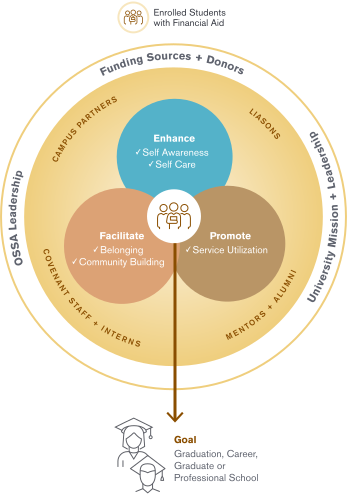
The CCMC was developed by CC staff and practitioners in the field who support students from low-income families and communities, by reflecting on their daily work and the evolution of the program over two decades. Figure 1 represents the CCMC as an ecological system. In ecological system theory, a person’s development is influenced by various interacting systems within the person’s environment and by nested layers that influence one another (Bronfenbrenner 1979, 2005). The CCMC system centers on the enrolled student receiving financial aid, with a goal of graduation and plans for postgraduation (career and/or graduate or professional school). The CCMC begins after CC Scholars are admitted to UNC and continues throughout their college journey. . To help them achieve their goals, students are supported through efforts to enhance self-awareness and self-care, the utilization of on-campus services, and a sense of belonging. These efforts are carried out by individuals, including CC staff, campus partners, program liaisons, mentors, and alumni. In the final nested layer, the support of the Office of Student Scholarships and Aid, funding sources and donors, and the university’s mission and leadership are represented.
People Facilitate the Objective of Care
Program staff, campus partners, mentors, and alumni, known as care-givers,1 form the first concentric circle to support students from low-income families and communities in higher education. The program uses the term care-giver, which is consistent with program staff engaging daily with students, identifying and developing their strengths through attentive conversations and mutual support. These strengths help students connect with campus partners, mentors, and alumni, who offer tailored support. Campus partners provide individual and group services through specific university offices. CC mentors—faculty and staff volunteers—meet students for coffee, meals, or campus activities, often maintaining relationships beyond the first year. CC liaisons, typically from graduate programs, help students transition to further education. Mentors and liaisons undergo annual training, have a digital and in-person space for exchanging mentoring best practices, and receive regular updates from the program. Alumni contribute through advisory boards and social media, enhancing connections for students from low-income families and communities. Together, these care-givers create a supportive network around students from low-income families and communities throughout their university experiences.
University Culture Encourages and Sustains People Who Care
The outer concentric circle, as shown in Figure 1, includes university leadership, policies, and institutional investment, which are essential for establishing and sustaining a program for students from low-income families and communities. Support from senior leadership and effective policies are crucial for the program’s initiation and growth. These influencers help secure resources and maintain the program, making institutional buy-in a foundational step. Building and sustaining the CCMC requires ongoing collaboration with leadership to ensure updated policies, funding, and support, and to foster a culture of encouragement and care through strategic planning.
A Logic Model for Program Replication
As the CC celebrates its 20th year at the university, Table 1 offers a logic model to aid other institutions in developing their own models of care based on lessons learned. The CC includes four key supports: (1) financial aid, (2) academic guidance, (3) career development, and (4) well-being resources. The CCMC describes how these supports are delivered through staff, faculty, and program partners. Specifically, personnel use modeling, dialogue, practice, and validation. The authors updated Noddings’s (2002) “confirmation” to “validation” to align with prior research on the benefits of validation in an academic context (Linares Rendón and Muñoz 2011; Rendón 1994). The model highlights how the program fosters caring relationships that support student success (see Table 1).
| Context | Large, public, R1 university |
|
|
|---|---|---|---|
| Inputs | What we invest |
|
|
| Outputs | Care-givers | Who we are |
|
| Participants | Who we reach |
|
|
| Activities | How we do it |
|
|
| Outcomes | Short-term | Results in terms of learning |
|
| Intermediate | Results in terms of changing actions |
|
|
| Long-term | Results in terms of changing conditions |
|
|
| Continuous Improvement: Evaluation, Reflection, Iteration | |||
Context
The model starts with an appreciation of context, including environmental influences on the program. The CC is a program at a large, public research university in the southeastern United States. The institutional mission, vision, and values influence its development. Furthermore, as part of the institution’s enrollment management, enrollment goals impact the program, as do the changing demographics of college-going individuals in the region. The university’s active alumni and institutional fundraising, which helps support the CC through gifts and donations, is also influential. Finally, UNC has a strong commitment to public service, especially to serving the people of North Carolina, and seeks to meet critical workforce needs with highly skilled, well-prepared graduates ready to contribute to local, national, and global economies. All these factors influence the purpose and objectives of the CC program.
Inputs
Inputs to the model include institutional investments: the resources and contributions that an organization invests in a program to achieve its goals. Investments include staff time, volunteer hours, planning time, financial aid, social events, academic support, career development curricula, and well-being support.
Outputs
Outputs, the people and activities of the program, include care-givers, participants, and activities. Care-givers include professional staff, student interns/peers, campus partners, faculty mentors, donors, and alumni. Collectively, this team employs a strengths-based approach, focusing on celebrating strengths, acknowledging challenges, and fostering mutual, supportive relationships. These individuals work to enhance students’ self-awareness, teach them to practice self-care, promote awareness of and use of student services on campus, facilitate belonging, and build community. This approach helps students from low-income families and communities engage with mentors and campus resources, facilitating their personal and academic growth (Foss, Generali, and Kress 2011; Jack 2019; Shushok and Hulme 2006).
In the CCMC, the relationship between student and care-giver is the most important factor. Care-giver activities include modeling, dialogue, practice, and affirming students in a culturally responsive manner. Modeling is used to demonstrate intentional behaviors for academic and student success. Dialoguing promotes reciprocal learning through conversation. Practicing involves giving students opportunities to demonstrate their learning, make mistakes, ask questions, and adjust or make corrections. Affirming includes seeing and acknowledging student qualities, insights, behaviors, and experiences.
Faculty and staff engage in the activities of caring—modeling, dialoguing, practicing, and affirming students—in a culturally responsive manner. For example, they welcome and address students by name and seek to understand students’ experiences prior to enrolling at the university, as well as those beyond the campus. They also allow students to choose or direct activities to highlight their values and strengths, and they provide space for students to connect their life experiences, languages, and cultures with their learning. Care is facilitated through influential relationships, one-on-one meetings, communications about students’ experiences, and organized support partnerships.
Outcomes
Outcomes include the short-, intermediate-, and long-term results of a program’s activities. Short-term outcomes include results in terms of learning: critical thinking, self-awareness, self-care, awareness and knowledge of student support services, and a sense of belonging and community. Intermediate results refer to student actions, including informed academic decision-making, making healthy choices, seeking help when needed, and planning for the future. Long-term results involve changing conditions, such as increased enrollment, retention, degree completion, and job placement or graduate school enrollment; caring societal engagement; and a caring workforce.
Continuous Improvement
The model enhances continuous improvement involving evaluation, reflection, and iteration. This work is done to increase efficiency, improve quality, deliver more value, and provide information to support informed decisions. Knowledgeable decision-making can increase care for students in the most valuable ways. In addition, gaps in support that need attention are revealed. This information can guide policy and strategic planning from program administration to university leadership.
Conclusion
Higher education faces a well-being crisis, particularly affecting low-income and minoritized students (Scherer and Leshner 2021; Xiao, et al. 2017). To address this, practitioners must connect well-being insights with student support frameworks, focusing on a strengths-based approach that views students as assets (Demetriou and Powell 2014). Leaders should foster a culture of care built on respect and honesty, in which community members feel safe asking questions, listening to understand, and valuing cultural and identity differences throughout the student journey (Perry and Webb 2024). Additionally, enrollment leaders must encourage a collaborative, institution-wide culture of care (Hinojosa, Luff, and Woolston 2023). Colleges should develop multifaceted plans starting at enrollment that promote shared responsibility for institutional and individual student goals (Saweczko 2024).
The CC, recognized as a leader in integrative support for students from low-income backgrounds (Kezar, Walpole, and Perna 2015), is often consulted on replicating its approach. The program offers a model of care adaptable to other institutions’ needs, grounded in scholarship and the work with CC Scholars. While acknowledging potential biases and privileges, the authors recognize that their well-funded program may not reflect other institutions’ realities. As Henderson (2021) notes, best practices must be contextualized to each campus’s unique needs. Understanding students’ perspectives on how the campus environment impacts their academic experiences is crucial to integrating effective, student-centered initiatives (Secore 2018). Future research should explore how the CCMC operates under varying resource and support levels, assessing its feasibility and scalability across diverse contexts and student populations.
As higher education engages more low-income and first-generation students, the authors recommend delivering services through a caring framework that includes modeling, dialogue, practice, and validation. Financial assistance alone is insufficient; developmental services must be delivered with care to truly support students. The CC looks forward to the next 20 years, as it continuously improves its model of care and shares lessons learned with colleagues.
 Jayne Davis, Ed.D., is the Well-Being Specialist for the Carolina Covenant
 Cynthia Demetriou, Ph.D., is the Chief Enrollment Officer and the Associate
 Candice Williams, Ph.D., is the director of the Carolina Covenant at the
share