

The focus of every college is to keep students enrolled until graduation. Institutions set goals around persistence and reducing attrition, with time-to-degree-completion serving as a metric for internal and external reporting. For institutions with minimal admission barriers, the challenge intensifies: how do you ensure students admitted with a reasonable expectation of success actually succeed? At the University of Baltimore (UBalt), second-year retention rates for new transfer students dropped from 75 percent in Fall 2019 to 70 percent in Fall 2022 (University of Baltimore 2024). This downward trend, coupled with decreasing enrollments, signals concern not only for institutional stability but for student outcomes.
UBalt operates as a predominantly transfer institution requiring only a 2.0 cumulative GPA and 30 credits completed for admission. Traditional “red flag” markers are neither evaluated in admissions nor formally utilized in advising. Yet these “red flags,” unstated assumptions about student ability based on incoming GPA, race, gender, prior institution, Pell Grant status, or registration timing, set expectations about student success. Interventions driven by inaccurate data may lead to student dropout behavior and ineffective support services (Adlofo, Kim, and Crawley 2023; Chen, Ziskin, and Torres 2020; Choi 2018).
This study addresses two interrelated research questions:
- Are the red flag indicators selected for this study at UBalt effective in accurately identifying transfer students at risk for attrition?
- If not, what alternative predictive variables could more accurately identify at-risk transfer students at UBalt?
Study Contribution
This study contributes to the field in three key ways. First, it demonstrates that commonly accepted predictors of student success may have minimal explanatory power in nontraditional, transfer-serving institutions. Second, it challenges the assumption that statistically significant models produce actionable insights. Third, it advances a QuantCrit-informed critique of predictive analytics by highlighting the mismatch between simplified variables and complex student lives. These findings call for a reconsideration of how institutions define and operationalize risk.
Institutional Context
UBalt is one of thirteen member institutions of the University System of Maryland. Founded in 1925 to provide business and legal education to working adults in Baltimore, UBalt now serves as an undergraduate, graduate, doctoral, and professional degree-granting institution. Total enrollment in Fall 2023 was 3,101, of which 63 percent were women. At UBalt, 95 percent of undergraduate students were Maryland residents with an average age of 31. In Fall 2023, 63.2 percent of undergraduate enrollments were underrepresented minorities, and 52.3 percent were first-generation students (University of Baltimore 2024). The Carnegie Foundation classifies UBalt as a Professions-Focused Undergraduate/Graduate-Doctorate Medium institution and Research-Active University. UBalt holds the Predominantly Black Institution (PBI) designation.
The student profile differs markedly from traditional institutions. The top feeder of high school graduates from 2019–2023 is the GED, not a specific high school. Students carry additional identities: parent, spouse, employee, veteran, formerly incarcerated. The intersectional nature of this nontraditional student body reinforces the value of this analysis.
Theoretical Framework
This study employed an intersectional critical social theory approach grounded in QuantCrit perspectives. At the outset of a student’s college journey is the question of being “good enough.” Typically, those questions are answered by comparing an individual against an ideal candidate, reducing an intersectional individual to a data point that flattens their complex existence (Van Dusen and Nissen 2021).
Intersectionality
Intersectionality, originally developed by Kimberlé Crenshaw (1989), provides a framework for understanding how overlapping identities shape lived experiences in higher education. Rather than reducing students to singular characteristics, this approach emphasizes how race, class, gender, and life circumstances interact within systems of power. Within UBalt’s context, this framework is particularly relevant given the prevalence of students balancing roles as workers, parents, and caregivers. Although intersectionality encompasses multiple constructs (Collins 2019), this study centers on complexity and societal context as key lenses for interpreting student data.
QuantCrit
QuantCrit (Stage 2007; Gillborn, Warmington, and Demack 2018) challenges the assumption that quantitative data are neutral, emphasizing that data reflect both systemic inequities and researcher interpretation. This framework is particularly relevant to predictive modeling in higher education, where variables are often treated as objective indicators of risk.
The data gathered on students tells a complex story about lived experiences. The number of attempted credits may speak to changing career goals. Last-minute application for admission could result from job loss or a potential promotion. Course withdrawals may not indicate content struggle but could result from the student being a victim of violence or eviction. The intersectional framework with a QuantCrit perspective acknowledges the power relations and identities each student inhabits.
Literature Review
Research related to red flags in the college student experience focuses on two main areas: student factors and institutional factors. Current research supports a multifactor impact on dropout behavior (Chen, Ziskin, and Torres 2020); therefore, some combination of student and institutional factors is at the core of student success.
Foundational theories of student departure emphasize that persistence is shaped by both individual characteristics and institutional engagement. Tinto (1975), Bean (1982), and Astin (1984) collectively highlight the roles of background, motivation, and involvement, while Kuh, et al. (2006) further underscore the importance of institutional support structures. Institutional selectivity in student recruitment is a privilege and a strategic choice. Open admissions and mostly open admissions institutions like UBalt also work to develop student success profiles, although not usually for exclusion purposes. Institution type plays a role in student attrition. Community colleges struggle with retention (McKinney, et al. 2019). McKinney, et al. found that 13.5 percent of all courses attempted resulted in withdrawal, propelling 44 percent lower odds of earning a degree or transferring. Gramling (2013) studied for-profit institutions and found that graduation could be predicted with almost 75 percent accuracy by student characteristics alone, implying that institutional type may be more limited than assumed.
Nontraditional students are quickly becoming the norm (Levine and Van Pelt 2021). Chen, Ziskin, and Torres (2020) found that dropout behavior remaining high after the first year has an impact on retention, revenue, and student debt for institutions like UBalt. Enrollment intensity research by Stratton, O’Toole, and Wetzel (2007) warned that full-time models could not accurately predict dropout behavior of part-time students, and student characteristics such as race and gender were not correlated with dropout likelihood for full-time students. Crosta (2014) found that switching enrollment intensity was not harmful to some credential-seeking students, emphasizing that “the diversity in individual patterns cannot be overstated” (139).
Financial stress repeatedly appears in research on student persistence (Bird and Castleman 2016; Mukherjee, et al. 2017). The greater the financial stress, the more likely students are to reduce enrollment intensity or drop out entirely. Chen, Ziskin, and Torres (2020) found that among nontraditional students at 4-year universities, financially independent students were more likely to drop out. Choi (2018) found a negative impact and a higher likelihood of dropout behavior for working students.
This lack of robust data backing unofficial red flags is dangerous for student success and degree completion costs. Prior research suggests students’ academic and demographic characteristics predict success, but those markers vary by institution (Chen, Ziskin, and Torres 2020; Gramling 2013; Mabel and Britton 2018). Each institution must determine its most accurate success markers. Attewell, et al. (2022) found that across four states, models successfully predicted students at the highest risk of not graduating, but rightly summarized ethical dilemmas and the danger of false positives. UBalt experienced the impact of false positive red flags in early use of EAB’s student success platform. Taken together, existing literature demonstrates that while traditional predictors may show statistical relationships with student outcomes, their effectiveness varies, raising important questions about practical utility in transfer student populations.
Methodology
Research Design
Utilizing data from nineteen semesters, this quantitative study examined potential red flag student entry data against outcome data: successfully graduating from UBalt, graduating from another institution, or dropping out entirely. This study included both institutional and federal-level data to ascertain student behaviors inside and outside UBalt.
Sample and Data Sources
Data were sourced from UBalt data warehouse and the National Student Clearinghouse (NSC). The sample included all undergraduate students admitted from Fall 2018 to Spring 2024 who earned at least 30 credits at one or more prior institutions. All three terms (fall, spring, summer) were included. All three colleges at UBalt—Merrick School of Business (MSB), College of Arts and Sciences (CAS), and College of Public Affairs (CPA)—are represented.
The final sample consisted of 3,704 students. Student characteristics included: 58.88 percent female, 38.79 percent male; 31.18 percent Black/African American, 22.46 percent White, 39.17 percent not specified; 42.62 percent Pell Grant recipients; 47.35 percent earned an associate’s degree. The average age was 31 years.
Variables
Student academic demographics included: major of study; admission and enrollment dates; first semester GPA; total credits attempted and earned; credits by course modality; major changes; academic probation/suspension semesters; transfer credits; sending institution name and type; associate’s degree earned; enrollment intensity; completion status; and receiving institution information if applicable.
Student personal demographics included: age band, race/ethnicity, Pell Grant receipt, military affiliation, and first-generation status. These were used for descriptive purposes only and intentionally excluded from predictive models to avoid contributing to the continued stigmatization of marginalized groups (Stage 2007). The exclusion of student demographic information typically found in educational research should not be considered a limitation but may be appropriate for future research in certain contexts. Additionally, using 30 cumulative transfer credits as the cutoff point for inclusion may have artificially excluded students with unarticulated credit from the military or credit for prior learning.
This study received IRB exemption from UBalt and Frostburg State University. All data were anonymized, with student names and identification numbers removed. To further protect identity and mitigate bias, zip codes were excluded. Race and ethnicity were reported only via two categories: URM (underrepresented minority) and NURM (non-underrepresented minority), conforming with UBalt data-sharing practices. Gender was limited to three categories available in UBalt systems: female, male, and unknown/undisclosed.
UBalt-specific variables included: DFW courses (courses with high failure/withdrawal rates); embedded tutors; COVID-19 grading scheme changes (CR/CRD grades for Spring 2020), and UBalt home college. Variables reported as “not specified” were retained as recorded to preserve the integrity of the data. Deletion did not occur except in cases where the entire student record was erroneously included. Because demographic variables were excluded from predictive modeling, missingness in those fields did not affect regression results.
Data Analysis
This study utilized logistic regression models to examine the validity of variables predicting graduation likelihood. To address the first research question, four studies were selected as models for replication (Arhin and Laryea 2020; Chen, Ziskin, and Torres 2020; Gramling 2013; Mabel and Britton 2018). The second research question required developing a UBalt-specific model using stepwise regression. This approach was used to identify a combination of variables based on Akaike Information Criterion (AIC), allowing variables to enter or exit the model according to statistical contribution. Although stepwise regression has known limitations, including potential overfitting and model instability, it was employed here as an exploratory tool to assess whether commonly accepted predictors demonstrate meaningful explanatory power within this institutional context. Additionally, the dataset allowed analysis of COVID-19 impacts, intercollege comparison, and course modality effects.
Findings
This study considered two interrelated research questions through a series of regression analysis models. While all models reached statistical significance at the omnibus level, individual predictors were inconsistent, and explanatory power across analyses remained low. This indicates that statistical significance did not translate into meaningful predictive strength. The limited and inconsistent contribution of individual predictors emerged as the most important finding.
Research Question 1: Examining Existing Frameworks
Nontraditional Student Dropout Rate (Chen, et al. 2020 Replication)
A linear regression predicting second-term retention was significant, F(3, 404) = 27.74, p < 0.001, R² = 0.17. Both Pell Grant receipt (β = 1.85, SE = 0.51, p < 0.001) and first term GPA (β = 1.76, SE = 0.22, p < 0.001) were significant positive predictors of second-term retention.
A logistic regression predicting graduation was statistically significant, X²(3) = 74.06, p < 0.001, R² = 0.153. However, only first term GPA was a significant predictor (β = 0.89, SE = 0.04, p < 0.001), indicating that each one-point increase in GPA more than doubled the odds of graduating. Pell Grant receipt and enrollment load were not significant.
College Late Departure
(Mabel and Britton 2018 Replication)
A logistic regression examined graduation probability based on prior institution type. Only Maryland community college attendance was statistically significant (β = 1.73, SE = 0.87, p = 0.046). Cumulative transfer credits (β = 0.017, SE = 0.003, p < 0.001) and cumulative credits attempted at UBalt (β = 0.031, SE = 0.002, p < 0.001) were also significant. Associate’s degree completion was not significant.
For-Profit Comparison
(Gramling 2013 Replication)
A logistic regression tested whether first-term GPA, enrollment load, Pell status, and cumulative transfer credits predicted graduation. There were no statistically significant variables or interactions in predicting graduation likelihood. This lack of significance suggested that UBalt may not align with patterns observed in for-profit institutions.
Embedded Tutoring
(Arhin and Laryea 2020 Replication)
A linear regression predicting second-semester retention was statistically significant, F(3, 404) = 39.50, p < 0.001, R² = 0.227. Embedded tutoring was a significant predictor (β = 10.28, SE = 1.07, p < 0.001), but no other variable or interaction was significant. Such a strong positive effect on retention with p < 0.001 indicates this outcome is highly unlikely to be due to random chance.
Although several models demonstrated moderate explanatory power relative to others in this study, these results were not consistently replicated across analyses, reinforcing the variability and limited reliability of traditional predictors.
Research Question 2: UBalt Model Creation
First Term GPA
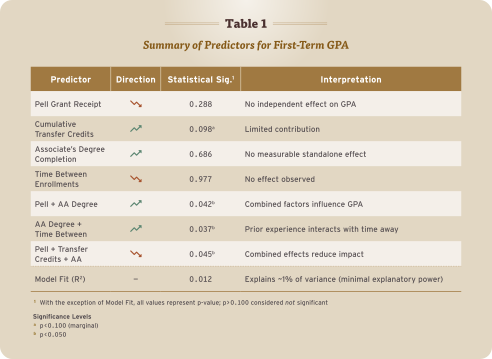
A linear regression model tested Pell status, cumulative transfer credits, associate’s degree, and time between institutions. The overall model was significant, F(15, 3688) = 3.185, p < 0.001, but the effect size was extremely small (R² = 0.012, indicating 1 percent explained variance). This indicates that approximately 99 percent of the variation in outcomes remains unexplained by the model. Significant positive interactions included receiving a Pell Grant and having an associate’s degree (β = 1.11, SE = 0.54, p = 0.042). Several negative interactions were also significant, indicating that prior degree completion may have a diminishing positive effect when coupled with other variables. Table 1 summarizes the predictors of first-term GPA, including significant interaction effects and overall explanatory power.
Graduation
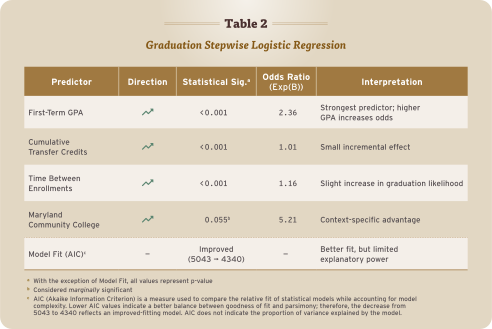
A stepwise logistic regression examined predictors of graduation, including Pell Grant receipt, enrollment load, cumulative transfer credits, first term GPA, time between institutions, UBalt college, and sending college type. The model fit improved significantly (AIC from 5043.73 to 4340.01). Students with more cumulative transfer credits were more likely to graduate (β = 0.033, SE = 0.008, p < 0.001). First term GPA was a strong predictor (β = 0.859, SE = 0.040, p < 0.001). Time between institutions (β = 0.151, SE = 0.023, p < 0.001) and attending a Maryland community college were also significant predictors. Table 2 presents the final stepwise logistic regression model predicting graduation, including key predictors and their practical interpretation.
Despite improved model fit, the overall explanatory contribution of these variables remains limited, suggesting that even optimized models do not provide meaningful predictive differentiation.
Opportunity Research
COVID-19 Impacts
A linear regression examined first-term GPA differences before, during, and after COVID-19. The overall model was significant, F(8, 3673) = 7.21, p < 0.001, with a small effect size (R² = 0.015), reinforcing that the model captures only a small portion of outcome variability. Students in the post-COVID period had significantly lower first-term GPAs (β = -0.15, SE = 0.080, p < 0.001), but during COVID there was a significant positive impact (β = 0.232, SE = 0.095, p < 0.05).
A logistic regression examining graduation probability was significant, X²(8) = 329.7, p < 0.001. Students in the post-COVID period had significantly lower odds of graduating (β = -0.75, SE = 0.19, p < 0.001).
Intercollege Comparison
A linear regression analyzed first-semester GPA by Pell status, cumulative transfer credits, time between institutions, and UBalt college. The overall model was significant, F(47, 3656) = 2.266, p < 0.001, but variance was low (R² = 0.028), further emphasizing the lack of explanatory power of the variables. The only significant interaction was for CPA students with an associate’s degree, time between institutions, and cumulative transfer credits; the impact was negative. No stark differences were found between colleges, contradicting institutional narratives that each college requires entirely different approaches.
Course Modality
A linear regression examined first-term GPA by course modality. The omnibus model was statistically significant, F(8, 3695) = 57.48, p < 0.001, R² = 0.056. All main effects of Zoom, hybrid, in-person, and web modalities were significant and positive. There were no negative effects on any modality or credit load within those modalities. However, the relatively modest explanatory power suggests that while modality has measurable effects, it does not strongly differentiate student outcomes.
High DFW Course
A linear regression examined the influence of IDIS 302 (required for all undergraduates) on first-term GPA. The overall model was statistically significant, F(16, 1482) = 37.49, p < 0.001, R² = 0.29. Compared to students who earned an A, all other grades were significantly associated with lower first-term GPAs, confirming IDIS 302 as a high DFW course with significant impact when taken in the first semester.
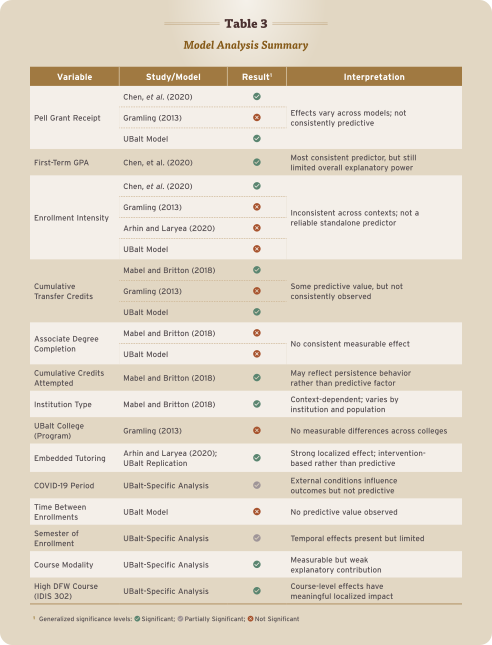
To illustrate the inconsistency of traditional predictors across models, Table 3 summarizes the significance and interpretation of variables across all analyses.
Taken together, Table 3 highlights the lack of consistency in traditional predictors across models, reinforcing their limited practical utility.
Discussion
Examining Existing Literature
Rather than revisiting prior findings, this section focuses on how results from this study align with and diverge from existing literature. Consistent with Chen, Ziskin, and Torres’s (2020) study, findings indicate that financial support and a positive first semester strongly predict second-term retention and graduation likelihood. While prior research identified significant challenges for community college students, findings suggest a more positive trajectory for those transferring from Maryland community colleges. Specifically, a statistically higher probability of graduating from UBalt. This finding suggests that institutional context and transfer pathways may influence outcomes differently than prior literature indicates.
In applying Gramling’s (2013) for-profit institution model to UBalt, none of the variables, either as main effects or interactions, were statistically significant. This lack of significance suggests that UBalt may not align with patterns observed in for-profit institutions and reinforces the variability of predictive factors across institutional contexts. Rather, the lack of statistically significant findings may indicate other, unmeasured factors, such as institutional culture, student support systems, or noncognitive factors like motivation, that contribute to student success at UBalt.
At UBalt, the presence of embedded tutors emerged as a statistically significant predictor of second-semester retention, contrasting with Arhin and Laryea’s (2020) findings of limited tutoring impact. While prior internal research affirmed this positive impact, the longitudinal nature of the current study provides stronger support for expanding embedded tutoring initiatives.
A New Model for UBalt
Utilizing linear regressions and stepwise logistic regressions, models predicting first-term GPA and graduation probability were tested and found to be statistically significant but demonstrated extremely low explanatory power. While relationships between variables could be identified, these did not translate into meaningful predictive utility. In practical terms, this means that a reliable, institution-specific predictive model could not be developed using these variables alone. This finding challenges the assumption that refining traditional predictors will yield actionable insights for transfer student populations.
Research Questions Answered
Are the red flag indicators selected for this study at UBalt effective in accurately identifying transfer students at-risk for attrition?
The results indicate limited and inconsistent predictive value. The indicators can indicate the likelihood of success and are similar to other studies, but the lack of statistical significance across so many variables implies that other factors not calculated in the study are at play. UBalt should not ignore the effectiveness of Pell Grant awards, associate’s degrees, or cumulative transfer credits, but acknowledge that these variables have a limited effect.
If not, what alternative predictive variables could more accurately identify at-risk transfer students at UBalt?
The absence of consistent, strong predictors implies there may be other variables more effective at identifying at-risk students, but they are not present here. In fact, they may not be measurable variables at all. Findings do not indicate institutionally identifiable variables. As UBalt students are complex, intersectional individuals, the ways they engage with higher education will vary from student to student and may not be measurable by traditional methods.
Where did the red flags go? This study indicates that the red flags may not have been red flags at all. This article does not advocate for labeling a human being as at risk due to race, gender, citizenship status, socioeconomic background, or other standard demographic variables, despite what the literature may say about success probabilities. Since UBalt remains a mostly open-access institution, its policies, technology usage, and advising protocols can be proactive to ensure students have the best opportunities for success through graduation.
Study Opportunities
As institutions grapple with COVID-19 fallout, it is clear that disruption extended beyond academics. While a drop in first-term GPA was expected, broader implications for retention and persistence are still unfolding. UBalt students faced many obstacles but found an increase in GPA during the pandemic. This implies that perhaps the work of dedicated staff and outside resources to meet those needs produced positive results. Continued exploration into the supports offered, particularly through qualitative methods, could determine how those resources contributed to student success and how to replicate them in the future.
This study also compared the three colleges at UBalt to determine if urban legends about differences were true. In this snapshot comparison, no stark differences were found between colleges. This finding aligns with Woodfield’s (2014) analysis that while differences exist between majors, student and institutional factors are more impactful than the chosen major alone. Further investigation is merited, but within this study’s context, there are no significant areas of divergence between students in the three colleges to warrant special considerations.
Implications for Practice
Immediate Actions
The analysis of embedded tutoring impact suggests that financial and personnel resources should be applied to further enhance this support service. What would happen if all high DFW courses were assigned an embedded tutor? The number of students impacted would dramatically increase, and additional support might improve student success in those courses.
Bringing 20 years of experience in academic advising, the recommendations in this arena are most personal. The lack of significant main effects and interactions does not leave tangible recommendations for advisors. There are no results telling students to limit themselves to online hybrid classes in their first semester or to always take at least twelve credits. Instead, recommendations are reminders to advisors that each student is unique and will not fit into any box or preconceived idea of a successful pathway. UBalt advisors know this well. The stories they tell of students who seemed least likely to graduate but somehow did so with flying colors are at the heart of this research. Instead, recommendations are for advisors to offer even more reassurance to students that their background, prior college experience or lack thereof, socioeconomic backdrop, career goals, or even how long the journey has been, do not determine their success. Leaning into unconditional positive regard and the inherent value of the human being is more helpful, in this administrator’s experience, than any tool or training that can be provided.
UBalt cannot and should not require students to complete the associate’s degree to transfer, but it can work with community college partners to better incentivize completion prior to transfer. Data in this study and countless others show short- and long-term benefits to students of associate’s degree completion. UBalt already does an exemplary job crafting articulation agreements that maximize transfer credits and should continue that work. Efforts can be enhanced by providing suggested options for elective credits so students can make more effective use of unassigned courses.
Given the lack of support in either direction for the benefit of an enrollment load or course modality, institutions should be cautious in any policy that pushes a position not grounded in data specific to UBalt. Every student is unique, meaning some students may thrive at fifteen credits while others may rightfully need to start with just three. Institutions should educate students to be informed consumers and then trust and support their academic decisions. A policy that encourages “15 to finish” may work at a traditional institution, but that is not UBalt, and there is little evidence in this study that those outcomes would apply here. Finally, given the results of analysis on high DFW course (IDIS 302), students may be advised to avoid the course in the first semester.
Near-Term Institutional Changes
Collegiate leaders may be disappointed to find that colleges are not as unique as previously thought, but this provides UBalt leadership with an opportunity to ensure students receive equitable treatment regardless of program of study. Deans are urged to bring together staff and faculty units and develop a repository of best practices that can be universally applied to all three colleges. Breaking down silos and working together can help stretch already-thin budgets and staffing ratios.
Even though the COVID-19 pandemic crisis point occurred five years ago, the time warp many feel shrinks the distance. What can institutions learn from such an unprecedented global emergency? Now is the time to take stock of all services and resources offered to students. When the next crisis appears, UBalt will have a playbook of processes and resources that can be deployed more efficiently.
System-Level Changes
Given the results, there are policy recommendations UBalt should consider to better position students for success. It is important to acknowledge that some things are beyond immediate institutional control. The ability to afford college factors in increasing success, a variable partially out of institutional hands. However, institutions can lobby at state and national levels for more holistic student financial aid programs grounded in better data and a modern student picture. At the institutional level, donors can be encouraged to provide support that honors the complex lives of nontraditional students. Scholarship and grant creation can be a collaborative process with academic units, enrollment management, and institutional advancement to ensure new donor agreements provide access to as many students as possible and do not continue systems of oppression.
UBalt, like many institutions, utilizes a CRM and student information system. Both systems could be optimized with data points from this study to better inform academic advisors prior to the first advising appointment and during the course of study. This article argues against literal red flags, but advisors should have access to information helpful in supporting students. For example, advisors should be able to see Pell Grant recipient status and a timer indicating how long it has been between college enrollments. Should new systems be pursued, it is important that data transparency be a key aspect of solution-building along with ensuring that any predictive analytics is accurately attuned to the UBalt student profile.
Future research at UBalt should include an expanded dataset. The original data should be augmented with additional data points such as unused transfer credit, incoming GPA, number of prior institutions, military service, academic performance in all gatekeeping courses, and enrollment load in each semester. Certainly, research could be expanded to include the traditional first-year population and graduate-level programs. Institutions with similar missions, admissions policies, or demographics can consider this study as a launching point. The goal remains to provide institutions with insight, leaders with data to support policy creation and revision, and student success teams with wisdom to support student success through personalized support.
Conclusion
What is there to take away from this research when the models were significant but the main interactions across a variety of variables were not? Perhaps, as intersectionality and QuantCrit state, people are more than numbers. As Collins and Bilge (2020) note, people are not a uniform group. Institutions can start by removing the label of transfer student. It is a grouping created by the institution, not the student. If there are no defining characteristics that definitively determine success for students at UBalt, then success can be created by providing the right supports, advice, and policies. Success can be encouraged by students understanding the path before them and their opportunities. When models explain only 1 to 2 percent of variation in student outcomes, their usefulness for institutional decision-making is limited. These findings suggest that predictive analytics may not meaningfully differentiate between students and should be used cautiously when shaping advising strategies, interventions, or resource allocation.
Should this study be considered a failure if the answer to both research questions is on the spectrum of no or inconclusive? No. The results are a reminder that institutions are working alongside human beings who cannot and should not be reduced to numbers to be manipulated for the betterment of institutional scorecards, ranking systems, or soundbites. A key takeaway is that UBalt and all institutions should be wary of any predictive analytics solution that does not take into account the results produced in this study. If higher education wants to maintain its value in a rapidly changing landscape, the field must remember that its purpose is to open doors to as many people as possible, not shut doors to the at-risk or hand out red flags of concern upon admission.

share