

This article presents a practical framework for re-engaging students who have stopped out of higher education. Drawing on applied experience and supported by current research, it outlines a structured process for identifying, validating, and reaching out to students who have earned college credit but have not completed a degree or credential. The article focuses on key steps including data extraction and scrubbing, targeted outreach campaign design, and the coordination of enrollment support. The focus is on how institutions move from identifying students in institutional data to executing outreach in a structured and repeatable way. It also highlights common barriers that affect re-enrollment and how they appear within the re-engagement process. Rather than treating stopped-out students as attrition, this approach positions them as a population that can be effectively re-engaged through intentional and coordinated efforts.
Across the United States, millions of individuals have earned college credit but have not completed a degree or a credential. According to the National Student Clearinghouse Research Center, more than 43 million individuals fall into the “some college, no credential” population, with 37.6 million under the age of 65 (Shapiro, et al. 2025). While more than one million of these students re-enrolled in 2023–24, the overall population continues to grow as stop-outs continue to outpace re-engagement. In many cases, this challenge begins with outreach itself. Research on re-enrollment efforts suggests that some stopped-out students receive little to no communication from their institution after leaving, limiting opportunities to reconnect and support their return (Love, Nzau, and Thai 2025).
Current stop-out patterns do not reflect a simple exit from higher education, but instead reflect a more cyclical pattern, with many students stepping away and returning later. In that sense, stopping out is often a pause rather than a permanent departure. Earlier research supports this idea, showing that a significant portion of students who leave intend to return and many actually do (Woosley, et al. 2005). This creates a clear opportunity for institutions to rethink how they approach stopped-out students. Rather than assuming they are no longer part of the institution, the focus can shift to how to re-engage this population through more structured and intentional outreach efforts. This requires more than identifying students who have stopped out. Institutions need a clear process for moving from raw data to validated outreach lists and coordinated communication.
The Opportunity of Stopped-Out Students
Students who leave college without completing a degree or credential represent a meaningful opportunity for institutions. Many have already completed a significant portion of their coursework and may be closer to finishing than they realize. In one study, about 40 percent of students who withdrew reenrolled within four semesters, and more than half indicated they planned to return (Woosley, et al. 2005). This suggests that a large portion of this population is not disconnected, but rather is considering the right time or pathway to return. More recent data also show that select groups, particularly recent stopouts and those who have already made substantial academic progress, are more likely to re-engage (Shapiro, et al. 2025). This highlights the importance of prioritization. Rather than attempting to reach all stopped-out students at once, institutions can focus their efforts on those most likely to return.
At the same time, many of these students are balancing work and family responsibilities, which can influence when and how they are able to return. This also means institutions do not need to approach all stopped-out students in the same way. Students with more recent enrollment or higher credit accumulation are often more likely to return (Shapiro, et al. 2025), which makes it possible to prioritize outreach efforts rather than applying a single approach across the entire population.
Identifying and Validating the Target Population
The first step in any re-engagement effort is identifying which students are realistic candidates for outreach. While this typically begins with pulling institutional data, in practice it requires a more deliberate process of filtering and validation. In most cases, institutions start with criteria such as:
- students who have not transferred or completed elsewhere
- students in good academic standing
- students who do not have any holds on their accounts (e.g., financial, student affairs, etc.)
- students who have accumulated a certain number of credits
- students who are near completion
- students who recently stopped-out
At the same time, academic performance alone does not provide the entire story. Research suggests that factors such as a student’s connection to the institution and their intention to complete are often stronger indicators of reenrollment than GPA alone (Woosley, et al. 2005). This is where institutions may need to broaden how they define which students are ready to return. This step is more effective when institutions combine academic indicators with signs of prior engagement. While GPA and credit accumulation are good starting points, additional indicators such as prior advising interactions or responsiveness to earlier outreach can help refine the list into a more usable outreach population. Developing a clearer understanding of this population can further strengthen this step. Insights into student motivations, barriers, and decision-making patterns can help institutions move beyond basic filtering and toward more intentional segmentation. This allows outreach efforts to be better aligned with where students are in their decision-making process, rather than treating all stopped-out students as a single group (Ashbrook 2023). These may include prior engagement with advising, expressed intent to return, or responsiveness to past outreach. Combining academic and behavioral indicators provides a more complete picture of readiness and can improve the accuracy of targeting efforts.
Data Validation and Scrubbing Process
Once the initial list is generated, the next step is validating and cleaning the data. This is one of the most important and time-consuming parts of the process. Initial datasets often include students who are not appropriate for outreach, such as those who have already graduated, transferred, or, in some cases, are deceased. Without proper filtering, outreach efforts can target the wrong students or miss the right ones entirely. At a minimum, the dataset should be reviewed and filtered to remove:
- students who have completed a credential
- students who have transferred (if known)
- students currently enrolled
- students marked as deceased
- duplicate or incomplete records
- data fields missing information
Additional filters may include academic standing, credit thresholds, and recency of enrollment, depending on the goals of the campaign. This process is rarely straightforward. Institutional systems do not always capture student status cleanly, and data may be incomplete or outdated. In my experience, this is the most time-intensive step, but it is also what ultimately determines whether the outreach effort is meaningful. The goal is not just to identify potential returners, but to produce a dataset that can be used immediately for outreach. A smaller, validated list is often more effective than a larger, unfiltered one. This aligns with re-engagement approaches that emphasize clean and actionable data as the foundation for outreach (InsideTrack and Inside Higher Ed 2024; Trellis Strategies 2025).
Operationalizing Data Requests and Cross-Functional Collaboration
Identifying the target population requires coordination with a variety of departments or teams including Institutional Research, IT, or a designated data team responsible for extracting student data. Clearly communicating what data is needed and how it will be used is an important part of the process. This also requires being mindful of institutional policies and FERPA guidelines when requesting and sharing student data, ensuring that data access and use are aligned with established protocols. One approach is to develop a structured data request that outlines the target population, filtering criteria, and specific data fields required. Documenting this request through a standardized process, such as an electronic form or designated institutional pathway, creates a repeatable and consistent approach that can be used across future campaigns, reducing the need to rebuild the requirements each time. This helps ensure that the data returned aligns with the goals of the outreach campaign and reduces the need for multiple revisions.
Additionally, preparation before launching a campaign is just as important as the outreach itself. This includes confirming that the data is accurate, aligning internal teams, and ensuring that messaging and processes are in place before outreach begins. Campaigns that move forward without this level of preparation often require adjustments midstream, which can slow execution and reduce overall effectiveness (Cabrera 2021).
For example, a data request may include filters such as last term attended, credit accumulation, academic standing, and degree program, along with core contact and demographic fields needed for outreach. Providing both easy to understand labels and system field names can improve clarity when working across teams. Once the data is validated, collaboration with communications or marketing teams becomes equally important. These teams can support message development, campaign timing, and delivery channels, helping ensure that outreach is coordinated and consistent. A structured data request template can be used to standardize communication with data teams and ensure consistency across outreach campaigns. In my experience, this cross-functional coordination between various departments (e.g., institutional assessment, IT, academic advising, enrollment management, and marketing) is often what determines whether an outreach effort is efficient and scalable. This coordination also reduces the time between data extraction and outreach execution. When roles and timelines are clearly defined, institutions are better positioned to act on the data while it is still relevant within the enrollment cycle (InsideTrack and Inside Higher Ed 2024).
Designing and Executing Targeted Outreach Campaigns
Once a target population is identified and validated, outreach can begin. This is where many efforts fall short, particularly when outreach is treated as a single communication rather than a coordinated series of outreach efforts. This also reinforces the importance of preparing key elements in advance, including defining the target audience, messaging, and communication channels, rather than building them while outreach is already underway (Cabrera 2021).
Outreach is more effective when it clearly connects degree completion to concrete outcomes such as program completion timelines or career progression (UPCEA and Thinking Cap Agency 2021).
How that message is delivered also matters. Many adult learners are not actively navigating institutional websites, which makes direct communication critical. This includes email, text, and other channels that allow for timely and accessible engagement. The InsideTrack re-enrollment model emphasizes the importance of customized communication that reflects where the student is in their journey (InsideTrack and Inside Higher Ed 2024). This means moving beyond generic messaging and providing communication that feels relevant and actionable. This is closely tied to how students are segmented within the outreach process. Students who are closer to completion may respond to messaging focused on finishing, while earlier stop-outs may need clearer guidance on how to return. Aligning messaging with segmentation allows outreach to remain relevant without requiring fully customized campaigns.
Step-by-Step Outreach Campaign Process
Based on this work, outreach campaigns can be structured in a clear and repeatable way:
- Define the objective and timeline. Establish the goal of the campaign and align it with institutional timelines, such as upcoming terms or enrollment cycles.
- Extract and validate student data. Pull the initial population and complete the data validation and scrubbing process to ensure accuracy.
- Segment students based on readiness and progress. Prioritize students based on factors such as credit accumulation, recency of enrollment, and likelihood to return.
- Develop targeted messaging. Create messaging that connects degree completion to student goals, including career advancement and personal outcomes.
- Execute a multi-touch outreach campaign. Use multiple communication channels over time rather than relying on a single message (e.g., drip campaign, email follow-up, text messaging, etc.)
- Provide a clear next step or call-to-action. Ensure students know exactly what to do next, whether that is applying, scheduling a meeting, or requesting more information.
- Track engagement and adjust as needed. Monitor response and engagement data to refine outreach strategies over time.
Skipping steps, particularly data validation or segmentation often limits the effectiveness of the entire campaign. In addition, tracking outcomes such as response rates, application starts, and reenrollment helps identify where the process is working and where it may need adjustment (Shapiro, et al. 2025).
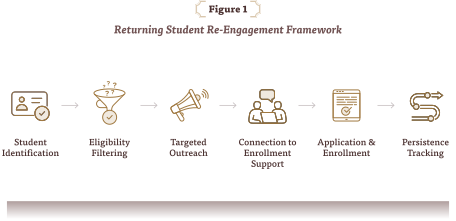
Figure 1 outlines the progression from identifying students through tracking persistence after enrollment. This approach aligns with the InsideTrack “5 Cs” model, which emphasizes clean data, customized communication, clearing obstacles, collaboration, and change management (InsideTrack and Inside Higher Ed 2024). This reinforces that re-engagement is not just about sending outreach messages. It requires coordination across the institution. While this framework is presented as a sequence, in practice it functions more as a cycle. Insights from later stages, particularly enrollment outcomes, can be used to refine how students are identified and prioritized in future outreach efforts. This also means using engagement data as the campaign is running, not just after it ends. Patterns such as email response, click activity, and inquiry behavior can help inform adjustments to messaging, timing, and channel strategy in real time. This is particularly important given that many adult learners engage with content before ever responding directly, requiring outreach efforts to adapt based on observed behavior rather than waiting for a reply (EAB 2025).
Addressing Barriers and Supporting Re-Enrollment
Even when students are interested in returning, there are often barriers that prevent them from doing so. These barriers are not isolated, and in practice, they often overlap in ways that make re-engagement more complex. Barriers are often described across categories such as situational, institutional, and dispositional (Koller 2025) , but they tend to overlap. Situational barriers include work obligations, family responsibilities, and financial constraints. Institutional barriers reflect policies and processes that can be difficult to navigate, such as inflexible scheduling or unclear enrollment pathways. Dispositional barriers may include confidence, motivation, or perceptions about returning to school, which can influence whether students see reenrollment as a realistic or achievable option (Selagea 2024).
These barriers rarely exist in isolation. This also shows up in re-enrollment efforts. Outreach can get students to come back, but on its own it does not necessarily translate into long-term persistence or completion without additional support in place (Ortagus, et al. 2024). For example, a student balancing work and family responsibilities may also experience stress and uncertainty about returning, while institutional processes can further reinforce those challenges. Because of this, re-engagement requires more than outreach alone.
Institutions need to consider how to reduce barriers as part of the process, whether through clearer pathways, more flexible options, or more responsive support systems. Many of these barriers appear within institutional processes, such as financial holds, incomplete records, or unclear enrollment steps. Identifying these early, either through data or initial outreach responses, allows institutions to connect students more quickly to the support they need (Bagley 2025). Research consistently points to the importance of institutional flexibility and responsiveness in supporting adult learners as they return (Koller 2025).
Addressing these barriers is most effective when it is built into the outreach and enrollment process rather than treated as a separate step.
Conclusion
Re-engaging stopped-out students requires a shift in how institutions think about returning student pathways. Rather than viewing stopping-out as a final outcome, it can be understood as part of a longer and more complex educational journey. This work shows that re-engagement is not a single intervention, but a coordinated process. Identifying and validating the right students, designing intentional outreach, and addressing barriers all play a role in whether students return. Even small gaps in this process can limit effectiveness. Skipping data validation, relying on one-time outreach, or failing to address barriers can make it more difficult for students to re-engage. Taking a more structured and intentional approach helps create clearer and more accessible pathways for students to return by ensuring that outreach is grounded in accurate data, coordinated across teams, and supported by processes that make it easier for students to navigate reenrollment. Ultimately, this is about meeting students where they are and recognizing that many are still interested in completing what they started. With the right approach, institutions are in a strong position to bring these students back and support them through completion. This comes down to execution, particularly how institutions move from raw data to coordinated outreach in a way that is structured and repeatable.

share