
Mobile Nav
Mobile Nav

Editor’s Note

Welcome to another jam-packed issue of College and University!
Five authors featured in this issue are brand new authors and a part of our C&U100 initiative. I’m grateful for them making their debut and sharing their talents with us.
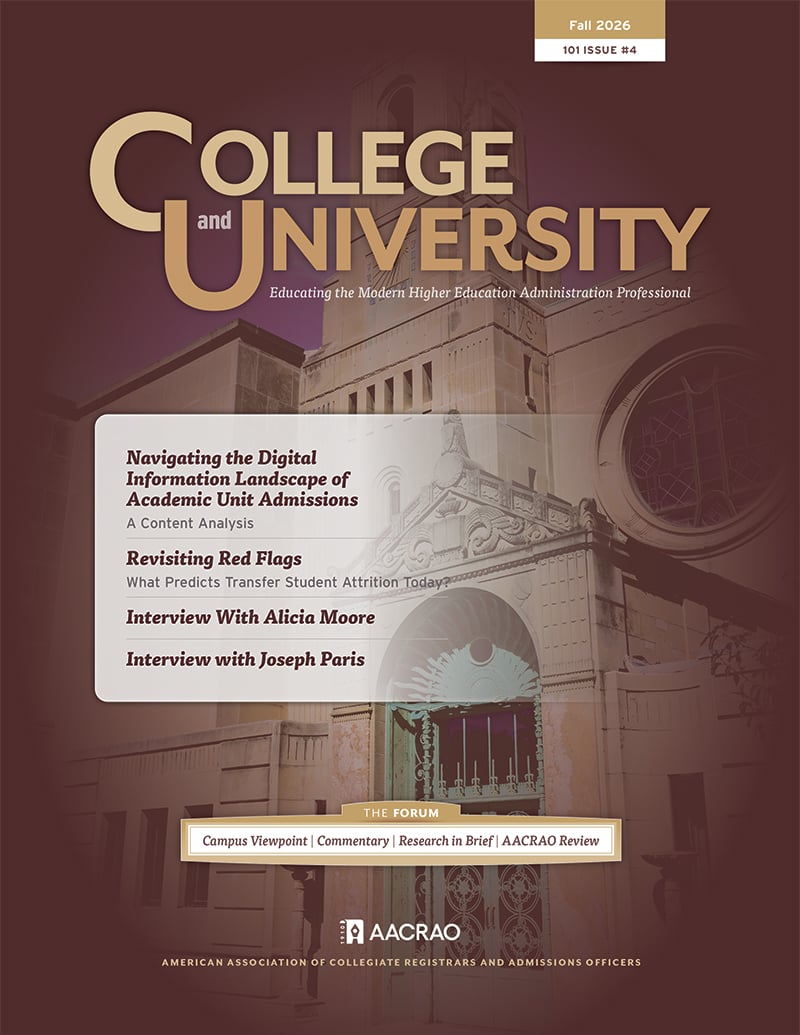
This issue offers a rich mix of research, dialogue, and reflection on the field. Two feature articles examine how universities communicate admissions criteria and how well traditional risk indicators actually predict transfer student outcomes, while interviews with Alicia Moore and Joseph Paris illuminate the personal journeys and human-centered values behind long careers in enrollment management. The Forum brings together practical, technology-driven solutions—from a DIY AI workflow for credential evaluation to frameworks for combating credential fraud and re-engaging stop-out students—and the Commentary section explores apprenticeship-to-credit pathways, the registrar’s evolving interpretive role, and the tension between FERPA compliance and student support. A Research in Brief piece offers cautionary lessons from a statewide transfer articulation policy, and the issue closes with three book reviews—all from first-time C&U reviewers—that grapple with meritocracy, democracy, and leadership in higher education.
Features
This issue includes two feature articles and two interviews.
Abernathy’s content analysis examines how nine Midwest public universities (in Iowa, Kansas, and Missouri) communicate academic-unit-level admissions criteria on their websites, finding widespread inconsistency. This study is a concrete benchmark against which to check our own admissions communications, particularly for rural and first-generation applicants who are shown to be most disadvantaged by unclear criteria.
In the second feature, Smith’s study finds that traditional “red flag” indicators like GPA, Pell status, and enrollment patterns explain only 1 to 2 percent of the variation in transfer student outcomes at a predominantly transfer institution, even when the models are statistically significant. This article reminds us against relying on simplistic risk markers in advising and predictive analytics, since intersectional, nontraditional transfer students’ complex circumstances are not well captured by conventional data points.
I was fortunate to have two recent conversations with colleagues Alicia Moore and Joseph Paris which appear as interviews in this issue. Great ready to meet Alicia Moore, a 30-year higher education veteran—now leading enrollment and student affairs at Central Oregon Community College—whose accidental path from corporate advertising into student housing, admissions, and eventually AACRAO Consulting and community-college SEM advocacy has been shaped by mentorship, a philosophy of “playing well in the sandbox,” and a deep commitment to holistic student success over pure recruitment.
Her interview is followed by a discussion with Joseph Paris, Dean of Graduate and Professional Studies at Delaware Valley University. Paris overcame a rocky high school record to build a decades-long career in enrollment management, going on to co-edit the first comprehensive graduate enrollment management handbook and to reflect thoughtfully on ai’s role in—and tension with—human-centered admissions counseling.
Both interviews remind us of the important “person side” of our calling to this work.
Campus Viewpoints
The Forum section brings together three distinct but complementary looks at how technology and process can strengthen enrollment and credentialing work. Rahimoon shows how a Pakistani public university built a no-cost, DIY workflow—wiring Google’s Gemini LLM into Google Forms/Sheets/Drive via a simple Apps Script—to screen faculty applications and reconcile international credential equivalencies, arguing that AI literacy among existing staff can strengthen SEM execution just as effectively as expensive enterprise platforms. I appreciate how Rahmoon directly addresses the budget-constrained reality most of us face, offering a concrete, replicable technical model (with actual code) for admissions and transcript-evaluation workflows, and reframes AI adoption as a capacity-building tool for policy execution rather than a costly procurement decision.
Tse and Herckis map the “credential fraud continuum”—from diploma mills and fake accreditation/evaluation agencies to falsified academic records and evaluation reports—and outline how AI-enabled detection tools, verifiable digital credentials, and cross-agency cooperation can help build a more secure verification ecosystem. It provides admissions and registrar professionals a practical, up-to-date framework for spotting and countering credential fraud (including AI-driven threats) in our daily evaluation and document-verification work.
Then Kelly presents a practical, step-by-step framework for identifying, validating, and re-engaging “some college, no credential” stop-out students through coordinated data, outreach, and cross-departmental collaboration. Kelly offers a concrete, repeatable operational model—spanning data scrubbing, FERPA-conscious data requests, segmentation, and multi-touch messaging—for tackling one of the field’s largest untapped enrollment populations.
Commentary
In this section, we learn about apprenticeship-to-credit pathways, the registrar’s evolving role in learner records as well as FERPA and privacy vs. student support.
Johnson describes Michigan’s Michigan College Credit for Apprenticeships Program (MI-CCAP) initiative, a coordinated statewide partnership that translates registered apprenticeship training into community college credit and builds clear pathways to an associate’s degree for skilled trades workers.
Parks authored two pieces in this issue. In his first article, Parks argues that experiential and comprehensive learner records are quietly transforming registrars from neutral record-keepers into unacknowledged interpretive authorities who make high-stakes ethical, legal, and governance decisions without adequate training or institutional standards to support them. This is a great read on the intersection of narrative documentation and student record governance. Then, he reflects on how FERPA’s vague “legitimate educational interest” standard forces universities to balance student privacy with the collaborative, holistic support students actually need, arguing institutions should move from fear-based compliance toward principled, ethics-driven judgment.
Research in Brief
Krech, Felder, and Laughlin examine a statewide general-education transfer articulation framework via mixed-methods evaluation—finding that transfer volume and average credits transferred actually declined post-implementation, and that advisors and registrars bore the brunt of operationalizing the policy with little technological or structural support. It offers us concrete, research-based lessons on anticipating the operational burden and infrastructure needs created by state-mandated transfer policy.
AACRAO Review
I’m thrilled that all three book reviews in this issue are authored by first-time reviewers to C&U!
Rejebian’s review of Tierney’s Higher Education for Democracy argues that neoliberalism and globalization have eroded higher education’s democratic mission, and it challenges enrollment management professionals to reckon with that erosion—including through the lens of GenAI and post-affirmative action policy—rather than merely debate it.
Taylor’s review of Sandel’s The Tyranny of Merit argues that America’s belief in meritocracy — especially as expressed through college admissions — erodes social bonds and the “dignity of work,” and calls on higher education practitioners to reexamine what merit-based success really signals.
Pepin reviews Sanborn’s You Don’t Need a Title to Be a Leader, applying its six leadership principles to higher education and arguing that leadership stems from everyday care and initiative rather than job titles.
Concluding Thoughts
Taken together, these pieces remind us that our work is both deeply practical and deeply human. The data-driven studies challenge us to question assumptions baked into our systems—while the interviews and commentary call us back to the relationships, mentorship, and ethical judgment that no policy or algorithm can replace. Real progress happens when we let these two threads reinforce each other: use the frameworks and tools in this issue—AI-assisted workflows, credential-fraud detection models, stop-out re-engagement strategies—not as substitutes for care, but as ways to free up more time and capacity for it.
Whether you lead from a formal title or, as Pepin’s review reminds us, simply through the daily choice to show up for a colleague or student, the invitation is the same: take one idea from these pages and put it into practice this term. Small, deliberate actions—clarifying a webpage, rethinking a risk model, reaching out to a stalled student, mentoring a newer colleague—are how the field moves forward, one office and one relationship at a time.
Every registrar, admissions officer, and enrollment leader who chooses care over checklist is quietly building the more just, more human colleges that our students deserve.
Enjoy this issue’s content!
Filters
Search
Department
-
We couldn’t find any results. Please check again later.
share