Aibana, O., J. L. Swails, R. J. Flores, and L. Love. 2019. Bridging the gap:
Holistic review to increase diversity in graduate medical education.
Academic Medicine. 94(8): 1137–1141.
Annamma, S. A., D. D. Jackson, and D. Morrison. 2017.
Conceptualizing color-evasiveness: Using dis/ability critical race theory
to expand a color-blind racial ideology in education and society.
Race Ethnicity and Education. 20(2): 147–162.
Balayan, A., C. Connor, and J. LaFave. 2022. The evolution of graduate
enrollment management. Strategic Enrollment Management Quarterly.
9(4): 35–46.
Bastedo, M. N. 2021.
Holistic admissions as a global phenomenon. In Higher Education in the Next Decade, edited by H. Eggins, A.
Smolentseva, and H. de Wit. Brill.
Bastedo, M. N., N. A. Bowman, K. M. Glasener, and J. L. Kelly. 2018.
What are we talking about when we talk about holistic review? Selective
college admissions and its effects on low-SES students. Journal of Higher Education. 89(5): 782–805.
Bleske-Rechek, A., and K. Browne. 2014. Trends in GRE scores and graduate
enrollments by gender and ethnicity. Intelligence. 46: 25–34.
Connor, C., J. LaFave, and A. Balayan. 2015.
Integrated interdependence: The emergence of Graduate Enrollment
Management (GEM). Overland Park, KS: NAGAP.
Creswell, J. W., and V. L. Plano Clark. 2017.
Designing and Conducting Mixed Methods Research (3rd edition).
Thousand Oaks, CA: SAGE Publications.
DeWitty, V. P. 2018.
What is holistic admissions review, and why does it matter? Journal of Nursing Education. 57(4): 195–196.
Grabowski, C. J. 2018.
Impact of holistic review on student interview pool diversity.
Advances in Health Sciences Education. 23: 487-498.
Guest, G., K. M. MacQueen, and E. E. Namey. 2014. Introduction to applied
thematic analysis. Applied Thematic Analysis. 3(20): 1–21.
Haviland, S., J. H. Paris, R. Gooch, and J. Sotelo. 2023.
What’s Now and What’s Next in Graduate Admissions Policies: Results from
the ETS/NAGAP 2022 Admissions Survey. Princeton, NJ: ETS.
Kent, J. D. and M. T. McCarthy. 2016.
Holistic Review in Graduate Admissions: A Report from the Council of
Graduate Schools. Washington, D.C.: Council of Graduate Schools.
Kyllonen, P. C. 2005.
The Case for Noncognitive Assessments. Princeton, NJ: ETS.
Kyllonen, P. C., A. M. Walters, and J. C. Kaufman. 2011.
The Role of Noncognitive Constructs and Other Background Variables in
Graduate Education. Princeton, NJ: ETS.
Margolis, E. 2001. The Hidden Curriculum in Higher Education.
London, U.K.: Psychology Press.
Michel, R. S., V. Belur, B. Naemi, and H. J. Kell. 2019.
Graduate Admissions Practices: A Targeted Review of the Literature.
Princeton, NJ: ETS.
Miller, C., and J. Posselt. 2020. Equitable admissions in the time of
COVID-19. Physics. 13: 199.
Miller, C., and J. Posselt. 2018. Broadening participation in graduate
education through holistic review.
Bulletin of the American Physical Society. 63.
Miller, C., and K. Stassun. 2014.
A test that fails.
Nature. 510(7504): 303–304.
Okahana, H., R. M. Augustine, and E. Zhou. 2018.
Master’s Admissions: Transparency, Guidance, and Training.
Washington, D.C.: Council of Graduate Schools.
Posselt, J., K. A. Reyes, K. E. Slay, A. Kamimura, and K. B. Porter. 2017.
Equity efforts as boundary work: How symbolic and social boundaries shape
access and inclusion in graduate education.
Teachers College Record. 119(10): 1-38.
Remler, D. K., and G. G. Ryzin. 2015.
Research Methods in Practice: Strategies for Description and
Causation. Thousand Oaks, CA: SAGE Publications.
Scott, L. D., and J. Zerwic. 2015.
Holistic review in admissions: A strategy to diversify the nursing
workforce.
Nursing Outlook. 63(4): 488–495.
Sedlacek, W. E. 2004.
Beyond the Big Test: Noncognitive Assessment in Higher Education.
San Francisco: Jossey-Bass.
Sedlacek, W. E. 2017.
Measuring Noncognitive Variables: Improving Admissions, Success and
Retention for Underrepresented Students. Sterling, VA: Stylus Publishing LLC.
Students for Fair Admissions, Inc. v. President & Fellows of Harvard
College;
Students for Fair Admissions, Inc. v. University of N. Carolina, et
al.
2023. No. 20-1199, No. 21-707, 14 S. Ct. 2141.
Wilson, M. A., M. A. Odem, T. Walters, A. L. DePass, and A. J. Bean. 2019.
A model for holistic review in graduate admissions that decouples the GRE
from race, ethnicity, and gender. CBE—Life Sciences Education. 18(1): 1-12.
Wise, D., J. Dominguez, Z. Kapasi, B. Williams-York, V. Moerchen, S. Brooks,
and L. J. Ross. 2017.
Defining underrepresented minorities and promoting holistic review
admission strategies in physical therapist education.
Journal of Physical Therapy Education. 31(4): 8-13.


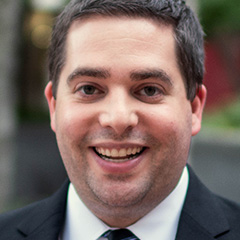 Joseph H. Paris is Dean of the School of Graduate and Professional Studies at
 Jake D. Winfield recently completed his Ph.D. in Policy and Organizational
share