

In this technological era, many scholars argue that AI, analytics, and digital transformation are needed across all fields (Ferrazzi 2025). As stated by Ferrazzi (2025): “AI revolution will separate winners and losers in any industry.” Analytics and digitalization have long existed, whereas AI is more recent. AI refers to machine-based systems that can, given a set of human-defined objectives, make predictions, recommendations, or decisions that influence real or virtual environments. AI systems interact with us and act on our environment, either directly or indirectly. Often, they appear to operate autonomously and can adapt their behavior by learning about the context (UNICEF 2021, 16). AI is also defined as “a technology that enables computers and machines to simulate human learning, comprehension, problem solving, decision making, creativity and autonomy” (IBM n.d.).
Accordingly, the scope of AI is broader, encompassing both analytics and digitalization. As Moore, Mamrick, and Reinhardt (2023) mention, AI “refers to the general ability of computers to emulate human thought and perform tasks in real-world environments, while machine learning refers to the technologies and algorithms that enable systems to identify patterns, make decisions, and improve themselves through experience and data” (Moore, Mamrick, Reinhardt 2023, 2).
In an increasingly digital world, rapid technological advancements are reshaping industries and driving change across all sectors, including higher education (IBM n.d.). Within this context, the integration of artificial intelligence into higher education is now imperative. As Ferrazzi (2025) mentions, since “AI’s real power lies in reimagining workflows across functions not just boosting productivity,” AI will play a crucial role and have a significant impact on EM. EM has been defined in multiple ways across literature. The most relevant definition for this article is from Hossler and Bean (1990), who state that EM is “an organizational concept and a systematic set of activities designed to enable education institutions to exert more influence over their students’ enrollment” (1990, 4)
Over the years, EM has become inherently goal-driven and results-oriented. Thus, it is not surprising that institutions of higher education have progressively recognized the need for reliable and systematic EM analytics (i.e., data and research). Recent scholarship has defined “EM Analytics” as: “The utilization of analytic tools and techniques, mainly computerized, to develop actionable decisions or recommendations in the student recruitment process that will successfully lead to matriculation at an educational institution” (Delcoure and Carmona 2019, 914).
Business intelligence (BI) platforms and data have long been used for decision-making in higher education management, leadership, policy-making, and learning. One example of BI and data-driven decisions implementation was mentioned by Hassanein (2020): “DGS (Dean of Graduate Studies office) embraces a data-driven strategic graduate enrollment plan. AUC (The American University in Cairo) is using business intelligence (BI) dashboarding to collect and centralize data across various academic areas at the graduate and undergraduate levels. Displaying centralized data in a highly visual and easy-to-use dashboard facilitates AUC administrators’ discovery of insights and sharing of data with business users through advanced analytics features” (Hassanein 2020, 22). EM Analytics stresses the importance of depending more on analytics, AI, and digitalization in EM. Accordingly, it aligns with the current article’s hypothesis, which argues that EM practices are more efficient with AI and digital transformation.
Fostering Engagement
As education stands at a technological crossroads, institutions need guidance to navigate the evolving landscape. It is important to recognize that success does not depend on fully adopting or rejecting AI, but rather on its thoughtful integration—an approach that prioritizes educational values, equity, and human connections. Implementing AI inevitably disrupts the status quo, leading to periods of resistance, inertia, and endurance among staff, students, and faculty. To foster engagement with this change and to nurture new institutional cultures, universities can pursue two core strategies that activate all ecosystem stakeholders composed of faculty, staff, students, and the surrounding community and drive the successful implementation of emerging practices: (1) employing visual mapping techniques and (2) cultivating innovation sprouts to guide transformation efforts.
Employing Visual Mapping: The EM Cracked Raceway Model
Research by Ball, et al. (2008), Filgueiras, et al. (2024) and Haefner, et al. (2021) demonstrates the transformative impact of AI on management. In the case of educational management, it reinforces the trend of marketization and constitution of education as a business” (Filgueiras 2024. AI has the potential to support teaching, learning, administration, and research, underscoring the need for its thoughtful integration within higher education. Accordingly, institutional stakeholders must be motivated and equipped to adopt AI as a catalyst for systemic advancement in higher education.
Once a change or transformation in strategies and processes is required, it is crucial, as Hassanein (2022) notes, “to assist stakeholders to imagine, visualize and sense their influence and impact on a process” (23). Visualizations help stakeholders grasp the big picture and understand their role in shaping change, thereby encouraging confident and sustained engagement. Providing visual information indicates a focus on the big picture and on improving the whole rather than on individual processes (Shou, et al. 2017). So, visual maps are vital for engaging stakeholders in the EM process, in general, and in its digitalization and AI association, in particular.
Hassanein’s (2022, 23) Student Journey Raceway illustration reimagines students as racers navigating key milestones of their journey, including application, orientation, academic support, and graduation. The faculty and staff are the pit crew who need to be trained and upskilled to provide personalized, timely support and assistance to ensure the student’s successful completion. As EM oversees the entire journey, this article reimagines EM’s role in the Student Journey Raceway, as illustrated in Figure 1. Although the track may seem functional, cracks—caused by outdated systems, fragmented processes, and growing digital complexity— are beginning to form across the road. These fissures threaten to slow students down, throw them off course, or even cause them to drop out of the race prematurely.
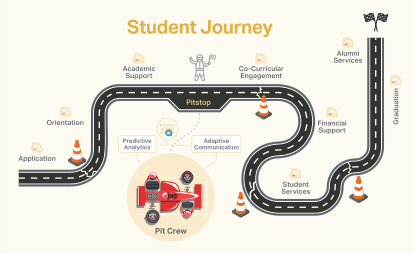
The Cracked Raceway Model depicts EM as a high-speed yet deteriorating track. The cracks symbolize underlying challenges: siloed data, manual decision-making, poor coordination, limited predictive insight, and delayed support for struggling students. As digital expectations rise and student journeys become more diverse, these flaws risk undermining the very system designed to guide students to success.
This race is about more than enrollment—it’s about empowerment. With students in the driver’s seat, institutions must ensure the track is strong. AI, through the T3 framework proposed later in this article, equips the human pit crew to reinforce, redirect, and refuel the student journey for success. Faculty and staff form the AI-powered pit crew, no longer watching passively from the sidelines or offering detached guidance but stepping in with the tools and insights needed to keep students safely and efficiently on track. Guided by the T3 Model (Trigger, Tailor, Track) — discussed below—AI serves as their toolkit and skill set, identifying where breakdowns occur, customizing timely interventions, and monitoring effectiveness over time. Furthermore, AI empowers the pit crew to respond precisely to students’ evolving needs through predictive analytics for recruitment, automated admissions and aid processes, real-time chatbots for engagement and retention, and much more.
While some institutions have already introduced AI tools, these efforts are often fragmented. To truly support every student-driver, institutions need a coordinated, ethical, and human-centered approach to AI—one that rebuilds the track rather than just patches it. That means rethinking workflows, aligning systems, and communicating with students in a language they understand that is responsive, data-informed, and digital.
Finally, visualizing the system in this way can build powerful buy-in across the educational ecosystem. The EM Raceway Model encourages faculty and staff to see themselves not just as passive spectators of AI, but as skilled collaborators in a vital support team. It invites them to upskill, take initiative, and engage in the shared mission of helping every student cross the finish line successfully, equitably, and empowered.
Although some AI-driven approaches are already in place, like chatbots (Annamalai, et al. 2023) and predictive analytics (Doleck, et al. 2020), structured human–AI collaboration remains indispensable for navigating the demands of the new era, developing effective models, reimagining workflows, and communicating with emerging generations in their own digital language. Achieving this transformation requires active stakeholder engagement in organizational change and meaningful participation in human–AI collaboration. Providing visual information indicates a focus on the big picture and improving the whole, rather than a focus on individual processes (Shou et al. 2017). Accordingly, it plays a critical role in conveying the need for change and securing stakeholder buy-in. Within this context, the EM Cracked Raceway Model facilitates collaborative AI adoption by marking the gaps along the student journey and making it visible and actionable. Furthermore, the model supports stakeholders in progressing along a developmental pathway toward AI literacy and proficiency, enabling them to use, design, and implement AI solutions that strengthen enrollment management practices.
Cultivating Innovation Sprouts
The second strategy for fostering new institutional models involves cultivating Innovation Sprouts. These initiatives build momentum from the ground up rather than through top-down mandates, by leveraging the efforts of individuals who are already experimenting with and generating value through innovative practices.
Institutions can identify these early adopters and invite them to share their use cases and experiences with others who are still in the early stages of learning. “This team would be considered higher education ‘innovation sprouts,’ as they are the ones who would lead and pace up the change” (Hasanein 2022). By establishing peer coaching circles, in which small groups of early users meet regularly to exchange best practices and coach one another, organizations can foster internal innovation without relying heavily on external consultants. As these groups document successes and circulate knowledge across the institution, proven methodologies begin to emerge organically through systematic cross-functional synergy and collaboration.
By nurturing grassroots movements, institutions create a sustainable, community-driven model for AI integration and innovation (Ferrazzi 2025). In addition, it will enable natural scaling through peers, with early users acting as mentors to guide small groups of eager learners. This approach allows knowledge to spread throughout the institution with minimal central coordination. It works because it taps into basic human psychology: people are more likely to adopt practices championed by respected peers than directives issued by leadership.
To repair the track, higher education stakeholders must be coached and guided to utilize AI as a change agent who will assist in addressing gaps, repairing the cracks, reinforcing the structure, and transforming enrollment into a data-driven, automated, and student-centered model. Stakeholders must be upskilled to design, implement, and continuously assess in-house human–AI collaboration models, enabling their ongoing refinement and adaptation. This upskilling may also contribute in the emergence of new institutional and cross-sector roles, such as prompt engineers, AI literacy educators, AI model trainers, and AI integration specialists. Moreover, developing these competencies helps prevent artificial ignorance—the condition that emerges when insufficient AI literacy leads to the misuse of AI or the inability to effectively navigate and develop AI tools.
Embarking on AI-driven transformation may be overwhelming, so it is crucial to prioritize the well-being of all stakeholders, including faculty, staff, and students. Consequently, “…training staff to apply Emotion AI may be of great benefit. It would enable them to follow up on students’ wellbeing, mental health, and other challenges and offer timely, empathetic support and communication” (Hassanein 2022, 26). This also includes maintaining their own health and well-being.
While AI enhances efficiency and decision-making, a rapid and unstructured shift can lead to resistance, stress, and uncertainty. Ensuring a smooth transition requires a human-centered approach that acknowledges the psychological and professional impact of technological change. By prioritizing the well-being of the ecosystem at the core of AI integration, institutions can build trust, reduce resistance, and foster an environment where AI is viewed as a collaborative asset rather than a disruptive force that overwhelms faculty, staff, and students in their academic and professional journeys.
Finally, for higher education professionals and innovation sprouts who will take the lead in coaching the educational ecosystem and creating the training materials, it is necessary to first identify and redefine AI in education as a tool, a skill, or both.
Beyond a Tool: AIing as a Skill
For a long time, AI was viewed as a simple tool used to complete tasks; universities, faculty, staff, and students could choose to adopt it or ignore it. However, in today’s rapidly evolving higher education landscape, AI is no longer optional, even though it does not benefit all stakeholders equally. Furthermore, the widespread use of AI tools requires developers and users to possess certain skills to navigate them and achieve optimal benefits. As Ferrazzi (2025) stated, “The future of AI in education will be determined not by the technology itself, but by how we choose to shape and use it in service of learning.”
This article argues that, given AI’s role as a game-changer across industries, it has evolved from a mere tool into a skill that professionals across fields must acquire to compete in this era. This article also contends that soon, an essential question will be added to all job interviews to assess the interviewees’ proficiency in AI: What is your level of expertise in AIing? This author proposes the term “AIing” and defines it as the act of developing, navigating, prompting, evaluating, and applying AI as a core skill within academic and administrative contexts. Accordingly, lacking proficiency in AI may lower the applicant’s chances of landing a job.
AI should be seen as a skill that all educators and students need to acquire to be competent in this digital era. AI is becoming a basic competency, as fundamental as reading, writing, or using the internet. Accordingly, before pursuing AI integration, stakeholders across the educational ecosystem must understand the benefits of this capability, recognize its necessity, and be equipped with the skill sets to adopt and implement it effectively.
To evaluate AI skill competency, institutions should establish AI competency levels, as digital literacy is assessed. Regional and international institutions should work toward a shared set of core competencies, with the flexibility to expand or adapt them to meet specific institutional needs. Subsequently, different methods for evaluating AI proficiency should be developed.
Table 1 shows the proposed proficiency levels, their usage description, and usage examples.
| Proficiency Level | Skill Usage Description | Example Use in Higher Ed |
|---|---|---|
| Basic | Understanding AI concepts, using AI-driven tools |
|
| Intermediate | Customizing AI settings, interpreting AI-generated insights |
|
| Advanced | Developing and training AI models, refining algorithms, and making strategic AI-driven decisions |
|
In addition, methods to assess AI proficiency should be developed to evaluate stakeholders’ proficiency levels and build on them for future development. These assessment methods would include: knowledge-based quizzes, case studies, and concept mapping; hands-on use of tools, simulations, and real-time challenges; and practical performance initiatives and integration planning.
The integration and implementation of AI in higher education institutions must be structured and applied systematically. The T3 model, detailed below, establishes a guided and moderated approach for AI implementation.
T3 Model
The T3 Model (Trigger, Tailor, Track) provides a structured approach for integrating AI as a skill and a craft in higher education EM, rather than just a tool. As AI becomes increasingly embedded in decision-making processes, institutions must shift from relying on AI as an external resource to developing an in-house, human-AI framework. Achieving this shift requires that faculty, staff, and students become AI literate and develop proficiency in AI. The human-AI collaboration “in higher [education] system would easily enrich the stakeholders of higher educational institutes as they would get scope to accurately and quickly exchange knowledge through AI” (Chatterjee and Bhattacharjee 2020, 3457), enabling them to apply learned models in practice. It would also help them integrate AI analytics to shape policies based on real-time institutional data. To achieve this collaboration, it is worth noting that human expertise is irreplaceable. AI enhances efficiency, accuracy, and personalization, while human expertise ensures ethical, meaningful, and inclusive decision-making. Accordingly, in AI-enhanced models, human expertise remains critical across all aspects of higher education, especially EM. The following equation represents the optimum human-AI collaboration while ensuring purpose, ethics, and fairness in all processes.
Human Judgement + AI-Driven Models = Scalable Solutions
Also, it is very important for higher education institutions to set key principles for human-AI collaboration to ensure AI is used effectively while keeping human expertise central. According to Amershi, et al. (2019), “Principles for human-AI interaction have been discussed in the human-computer interaction community for over two decades, but more study and innovation are needed in light of advances in AI and the growing uses of AI technologies in human-facing applications” (1). These principles include, but are not limited to:
- Augmentation, not replacement. AI will replace tasks, not jobs. Accordingly, it should handle repetitive, data-intensive tasks, while humans focus on critical thinking, ethical decisions, and student engagement.
- Human oversight and ethical guardrails. AI-driven decisions (e.g., admissions, financial aid) should always include human review to ensure fairness and equity. Moreover, institutions must audit AI models for bias and adjust policies accordingly.
- Training and upskilling for AI literacy. Faculty, staff, and students need AI literacy training to navigate AI-driven processes effectively.
- Student-centered approach. AI enhances efficiency, but human relationships, empathy and considerate interactions remain at the core of higher education.
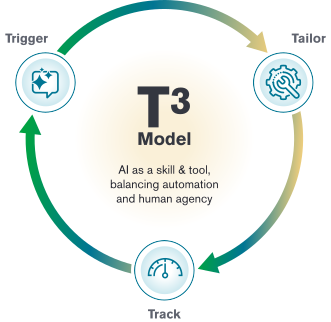
After setting these principles and sharing them with the stakeholders, the adoption of the T3 model, illustrated in Figure 2, would be justified. Accordingly, its implementation would be deemed necessary to enable higher education ecosystem elements to create and tweak AI models to best serve their purposes. The T3 model components are:
- T1 – Triggering: The input the human provides to AI (e.g., prompt, data, instructions).
- T2 – Tailoring: Adjusting and fine-tuning the model for better performance.
- T3 – Tracking: Evaluating the output, removing bias, implementing results, and assessing for further adjustments.
By integrating these three stages, the T3 model offers practical capabilities that enable stakeholders across the educational ecosystem to:
- Generate and refine ideas for enrollment strategies, instructional innovation, and student engagement,
- Create and adapt content, including communications, learning materials, assessments, and policy drafts,
- Improve productivity and decision quality through structured automation, while maintaining human oversight,
- Develop AI literacy and proficiency by engaging with AI as a skill and a craft,
- Design, implement, and assess AI-assisted workflows rather than relying on unstructured or non-transparent AI use,
- Mitigate risks associated with bias, over-automation, and misuse through continuous tracking and evaluation.
Moreover, by following this T3 model, higher education institutions can effectively integrate AI, ensuring EM remains efficient, ethical, and student-centered. This approach would also streamline and augment processes and make decisions more strategic, personalized, and efficient.
To enhance enrollment, some applications of the T3 model in the enrollment assessment phases—such as projection, recruitment, admissions, the student journey, retention, financial support, and funding opportunities introduced by Hassanein (2020)—are detailed below.
Phase 1—Enrollment Projections: Interpreting AI-Driven Insights
- AI Role: analyzes data to understand individual behavior and enrollment patterns to offer insights.
- Stakeholder Focus: contextualizes insights for decision-making and
ensure alignment with institutional mission.
- Trigger: AI is requested to gather and process large datasets to forecast enrollment trends.
- Tailor: Staff adjust enrollment policies based on AI-driven predictions, considering institutional goals and external factors.
- Track: AI dashboards monitor enrollment patterns, and human leaders validate insights before implementing strategies and devise any further adjustments.
Phase 2—Recruitment: Personalized Outreach
- AI Role: Supports personalized outreach by identifying patterns and trends across recruitment fairs and engagement events.
- Stakeholder Focus: Enables data-driven recruitment through
coordinated faculty and admissions collaboration, leveraging
AI-powered segmentation to target
prospective students based on their interests, profiles, and engagement
behaviors.
- Trigger: AI is requested to identify prospective students based on browsing behavior, academic background, and engagement with university materials.
- Tailor: Recruitment officers refine AI-driven marketing strategies to target diverse demographics
- Track: AI monitors outreach success rates, and staff adjust campaigns accordingly and reevaluate the processes to implement any necessary changes.
Phase 3—Admissions: Efficient Review of Data Elements
- AI Role: Assists in pre-screening and evaluating applicants’ attributes
- Stakeholder Focus: Reviews
AI-screened applicant pools and assess the
applicants’ non-cognitive variables, like motivation, resilience, and
empathy, and make the final decisions ensuring fairness.
- Trigger: AI is asked to sort applications, highlighting strong candidates based on historical trends.
- Tailor: Admissions teams review flagged applications, assess qualities AI cannot quantify (e.g., motivation, leadership, personal challenges) and override AI decisions where necessary to maintain equity and diversity.
- Track: AI analyzes trends in admission success rates, informing future policy changes and teams assess the strategies in hand to make any necessary modifications.
Phase 4—Student Journey: AI-Powered Student Support
- AI Role: Enhances academic and career advising by quantifying program and interdisciplinary course impact, evaluating student performance, and identifying personalized learning and progression pathways.
- Stakeholder Focus: Provides targeted mentoring and advising to
support student well-being, ensure successful progression across
disciplinary and interdisciplinary curricula, and promote timely program
completion.
- Trigger: AI chatbots are developed to answer routine student queries and track student engagement.
- Tailor: Advisors intervene in complex advising issues and offer human interaction to safeguard student wellbeing along the journey.
- Track: AI generates reports on student support effectiveness. Advisors reassess the procedures in place to ensure their effectiveness and make alterations if deemed necessary.
Phase 5—Retention: Early Risk Detection
- AI Role: Identifies students at risk due to academic, financial, or any other challenges by analyzing early cautioning indicators.
- Stakeholder Focus: Leverages
AI-powered early alert systems to enable
timely, personalized interventions that support student persistence and
well-being.
- Trigger: AI is requested to identify at-risk students based on specific metrics including attendance, grades, engagement, registration persistence, etc.
- Tailor: Counselors personalize outreach strategies based on flagged insights, guide students to the available resources that can assist them and develop a personalized support-engagement plan to retain the student.
- Track: AI measures intervention effectiveness and recommends adjustments. Counselors evaluate the effectiveness of these strategies and make the necessary adjustments.
Phase 6—Financial Support and Funding Opportunities: Optimized Aid Distribution
- AI Role: Supports financial aid decision-making by recommending aid strategies, evaluating scholarship and fellowship applications, determining student eligibility, and generating award communications.
- Stakeholder Focus: Uses
AI-assisted analyses to inform committee
decisions for allocating merit-based and need-based financial support in a
transparent and equitable manner.
- Trigger: AI is prompted to evaluate students financial data and predict aid requirements.
- Tailor: Financial aid officers adjust recommendations based on individual student needs.
- Track: AI audits financial aid distribution efficiency. Officers reevaluate the effectiveness of the aid distribution and make any necessary changes to the model.
By applying the T3 model across enrollment management (EM) assessment phases, universities can ensure that AI is deployed effectively while maintaining essential human oversight. This structured integration enables institutions to audit algorithmic processes and uphold principles of fairness, transparency, and ethical responsibility, while also supporting personalized student engagement and decision-making. Beyond operational gains, the T3 model contributes to broader institutional capacity-building by strengthening AI literacy and developing AI proficiency across the higher education ecosystem.
Specifically, the application of the T³ model allows universities to:
- Ensure human-in-the-loop oversight, enabling stakeholders to monitor, validate, and adjust AI-driven processes.
- Promote ethical and equitable AI use by systematically identifying and mitigating bias in enrollment-related decisions.
- Enhance recruitment, admissions, retention, and student success through data-informed and personalized interventions.
- Empower faculty, staff, and administrators with AI literacy and practical proficiency, positioning AI as both a skill and a craft.
- Support continuous learning and adaptation, allowing institutions to respond effectively to evolving student needs and technological change.
Furthermore, the T3 model can be mapped onto the AI competency assessment to ensure that AI proficiency is not only tested but also refined and continuously improved. Below, a proposed alignment illustrates how each phase of the cycle supports AI proficiency assessment in higher education enrollment management.
The T3 Model Implementation in AI Proficiency Assessment
Table 2 presents the implementation of the T3 model as a structured mechanism for assessing and developing AI proficiency across the higher education ecosystem. Building on this process-oriented framework, Table 1, earlier, defined the resulting AI proficiency levels by describing the skills, capabilities, and practical applications associated with each stage. Together, the two tables demonstrate how the T3 cycle operationalizes AI proficiency development and enables stakeholders to progress from basic AI usage to advanced, strategic AI integration in enrollment management.
| T3 Phase | Objective | Application in AI Proficiency Testing | Outcome |
|---|---|---|---|
| Trigger | Define AI competencies to be assessed and engage stakeholders in testing their knowledge. | Pre-test, self-assessment, AI literacy quiz | Identifies baseline proficiency levels |
| Tailor | Adapt learning pathways based on assessment results to meet stakeholders’ needs. | Personalized training modules, adaptive AI courses | Custom learning pathways for improvement |
| Track | Use AI-generated performance data to monitor progress and iterate training strategies. | AI-powered tracking dashboards, post-training evaluation | Continuous monitoring and skill development |
Finally, fostering engagement through visual mapping and Innovation Sprouts, clarifying AI’s role as both a tool and a skill, and integrating it through the T3 model builds institutional agency and ensures that the higher education ecosystem is prepared to lead sustainable human–AI collaborative workflows.
Building on this institutional readiness, the following section shifts from conceptual alignment to applied practice by examining how the higher education ecosystem can be upskilled through sustained, hands-on engagement with AI.
Upskilling the Ecosystem through Practice
“The prospect of use of AI includes investigation of educational implications as to how teachers would enrich them, how students would learn, and how accurate and prompt decisions can be taken in the institutes of higher [education]” (Chatterjee and Bhattacharjee 2020, 3443).
It is fundamental that, through upskilling stakeholders, institutions build agency for AI embracement. Humans have, and will always have, the upper hand in technological development, usage, and allocation. So, upskilling stakeholders to develop, implement, use critical thinking to evaluate, and reinvent AI in hand is necessary to build agency and be in control of the new technology. Accordingly, upskilling alone is insufficient; institutions should also critically assess their processes and remain mindful that AI is fundamentally a product of human intelligence. Maintaining this awareness encourages future generations to continue developing their own skills rather than over relying on AI, while reinforcing that humans have driven—and will continue to drive—technological change, not the other way around. As AI evolves from a mere tool to a skill, stakeholders need to be upskilled in AI to meet the required proficiency levels. As mentioned by Chatterjee and Bhattacharjee (2020) “…unless the students, teaching and non-teaching staffs including administrative staffs adopt AI, its benefits cannot be perceived” (3444).
Evidently, AI and digitalization are making the transition in higher education EM as “…now is the time for universities to rethink their function and pedagogical models and their future relation with AI solutions and their owners. Furthermore, institutions of higher [education] see ahead the vast register of possibilities and challenges opened by the opportunity to embrace AI in teaching and learning” (Popenici and Kerr 2017, 11). AI solutions have opened a new horizon of opportunities for teaching, learning as well as for administrative works in institutes of higher [education]” (Chatterjee and Bhattacharjee 2020, 3456).
AI now directly influences major university functions, such as admissions, advising, student success tracking, and financial aid allocation. Higher education institutions must coach and guide stakeholders to understand and leverage AI effectively. AI literacy is becoming a professional necessity, just like digital literacy was in the early 2000s. As previously mentioned, higher education institutions must actively train and upskill all stakeholders to be competent in using AI.
It is a valuable practice to collect data from stakeholders to evaluate their perceptions of the new concept before introducing it and embarking on the guided implementation journey. Accordingly, it is useful for the institution to gather the perceptions, ideas, and suggestions of the stakeholders regarding the new skill and practice to be implemented. This would give stakeholders a sense of ownership over the process, encouraging them to collaborate and open their eyes to EM challenges and the necessity of change. Also, it would allow the institution and the innovation sprouts to tailor the training and guidance in a relatable, individualized manner when incorporating these suggestions.
These questions can be shared in a questionnaire, like the one below, and sent via email or asked in individual meetings. The template shown in Table 3 is an example of a form to be used to collect data from faculty and staff involved in enrollment management.
| Strategies | Techniques | AI Integration |
|---|---|---|
| Pillar #1: Recruitment and Admission | ||
| What are some effective ways to attract and identify strong candidates for our program? (Think of target audience, program differentiation, and marketing approaches) | What specific actions can we take to implement your suggested strategies? (Consider outreach initiatives, application process improvements, or scholarship programs) | How do you envision AI tools (e.g., predictive analytics, chatbot communication, personalized marketing) supporting or transforming our recruitment and admission efforts? |
| Pillar #2: Retention and Completion | ||
| How can we create a learning environment and support system that fosters student success and graduation? (Think inclusive learning, academic advising, and career development) | What specific programs or initiatives could we implement to achieve your suggested strategies? (Consider mentoring programs, personalized advising, or career workshops) | How might AI be used to identify at-risk students early, personalize academic support, or improve student tracking for timely interventions? |
| Pillar #3: Financial Support | ||
| How can we make our program more financially accessible and attract diverse students? (Think of scholarship models, financial aid guidance, and affordability efforts) | What specific funding mechanisms or support services could we offer to implement your suggested strategies? (Consider partnerships with funding organizations, flexible payment plans, or work-study options) | How could AI help optimize financial aid distribution, identify students with unmet financial needs, or personalize funding options? |
| Pillar #4: Student Services | ||
| How can we ensure students have access to the resources and support they need outside the classroom? (Think career guidance, health services, and extracurricular activities) | What specific services or programs could we develop or improve to implement your suggested strategies? (Consider online career resources, alumni mentorship networks, or mental health counseling services) | In what ways can AI enhance student services, such as automating support, expanding access to resources, or improving personalization? |
| Introductory Language | ||
| We value your expertise and want your input in shaping our AI-EM plan for the program. Four EM pillars are identified along with assessment that is considered an ongoing activity that embraces the pillars for regular evaluation and development. | ||
| Optional Open-Ended Questions | ||
| ||
| N.B.: Remember, effective strategies involve combining multiple techniques and constantly evaluating their effectiveness. | ||
Following data collection and analysis, tailored workshops, training resources, and practical guidelines should be developed for each group within the higher education ecosystem. Given the central role stakeholders play in enrollment management, it is equally important to address change from their respective perspectives and actively involve them in the transformation process to ensure institutional AI readiness.
Student Perspective: Preparing for an AI-Driven Future
As AI continues to reshape industries and redefine professional expectations, students must develop AI literacy not only to remain competitive in the job market but also to thrive in AI-augmented learning environments. Adaptive learning platforms now personalize educational pathways using AI, while digital ecosystems for research, networking, and job placement increasingly rely on intelligent automation. To succeed in this evolving landscape, students must go beyond basic usage and learn to integrate AI ethically, strategically, and responsibly into both academic and professional contexts.
Students are encouraged to view AI as a skill to be acquired and a collaborative tool, not a substitute for critical thinking or intellectual effort. This skill would be used to enhance their learning and performance, while preserving their independent reasoning, authorship, and academic integrity.
Table 4 details various higher education efforts in preparing students professionally and academically.
| Professionally: Preparing Students for the Workforce | Academically: Developing Governance and Guidance |
|---|---|
To build future-ready graduates, institutions need to offer:
| To help students to be skillful in using AI responsibly in academic
contexts, institutions need to develop:
|
Faculty Perspective: AI in Management and Academics
The importance of faculty engagement in EM is indispensable; this underscores the need to upskill and engage faculty in the AI-human interaction journey in higher education. Faculty members serve as the most impactful ambassadors, able to confidently communicate the institution’s overall quality and experience to prospective students. Furthermore, the quality of faculty as instructors and mentors is among the most important factors in choosing a college for both prospective students and their parents (Delcoure and Carmona 2019).
Institutions should offer recommendations and guidance on faculty engagement to enable them to integrate AI-driven insights into EM, as mentioned in the T3 model section above. Nevertheless, faculty play a crucial role in shaping how students interact with AI in the learning environment; they need to reimagine their classrooms with adaptive learning platforms, modify their teaching methodologies, integrate AI assessment techniques to provide just-in-time personalized feedback, design curriculum with AI, contribute to students’ AI literacy and academic integrity, and much more as the need arises. Furthermore, it is important that faculty help institutions establish AI ethics committees to regulate AI deployment.
Staff Perspective: AI in Administration
The third stakeholder is staff. Administrative staff are always perceived as the backbone of higher education institutions, serving as liaisons between faculty and students. They also play a crucial role in enrollment and institutional management. Hassanein (2022) noted that “AI would enable staff to optimize students’ potentials, accelerate their abilities and innovation, and reveal their concealed capacities. It may also allow staff to group students together according to their behaviors and interests to boost their academic and lateral thinking and social skills (whether virtually or face-to-face)” (26). It is noteworthy that most EM tasks required by faculty involve staff.
Morandini, et al. (2023) emphasize the importance of upskilling staff to use AI meaningfully alongside their activities in EM processes. Enrollment officers must understand AI-driven predictive analytics, be able to modify them, and master prompting and modeling to make strategic recruitment and retention decisions. They also need to adopt hybrid AI–human workflows, where AI-powered chatbots and virtual assistants automate student engagement. Moreover, they need to develop and implement AI-driven allocation models to optimize financial aid distribution and minimize the risk of student debt. Staff also leverage AI analytics to identify patterns in dropout behavior, persistence, and academic risk, enabling more proactive, personalized student retention interventions.
Administrative leaders play a critical role in shaping the AI readiness and governance of their institutions. As decision-makers, they must strategically harness AI to enhance operations, inform policy, and support both faculty and students. This includes, but is not limited to, strategic planning with AI insights, AI-generated forecasting and scenario modeling modification, data-informed policy development, governance of AI use across campus, faculty and staff enablement, AI-supported institutional dashboards, operational optimization, and student support integration.
The Surrounding Community
The surrounding community in higher education is defined by Hassanein as “individuals surrounding students, such as parents and members of society who are not formally affiliated with the institution or who may be disadvantaged” (Hassanein 2022, 27). As faculty, staff, students, and the surrounding community are interconnected within the same educational ecosystem, engaging the community through targeted training and awareness initiatives can meaningfully support student progress. As Hassanein (2022) notes, “training and awareness sessions offered to the surrounding community can assist in students’ progress. This could be part of the social activities that students undertake and part of their commitment to give back to their community” (27).
Such engagement expands access to quality and affordable education while promoting diversity, equity, and inclusion. It also ensures that members of the surrounding community are not excluded from participating in an increasingly technology-driven educational landscape. Accordingly, structured and regularly scheduled developmental workshops should be extended to the surrounding community to support collective growth and strengthen the higher education ecosystem as a whole.
Conclusion
As enrollment management becomes increasingly data-driven and digitally complex, institutions that fail to integrate AI meaningfully and upskill their faculty, staff, and students risk falling behind. This article has demonstrated that traditional EM models are no longer sufficient; they are collapsing under the weight of inefficiencies, outdated workflows, and disconnected systems. To address this, AI must be viewed not as a passing trend or a technological convenience, but as a core institutional skill, a strategic asset that empowers human capacity rather than replaces it.
The Cracked Raceway Model introduced in this article presents the breakdowns in the student journey caused by outdated EM systems. It also emphasizes that empowering the institutional “pit crew” with AI is essential to repairing these cracks and keeping students on track toward graduation.
In this new paradigm, the role of humans will shift from performing repetitive tasks to making strategic, ethical, and student-centered decisions, while AI handles automation, forecasting, and personalization. This shift requires deliberate investment in AI literacy, embedded within training, policy, and daily operations. Only by mastering AIing—the ability to navigate, prompt, evaluate, and apply AI critically—faculty, staff, and students can succeed in this era of transformation.
Furthermore, the T3 Model (Trigger, Tailor, Track) offers a structured framework for integrating AI proficiency into higher education, enabling institutions to assess needs, personalize implementation, and track progress, all while preserving essential human oversight. However, true transformation goes beyond technology. It demands a cultural shift: one that builds stakeholder agency, embeds ethical governance, and champions continuous upskilling across all levels of the academic ecosystem.
Ultimately, fostering AI as a skill rather than just a tool allows institutions to create learning environments where technology enhances human potential across teaching, research, administration, and enrollment management, while also developing AI-ready lifelong learning systems. Universities that embrace this shift will not only repair cracks in enrollment management but also unlock the full potential of AI to drive more effective, data-informed, and personalized EM strategies. By building equitable, adaptive, and future-ready systems, they ensure that every student has a clear, supported path to success while positioning themselves as leaders in higher education’s digital transformation.
 Shaimaa Nabil Hassanein is a higher education leader, data strategist, and AI
share