
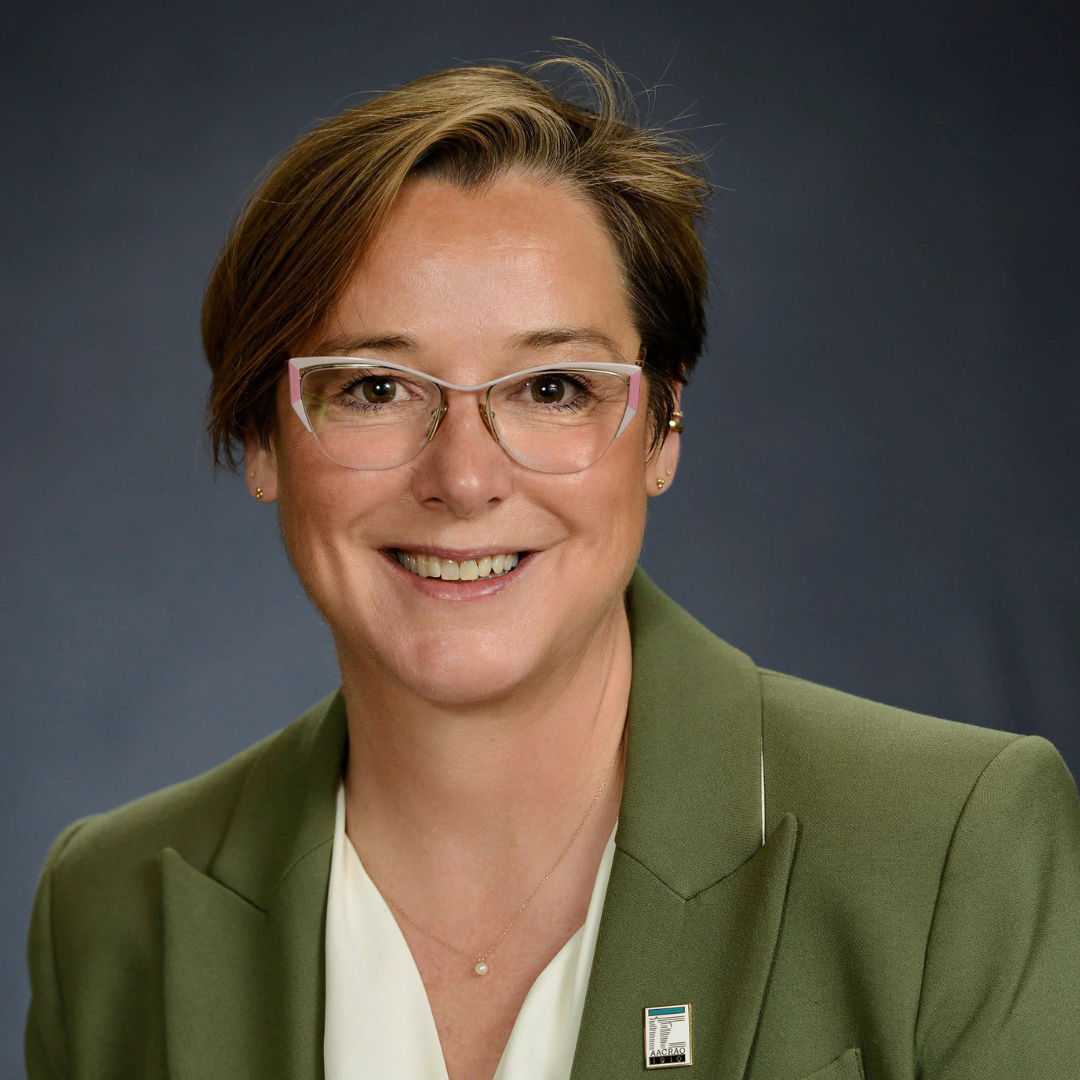
By Melanie Gottlieb, Executive Director, AACRAO, and President of the Groningen Declaration Network.
Last week I had the privilege of joining colleagues from across Mexico at the XIX Congress of the Association of School and Student Services Managers, or ARSEE, our sister association of school services and registrar professionals, hosted in Acapulco by the Universidad Interamericana para el Desarrollo. I came wearing two hats: as Executive Director of AACRAO and as President of the Groningen Declaration Network. By the end of the week, the reasons for our longstanding partnership with ARSEE were clear. Our contexts are quite different, but the work, and the goals, are the same.
Recognition: A word that travels better
One lesson I took home was about language. In the United States, AACRAO talks about Learning Mobility: a learner’s ability to carry, build on, and articulate their learning across institutions, systems, and life stages. In Spanish, the idea that resonates most directly is “reconocimiento,” or recognition. I had multiple hallway conversations with colleagues who shared the ways in which the contextual spaces for recognition between Mexico and the U.S. are different, but the principles that allow for greater recognition are the same: quality, transparency, trust. Mobility is the outcome learners experience; recognition is the work we do to make it possible. AACRAO Learning Mobility work stands on four principles that translate in any language: center the learner, build systems that can talk to each other through open standards, protect and promote the value of higher education, and make opportunity equitable.
The same shift is reshaping recognition everywhere: toward skills, microcredentials, and shorter, more flexible credentials.
- In the United States, reduced-credit bachelor’s degrees of roughly 90 credits are spreading quickly, and employers and states are beginning to move from seat time toward verifiable skills. There is a desire to open recognition for learning outside of a formal credential. Their learning is real; our systems just haven’t found a way to count it. Despite global conventions that are aligning systems, the US cannot participate formally. Recognition, like everything else in the education space in the US, is decentralized. Institution by institution, licensing board by licensing board, employer by employer. To counter the decentralization, AACRAO is working to drive a national conversation, with partners through the Learning Mobility Coalition, the LER Accelerator, and our Start from YES approach to recognition, because roughly 37.6 million American adults have some college and no credential. We have to do better for them.
- In Mexico, employers are hiring for skills, too, and the infrastructure to support it is being built: university networks collaborating on microcredentials, a national competency framework is in development, and there is a growing commitment to standards-based digital credentials. Recognition in Mexico’s model is centralized and federally regulated, and it is assessment-heavy. Mexico recognizes whole qualifications rather than partial credit, so there’s little stackability between labor competencies and academic programs. But because of the top-down formality of Mexico’s recognition, it has a long history of participation in formal global frameworks and conventions.
- Globally, recognition is a shared responsibility. The UNESCO Global Convention and the work of the Groningen Declaration Network rest on a simple premise: when learners move, their records should be trustworthy, portable, and in their own hands. AACRAO fully champions this mission as a founding member of the GDN. GDN acts as a convener to align the theoretical and the principle behind learning mobility with the global practical. This is where the GDN’s “network of networks” stops being an abstraction. Partnerships between associations and industry and governments are where trust actually gets built, one shared practice and one verified learning artifact at a time.
The professional themes transcend context and culture
My session was one of four plenaries, and the rest of the program said as much about where our profession is headed as anything on my slides. ARSEE organized the Congress around five lines of work: professional development and wellbeing, digital transformation and AI, regulation and quality, the whole student experience, and emerging challenges such as alternative credentials and inclusion. Four threads stood out to me.
- Trust in documents. Workshops and talks on document validation, document security, and authenticity in school processes ran through all three days. That is the problem the Groningen Declaration Network has worked on for more than a decade: a record is only as mobile as it is trustworthy, and verifiable digital credentials are how recognition scales across borders.
- Recognition as regulation. Two of the four plenaries came from Ministry-level presenters, and other sessions covered compliance in private higher education, and Mexico’s National Qualifications Framework. In Mexico, revalidation and equivalency sit at the center of how learning is recognized, which makes ARSEE’s members natural partners in the recognition conversation.
- AI in the registrar’s office. The opening keynote by UNID’s rector, Paulina Adalid Fernández, was about educating the human in the age of artificial intelligence, and sessions explored generative AI, autonomous agents, and predictive enrollment. The program raised the same questions we are asking at AACRAO: how to automate processes without losing professional judgment, and how to keep records trustworthy when machines help produce them.
- The people who do the work. A full block of sessions addressed mental health at work, burnout, and purposeful leadership. Others, such as one on moving the understanding of our work from an operational area to a strategic partner and one tracing the path from the traditional registrar to 21st-century school services, described a profession redefining its role. That conversation is happening on both sides of the border, and is directly aligned with the first goal of our strategic plan.
None of these sessions was labeled “learning mobility,” but each one is part of it. Validating a document, revalidating a degree, and supporting the staff who do both are the daily practice of recognition.
One learner, six handoffs
My session was one of four plenaries, titled “Beyond Borders: AACRAO’s Learning Mobility Framework and the Future of Equitable Recognition.” I opened with a composite learner I called “Sofía.” She:
- Finishes her bachillerato in Guerrero.
- Earns a microcredential.
- Enrolls at a community college in Texas.
- Engages in Optional Practical Training and picks up work-based learning.
- Transfers to a university and completes a bachelor’s degree,
- And eventually comes home to Mexico.
That is six handoffs. At each one, someone decides whether and how what Sofía learned counts. Every handoff is a chance to recognize learning, or to lose it. None of this is hypothetical. It is the everyday work of our profession, on both sides of the border.
Registrars as architects of trust
If there is one message I hope traveled home with attendees, it is this: recognition policy is one of the most powerful equity levers in higher education, and it is one we control.
Not legislators, not our EdTech partners who provide the tools to enable our work. Registrars, admissions professionals, and credential evaluators decide every day whether learning carries forward. We are the architects of trust that make learning mobile, and we have a responsibility to help to make social and economic mobility more accessible.
What comes next
I left Acapulco with a full notebook and a lot of momentum. My thanks to ARSEE’s leadership, to UNID for hosting, and to every colleague who stopped me in a hallway to share how they are solving these problems at their own institutions. We have much to do, but these experiences energize and reinforce the commitment. Muchas gracias.


share