
Welcome to the new AACRAO website. While the site is live, development is ongoing, visitors can expect updates and new features in the weeks ahead.

Ukraine

Last Updated:

27 November, 2024


Overview

Located in southeast Europe, Ukraine is neighbor to Belarus and Russia to the north and east, and to Moldova, Romania, Hungary, Slovakia, and Poland on the south and west. Carpathian and Crimean mountains rise in the south, and Ukraine has coastline on the Black Sea. The population of Ukraine is about 47 million, 67% in the urban industrial east. Although Russian is widely spoken, some 90% of the people claim Ukrainian as their native language. The country has about 200 colleges and universities and 500 technical and vocational schools, and 70% of the current adult population attended secondary or higher education.

Scythians, Goths and other nomadic peoples arrived in the Ukraine area throughout the first millennium B.C. Greeks and Romans established trading outposts there. Slavic tribes occupied central and eastern Ukraine in the 6th century A.D. and established Kiev, which long prospered as a commercial crossroad. By the 11th century “Kievan Rus” was the largest state in Europe. Most of the population converted to Christianity by 1000 A.D. But rivalries among feudal lords precipitated decline, Mongol raiders destroyed Kiev in the 13th century, and for hundreds of years the territory of modern Ukraine was partitioned and controlled by different forces—Poland, Lithuania, Russia, the Austro-Hungarian Empire, the Soviet Union. Through it all, the Ukrainian people maintained a sense of individual identity. The Cossacks earned a reputation for fierce martial spirit and love of freedom. Writers and intellectuals kept alive Ukrainian linguistic and cultural traditions.

After suppression by Stalin and the Nazis in the 1930s and 1940s, Ukraine spent another 46 years as a communist state within the Soviet Union. But the 1986 explosion at the Chornobyl nuclear power plant was in many ways a turning point for the Soviet Union and Ukraine, and with the collapse of the USSR, Ukraine became an independent state in 1991.

Preview EDGE Ukraine

Education

Ukraine began to reform its Soviet-dominated education system immediately after independence. Currenty, education in Ukraine is overseen by the Міністерство освіти і науки.

Primary and Secondary Education

All children, ages 7-16, attend a 9-year compulsory primary and lower secondary (middle) school program. When students complete the first nine years of education, they receive the Certificate of Incomplete General Secondary Education. After two years of upper secondary education, students receive the Certificate of Complete General Secondary Education.

Upper secondary education takes place at two types of institutions: general academic schools and secondary vocational-technical schools. Secondary vocational-technical schools are designed to give lower secondary graduates skills for entry directly into the job market. These studies are at the technikum, for highly skilled technical, industrial, engineering studies, agriculture, business and some applied arts; and the uchilishche, for pre-school teacher training, nursing, medical technologies, and librarianship. Admission to these upper secondary institutions is based on the nine-year Certificate of Incomplete General Secondary Education and heavily weighted entrance examinations which confirm general and mathematical knowledge. Programs last up to 5 years; typically 3 years to complete secondary education and 2 years of postsecondary education. Certificates awarded after three years of study include the Atestat or Matriculation School Certificate, Vocational School Leaving Certificate, Professional Secondary School Leaving Certificate, and, after two years of postsecondary level study, the Junior Specialist Diploma.

Post-Secondary Education

In the Ukraine, all education from the upper secondary through doctoral levels is considered “professional” education, and is as follows:

  • Level I: Technical and vocational education = first (or initial) professional education
  • Level II: College education = intermediate professional education/basic higher education
  • Level III: University education = higher professional education/complete higher education.

Traditional Ukrainian (Soviet) higher education was highly specialized, and emphasized engineering, technology, science and military fields. Curricula included mostly mandatory field­ courses and few un­related subjects like social sciences or humanities. Since 1992, private education institutions in particular have more closely followed Western models, and offered more flexibility and career variety. Economics, management, and the humanities have been especially popular.

The Ministry of Education is the only accrediting body, and both public and independent institutions may conduct educational activities and offer degrees at three levels.

Level I

Uchylyshcha and Technika (Vocational and technical schools) award the Swidoctwo Pro Zakinchennia Uchylyshcha and the Diplom Technika.

Institutions of Levels I and II are now considered institutions of higher education (prior to 1992 they were specialized secondary schools). They can exist separately or be affiliated with other institutions. Students can be admitted to Level I programs after completing either the Certificate of Incomplete General Education (which represents nine years of education), or the Certificate of Complete General Secondary Education (which represents 11 years of education); plus entrance examinations.

Students entering after “incomplete secondary education” study for one to five years. Students completing one or two year programs receive the Swidoctwo Pro Zakinchennia Uchylyshcha which qualifies them for employment. Students studying in programs of three, four or five years duration receive both the Attestat and the Swidoctwo Pro Zakinchennia Uchylyshcha, which qualifies them for employment and further education.

Students entering after “complete secondary education” study for two to three years and receive the Diplom Technika, (Professional Secondary School Leaving Certificate), which qualifies them for employment and further education.

Level II
Colleges award the Junior Specialist Diploma with Professional Qualification or the Bachelor’s degree.

Many of the institutions of Level II are the old secondary Technicums now upgraded to colleges. They tend to admit only students who have completed the Certificate of Complete General Secondary Education. The standard length of a program is 4 years and the award is the Bakalavra. This is consistent with the Bologna process which instituted the first separation between undergraduate and graduate (see Level III below) degrees throughout Europe.

Levels III and IV
Institutes, conservatories, academies, and universities award Dyplom Spetsialista, Bakalavra, Magistra, Kandydat Nauk and Doktor Nauk degrees.

Institutes normally offer Level III programs, and universities and academies usually rank at Level IV. (For example, after 1992, Level III Kiev Polytechnic Institute became the Level IV National Technical University of Ukraine, and expanded its degree offerings.) An “Institute” in Ukraine may offer a broader range of higher education programs than is often associated with specialized institutes elsewhere.

The Dyplom Spetsialista requires 5-6 years of study beyond the Certificate of Complete General Secondary Education. As the name implies, this diploma is awarded in highly specialized fields, especially in engineering.

The Master’s Degree also requires one to two years (and frequently one additional semester practicum) beyond the Bakalavra (bachelor’s degree). The master’s degree is oriented toward a scientific or research career.

Ukraine has two doctoral degrees, the Kandydat nauk, and Doctor nauk. The Kandydat nauk is awarded after 3 or 4 years of research beyond either the Dyplom Spetsialista or the Masters; plus a thesis and examinations. The Doctor nauk is the highest degree in Ukraine, awarded only to those already holding a Kandidat nauk who have published a significant volume of original research over an extended period of time. The doktor nauk is comparable to postdoctoral study in the United States.

Continuing Education

Ukraine continuing education serves persons who are already on the job. Candidates for such courses must pass an entrance exam. Some higher education institutions (mostly private) have departments of continuing education. A few higher education institutions organize evening classes in industry, at the same level as full-time studies. Ukraine television broadcasts public educational programs for students and teachers, primarily at the secondary level.

Teacher Training

Pre-primary and primary school teachers are trained in teacher-training institutions of Level I or II (see text, above). Secondary school teachers are trained at institutes and universities, (see Level III, above) in the respective faculties of their teaching specialties (Education, Mathematics and Natural Sciences, Physical Education, etc.). Higher education teachers are recruited from among university graduates who hold the Master or Candidate of Science degrees, and generally have some education training.
Credential Description

Diploma of Bachelor. The Ukrainian Bakalavra is an academic and professional diploma generally awarded after 4 years of study (6 years in medicine).

Credential Advice

The Dyplom Bakalavra (Diploma of Bachelor) represents attainment of a level of education comparable to a bachelors degree in the United States.

Credential Author Notes


Requirements

Entry requirement: Certificate of Complete General Secondary Education. Leads to: Employment or graduate studies.

Credentials

Search

Filter by Level

Title

Description

  • [Certificate of Basic Secondary Education]. Awarded after the completion of 9 years of education.

  • Vocational School Leaving Certificate. This is a five year combined upper secondary and post secondary program undertaken at specialized secondary and technical / vocational educational institutions: the technikum, for highly skilled technical, industrial, engineering studies, agriculture, business and some applied arts; and the uchilishche, for pre-school teacher training, nursing, medical technologies, and librarianship. Students must…

  • Junior Specialist Diploma. First awarded in 1993, the Dyplom Molodshogo Spetsialista (Junior Specialist Diploma) represents two years of postsecondary study beyond the Atestat (Certificate of Complete General Secondary Education, or Matriculation Certificate), or four years of study beyond the Swidoctwo Pro Nepownu Seredniu Oswitu (Lower Secondary School Leaving Certificate or Certificate of Incomplete General Secondary…

  • Diploma of Bachelor. The Ukrainian Bakalavra is an academic and professional diploma generally awarded after 4 years of study (6 years in medicine).

  • [Diploma of Specialist]. Until 2016, the Dyplom Spetsialista was awarded after 5 to 6 years of study, depending on the type of institution and field of study. Post-Bakalavra Specialist Diplomas were awarded after 1-2 years of study.

  • [Masters Diploma]. The Dyplom Magistra is awarded on the basis of 1 to 2 years of study beyond the Dyplom Bakalavra or Dyplom Spetsialista. Masters candidates must also pass final examinations and defend a thesis.

  • [Certificate of Complete General Secondary Education]. Since 2019, awarded after completion of 2 years of upper secondary education.

  • Diploma of Doctor of Science. Doctor Nauk is the highest academic degree in Ukraine, awarded only to those already holding a Kandidat Nauk who have published a significant volume of original research over an extended period of time.

  • Diploma of Candidate of Science. The Candidate of Science is obtained after 3 to 4 years of study, including public defense of a thesis and required examinations.

  • Diploma of Physician / Dentist / Veterinarian. This credential represents 6 years of post-secondary study of human medicine, 5 years for dentistry and veterinary.

  • [Certificate of Complete General Secondary Education or Matriculation Certificate]. Issued until 2019. Upper secondary grades 10 and 11 were called “Complete Secondary Education.” Programs were completed at general academic schools.

  • Professional Secondary School Leaving Certificate. Two or three year program undertaken at specialized secondary and technical / vocational educational institutions: the technikum, for highly skilled technical, industrial, engineering studies, agriculture, business and some applied arts; and the uchilishche, for pre-school teacher training, nursing, medical technologies, and librarianship. Students must pass heavily weighted entrance examinations which…

Title / Description

  • Svidotstvo pro zdobuttia bazovoi serednoi osvity

    [Certificate of Basic Secondary Education]. Awarded after the completion of 9 years of education.

  • Swidoctwo Pro Zakinchennia Uchylyshcha

    Vocational School Leaving Certificate. This is a five year combined upper secondary and post secondary program undertaken at specialized secondary and technical / vocational educational institutions: the technikum, for highly skilled technical, industrial, engineering studies, agriculture, business and some applied arts; and the uchilishche, for pre-school teacher training, nursing, medical technologies, and librarianship. Students must…

  • Dyplom Molodshogo Spetsialista

    Junior Specialist Diploma. First awarded in 1993, the Dyplom Molodshogo Spetsialista (Junior Specialist Diploma) represents two years of postsecondary study beyond the Atestat (Certificate of Complete General Secondary Education, or Matriculation Certificate), or four years of study beyond the Swidoctwo Pro Nepownu Seredniu Oswitu (Lower Secondary School Leaving Certificate or Certificate of Incomplete General Secondary…

  • Dyplom Bakalavra

    Diploma of Bachelor. The Ukrainian Bakalavra is an academic and professional diploma generally awarded after 4 years of study (6 years in medicine).

  • Dyplom Spetsialista [until 2016]

    [Diploma of Specialist]. Until 2016, the Dyplom Spetsialista was awarded after 5 to 6 years of study, depending on the type of institution and field of study. Post-Bakalavra Specialist Diplomas were awarded after 1-2 years of study.

  • Dyplom Magistra

    [Masters Diploma]. The Dyplom Magistra is awarded on the basis of 1 to 2 years of study beyond the Dyplom Bakalavra or Dyplom Spetsialista. Masters candidates must also pass final examinations and defend a thesis.

  • Svidotstvo pro zdobuttia povnoi zahalnoi serednoi osvity

    [Certificate of Complete General Secondary Education]. Since 2019, awarded after completion of 2 years of upper secondary education.

  • Doktor Nauk

    Diploma of Doctor of Science. Doctor Nauk is the highest academic degree in Ukraine, awarded only to those already holding a Kandidat Nauk who have published a significant volume of original research over an extended period of time.

  • Kandydat Nauk

    Diploma of Candidate of Science. The Candidate of Science is obtained after 3 to 4 years of study, including public defense of a thesis and required examinations.

  • Dyplom Likar / Dantýst / Veterynár

    Diploma of Physician / Dentist / Veterinarian. This credential represents 6 years of post-secondary study of human medicine, 5 years for dentistry and veterinary.

  • Atestat

    [Certificate of Complete General Secondary Education or Matriculation Certificate]. Issued until 2019. Upper secondary grades 10 and 11 were called “Complete Secondary Education.” Programs were completed at general academic schools.

  • Diplom Technika

    Professional Secondary School Leaving Certificate. Two or three year program undertaken at specialized secondary and technical / vocational educational institutions: the technikum, for highly skilled technical, industrial, engineering studies, agriculture, business and some applied arts; and the uchilishche, for pre-school teacher training, nursing, medical technologies, and librarianship. Students must pass heavily weighted entrance examinations which…

Ladders

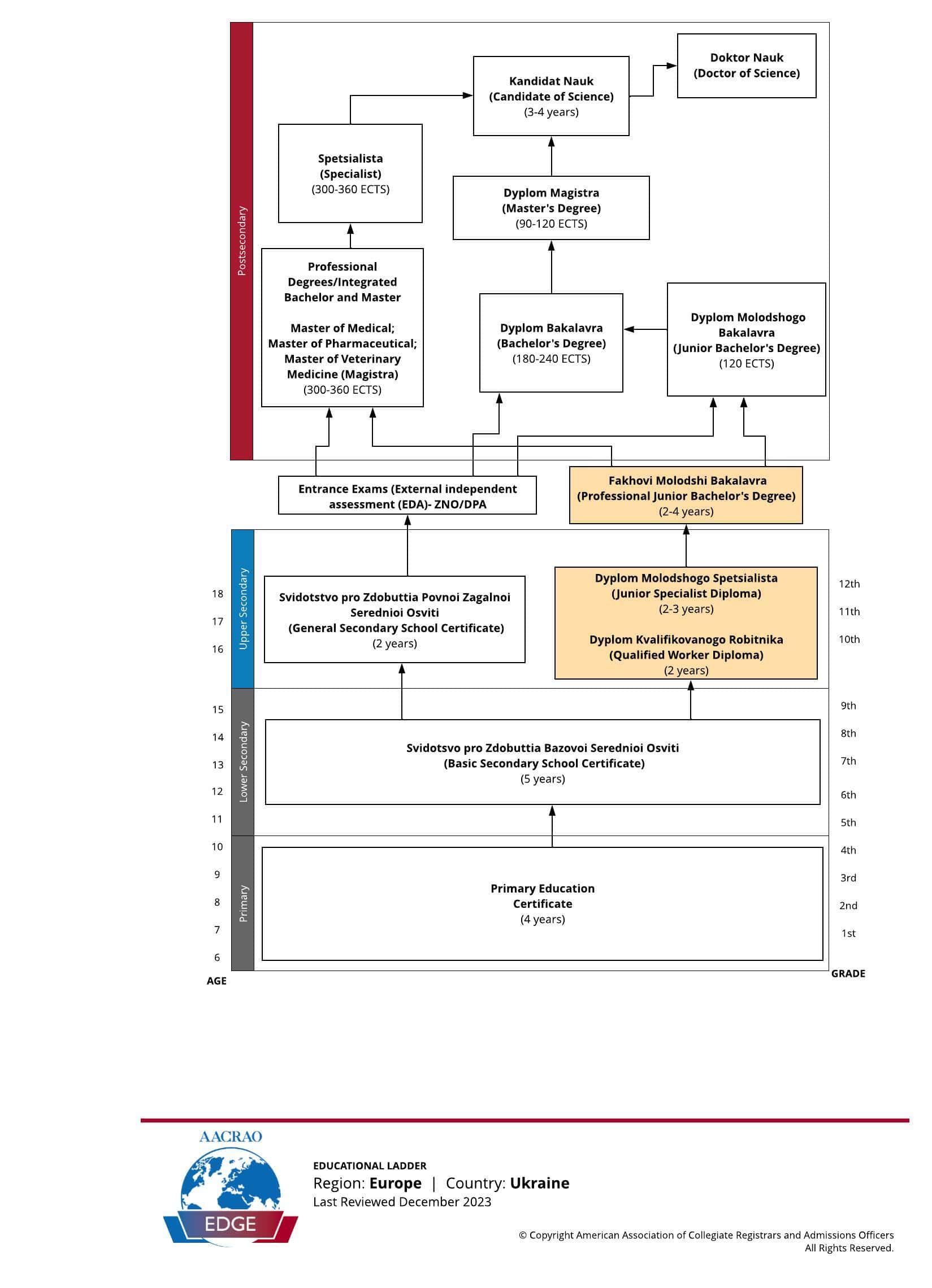
Ukraine educational ladder showing progression from primary school to doctorate and degree pathways
Ukraine Educational Ladder

Grading

Ukraine Secondary Education Grading Scale

Secondary Education Grading Scale
12-Point Scale
Indigenous Numeric Grade Indigenous Grade Descriptor Suggested U.S.
Equivalence
10 — 12 Excellent A 4.00
7 — 9 Good B 3.00
4 — 6 Satisfactory C 2.00
1 — 3 Unsatisfactory F Fail

Ukraine Post-Secondary Education Grading Scale

Higher Education Grading Scale
5-Point Scale
Indigenous Numeric Grade Indigenous Grade Descriptor Suggested U.S.
Equivalence
5 Excellent A 4.00
4 Good B 3.00
3 Satisfactory C 2.00
2 Unsatisfactory F Fail
Pass / Credit / Tested P Pass
  • “+” and “-” may be added to principal grades.
  • A grade of “Fail” is rarely given.
  • A grade of “Pass / Credit / Tested” represents completion of all course requirements without validation by examination.

Resources

Online Resources

Print Resources

  • Feagles, Shelley A., ed. 1999. A Guide to Education Systems Around the World. Washington, D.C. AACRAO/NAFSA.
  • International Association of Universities. 2003. International Handbook of Universities, 19th ed. Hampshire, UK. Palgrave Macmillan.
  • International Education Research Foundation. 2004. The New Country Index, Vol 1. Berkeley, CA. Ten Speed Press.
  • Paver, William J. 1990. Handbook on the Placement of Foreign Graduate Students. Washington, D.C. NAFSA.

Glossary

  1. Akademiaacademy
  2. Aspirantura3 year period of guided research
  3. Atestatmatriculation certificate
  4. Baccalaureatus Bachelor’s degree
  5. Dissertatsiyathesis
  6. Doktor naukDoctor of Sciences
  7. Dyplom Molodshogo SpetsialistaJunior Specialist Diploma
  8. Dyplom BakalavraBaccalaureate Diploma
  9. Dyplom SpetsialistaSpecialist Diploma
  10. Dyplom MagistraMaster’s Diploma
  11. Gimnaziaupper secondary special school
  12. Instytutinstitute
  13. Internaturainternship, sometimes associated with Master’s level programs
  14. Kandydat naukCandidate of Science, PhD
  15. Konservatoriaconservatoire
  16. Koledgecollege
  17. Liceiupper secondary special school
  18. Osnowna serednia shkolalower secondary school
  19. Starsha serednia shkolaupper secondary school
  20. Swidoctwo Pro Nepownu Seredniu OswituLower Secondary School Leaving Certificate
  21. Technikumvocational secondary school
  22. Uchilishchespecialized secondary school
  23. Uniwersytetuniversity

If you need to report an issue about this page please get in touch with us.

Recent Updates

Emergent News

Contributors

  • headshot of Johnny Johnson

    Johnny Johnson

    Director of Foreign Credentials Evaluation Services of America (FCSA)


AACRAO Electronic Database for Global Education (EDGE) is dynamic, and credential advice is subject to change. Information and suggestions contained within are modified after additional research has been completed. New placement recommendations are reviewed and approved by the International Education Standards Council (IESC). Copyright © 2004 – 2026 American Association of Collegiate Registrars and Admissions Officers.