

Represents the interests of the AACRAO community in developing and promoting the implementation of standards for electronic exchange of student education data.
What is SPEEDE?
SPEEDE (Standardization of Postsecondary Education Electronic Data Exchange) is a sub-advisory group of the AACRAO Technical Advisory Council (ATAC) that represents the interests of the AACRAO community in developing and promoting the implementation of standards for electronic exchange of student education data. To accomplish these goals the group members facilitate webinars, sessions, workshops and roundtables at the AACRAO Annual Meeting, Technology and Transfer Conference and Regional AACRAO Conferences. Committee members are actively engaged in various PESC workgroups focused on creating new standards, updating existing standards and identifying opportunities to increasing interoperability and adoption. If you have a question for the group or need help with EDX, check out the SPEEDE Community of Practice.
What is EDX?
Electronic Data Exchange (EDX) is an acronym used to describe various formats of electronic education record exchange. The most common formats used today in North America and Canada are EDI and XML structured data formats. The transactions are transmitted electronically between institutions and or their service providers through various secure networks then run through any variety of software translators in order to communicate information between computer systems. Institutions exchanging electronic education data agree to use the standard EDI and XML data formats which can be referenced at no charge on the Post Secondary Electronic Standards Council (PESC). There are schemas, implementation guides and recommended implementation practices available for a variety of education record types such as the College Transcript, High School Transcript, Request and Response, Financial Aid and the Application for Admissions. The use of standard EDI or XML formats enables institutions to exchange education records electronically between each other in a secure and efficient manner. The main benefits of EDX are secure data exchange, efficiency gains, automation opportunities and improved student experience due to decreased errors and processing time. Portable Document Format (PDF) is another popular method of electronic transcript exchange and does not natively contain machine readable data without the use of extraction tools.
EDX is a way to replace paper forms with electronic delivery and exchange of information. By making it possible for two computer systems to communicate, EDX trading partners realize the following benefits:
- Time savings in getting information from the sender to the destination institution
- Increased accuracy of data
- Elimination of data entry at the destination institution
- Data transmitted from the sender is exactly equal to the data received at the destination
- Improved data integrity when used in conjunction with a data encryption software
- Improved privacy of confidential data
- Increased data authenticity
- Cost savings as manual systems are replaced by electronic ones
AACRAO and others have developed a variety of standard formats for use in higher education. These formats have been developed in traditional EDI transaction sets, through ANSI ASC X12, and in XML schemas, through PESC.
More information including implementation guides and schema formats may be found on the PESC website. Other traditional EDI transaction sets available as X12 standards applicable to education include:
- Student Enrollment Verification (Transaction Set 190)
- Grant or Assistance Application (Transaction Set 194)
- Purchase Order (Transaction Set 850)
- Purchase Order Acknowledgment (Transaction Set 855)
- Invoice (Transaction Set 810)
and many others used in purchasing and accounting.
Technical Resources
- PESC Approved Standards & implementation Guides (IG’s)
- Recommended Implementation Practices (RIPS)
- Free Open SPEEDE Server
- Free Quick ‘n’ Easy Utility translation software
- Free Common Digital Layout (CDL) for PESC XML Transcripts
- Completed Crosswalks
- Paper vs. Electronic Transcript Cost Calculator (Excel file)
XML tools to for software development
- XMLSpy: Special thanks to Altova/Alexander Falk for their generous donation of the Enterprise Software Suite which has made development easier for the SPEEDE Committee.
- Liquid XML Studio Special: Thanks to Liquid Technologies for their generous donation of the Developer Software Suite which has made development easier for the SPEEDE Committee.
Additional licensing and fees may be required to utilize these tools
AACRAO provides a variety of ways to help colleges and universities learn about EDX and how to implement this technology.
- Attend The Assembly
- Attend the AACRAO Annual Meeting
- SPEEDE works in partnership with the Postsecondary Electronic Standards Council
Subscribe to the SPEEDE listserv (speede-g@vt.edu)
- Click here
- Depending on which option you are presented with, click the “Join group” button or “Subscribe to this group” link
Introduction and History
AACRAO and the AACRAO Standardization of Postsecondary Education Electronic Data Exchange (SPEEDE) Committee have been at the forefront of the development of electronic student records exchange. When the AACRAO SPEEDE Committee was first appointed in 1988, computers were still in their infancy and few people owned a home computer. The development of a standard format and server network for the exchange of electronic records was a truly visionary achievement resulting in the first SPEEDE EDI format, released in 1990. It helped pave the way for significant changes in the way student records and data are exchanged, and how institutions conduct their business processes. The server network (University of Texas at Austin Server, established in 1997) reached a milestone in January 2013 after exchanging its 35 millionth electronic education record.
In 2008, AACRAO appointed the Electronic Transcript Task Force to examine the current state of technology for electronic transcript exchange, describe best practices, and forecast future developments (Transcript Task Force Final Report). One of the conclusions of the report was that while there were well-defined standards and best practices for transcript exchange using EDI (Electronic Data Interchange) and XML (eXtensible Markup Language), AACRAO had not yet developed best practices and guidance for the exchange of transcripts using an increasingly common PDF format. Bob Morley and John “Tom” Stewart also noted in their chapter on electronic records in the AACRAO 2016 Academic Record and Transcript Guide that the “production and dissemination of PDF transcripts are not guided by any standards, guidelines or best practices to date.”
The AACRAO SPEEDE Committee was tasked with developing best practices and guidelines for processing electronic portable document format (PDF) transcripts. This document represents that compiled list of best practices for PDF transcript exchange.
Development of Best Practices
A 19-question survey was developed by the AACRAO SPEEDE Committee in spring 2013 to learn how institutions process both inbound and outbound PDF transcripts. The survey went to the following distribution lists:
- AACRAO membership via AACRAO Connect
- P20W Education Standards Council (PESC) Education Record User Group (ERUG)
- SPEEDE-l listserv
- University of Texas at Austin Server registrants
The survey closed May 1, 2013 with a total of 98 submitted responses from both Admissions and Registrar areas, with the majority of responses (76%) representing the Registrar area.
Survey results were analyzed by the AACRAO SPEEDE Committee and consolidated into the best practices described in this document. For the purposes of this document, the term “Best Practices” represents the results of the survey. Also included are AACRAO SPEEDE Committee member experiences gleaned from approximately 25 years of committee membership (committee mission and goals can be found at the end of this document). Committee members represent institutions from across the United States and Canada, and encompass various areas of a college/university including Registrar, Admissions, Enrollment Management, and Information Technology. Many have been involved with successful electronic data exchange (EDX) implementations at their respective institutions, and have shared those experiences at AACRAO national, regional, and state conferences. Some members are also EDX representatives for their respective state or province.
The AACRAO SPEEDE Committee aspires to foster and expedite the secure and effective transition from paper to electronic sharing of education records in the higher education community. The committee does not endorse any particular third-party provider, company, or organization that offers products and/or services for sending/receiving education records electronically.
PDF Best Practices
GENERAL
The survey showed that 51% of survey respondents are sending PDF transcripts; 85% are receiving; and 39% are doing both. Of those currently sending PDF transcripts, 82% use a third-party provider.
Of the respondents receiving PDF transcripts, 91% receive PDF transcripts from between one and five different third-party providers.
Of those sending PDF transcripts, 18% create their own PDF without the assistance of a vendor service. Institutions creating their own PDF documents should ensure that their security features and process protocols adequately protect the authenticity of the document and student data. In addition, sending institutions should communicate with receiving institutions to build a trusted relationship and ensure acceptance of the PDF document as the official transcript of the student academic record when the process protocols and security standards you have set are followed.
Over the past 5-10 years, the number of institutions using third-party providers to process PDF transcripts has increased significantly. This increase may be due to:
- Mandates for transcripts to be provided to state and province education agencies and to the United States Department of Education for statewide longitudinal data reporting.
- Institutions needing to reduce costs and operate more efficiently.
- Students wanting immediate transcript delivery to the destination.
- Institutions wanting to improve student services.
In addition to colleges and universities, PDF transcripts are also going to alumni, employers and potential employers, application centers such as the Nursing Centralized Application Service (NursingCAS) and the American Medical College Application Service (AMCAS). According to the American Council on Education (ACE), PDF is also the format utilized to create the approved Joint Service Transcript which is the official representation of servicemember military occupation and training. This replaces the former Guard Institute Transcript, the Army/American Council on Education Registry Transcript System (AARTS) and the Sailor/Marine American Council on Education Registry Transcript (SMART). For more information, visit the ACE website.
BEST PRACTICE #1: Understand and select the appropriate security for PDF transcripts.
Survey respondents using a third-party provider indicated the most common method of sending PDF transcripts is via a secure website with login.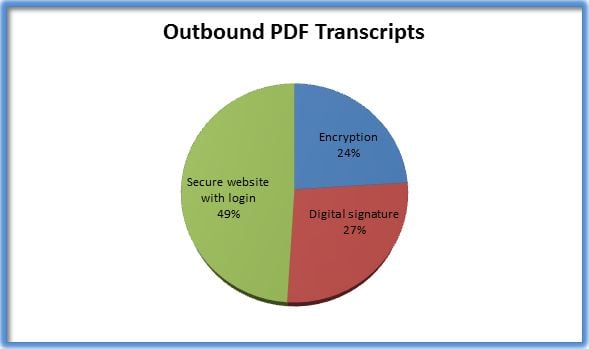
According to a PDF white paper published by PDF-Tools.com, PDF is appropriate for processing sensitive documents such as student academic transcripts because it supports encryption, access control, and digital signatures. PDF transcripts can be encrypted, which means the contents cannot be reconstructed without knowledge of a password. Various methods for delivering passwords for encrypted files in a separate message ensure security is not compromised.
As PDF technology has advanced to include multiple technologies, the education industry has taken advantage of this more intelligent file format, creating a new PDF standard for the education record. In 2011 PESC developed and approved our next generation PDF transcript. The PDF serves as a container for the embedded XML Transcript, enabling data to be sent and extracted as part of the electronic transcript process. This provides the institution the opportunity to ingest the XML data into a SIS or Transfer Articulation System. These PDF documents may also contain other documents in various file formats including but not limited to MS Word, media files, another PDF document (e.g. transcript, diploma, course syllabi, dissertation, publications), or EDI.
Survey results showed that only 3% of those sending PDF transcripts include embedded XML or EDI. This survey question allowed for additional explanation, some of which are highlighted below:
We are receiving these only from out of our jurisdiction, so the XML is not immediately relevant. However, in general terms I would prefer that the XML was available.
If the embedded XML would allow upload into our SIS system, we would prefer to receive it.
I would prefer to receive embedded XML as it would allow us to take advantage of a “drag and drop” feature of our software to post transfer work.
It would be nice to be able to receive these with key information so they can be electronically loaded either with embedded XML or otherwise.
Depends on how it could interact with Datatel systems…[I]f things such as course descriptions/syllabi are embedded into the transcript, that would be a great time-saver…[and] keep us from having to research the course description…[S]tudent may receive more credit because we can verify all components included in the class.
We run them through an imaging system and then auto articulate through Banner.
I think that I would prefer to [receive embedded XML] because…that might work better with our PeopleSoft system.
BEST PRACTICE #2: Understand and select the appropriate rights management of the document.
Various rights management options are offered by third-party providers of PDF transcripts. Some of the most common options offered are:
- Expire the transcript once opened by the recipient
- Watermark the transcript when printed by the recipient
- Limit the number of times the transcript can be accessed or opened by the recipient
- A combination of the above
Some key points to consider when selecting rights management options:
- Expiration. If the recipient is an employer, expiring the transcript once opened may be appropriate. However, if the recipient is another institution, expiration of the opened document may cause issues with retaining and/or viewing the academic record in the institution’s imaging system or document repository.
- Limit on the number of times it can be opened. If the sender places a limit on the number of times a document can be opened when sending to an institution, this may cause issues if the academic record needs to be forwarded and reviewed by various colleges or departments at the institution.
Of the respondents indicating they send PDF transcripts using a third-party provider:
- 65% place an expiration date on the documents
- 48% allow the document to be printed with a watermark
- 31% limit the number of times the document can be printed
- 17% place no restrictions on viewing or printing
BEST PRACTICE #3: Understand the various costs associated with transcript orders, and determine the appropriate time to collect the transcript fee.
If using a third-party provider, most pricing options are similar and may include :
- Base charge per transcript order
- Additional charge if document contains electronic signature
- Additional charge for rights management of the document
The actual charge may occur when the transcript is ordered, when it is delivered, or when it is delivered and opened by the recipient.
Of those institutions that indicated they charge a transcript fee, most apply the charge when the student orders the transcript.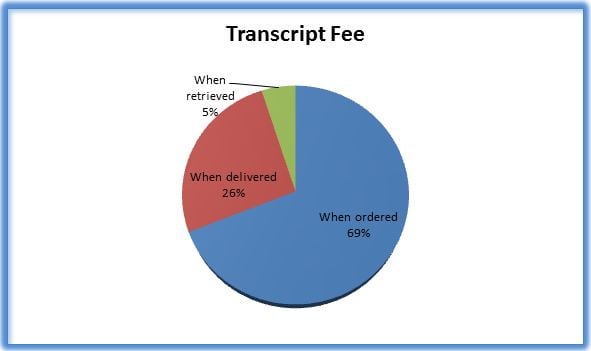
BEST PRACTICE #4: Accept secure PDF transcripts as “official” transcripts.
As the rate of acceptance increases, the PDF exchange format becomes more valuable to all institutions. The majority of the respondents that receive PDF transcripts replied “Yes” that they accept a secure PDF transcript as an official document. Some specified various conditions under which they would accept it as official, and some provided reasons that they would NOT accept as official.
| Accepted as official: | NOT Accepted as official: |
| The PDF transcript was delivered from a verified/secured sourceThe PDF transcript was encrypted/digitally certifiedThe issuing institution marked them as “official”Secure email method for those pushed from originating institution or their provider, and the document has NOT already been opened/accessed | If document is NOT encryptedDelivered direct or forwarded from students via emailDocuments that have been opened or accessed first by another partyDelivered direct or forwarded among colleges within an institution via email |
BEST PRACTICE #5: If using an imaging system to capture PDF transcripts, use automated indexing for improved efficiency.
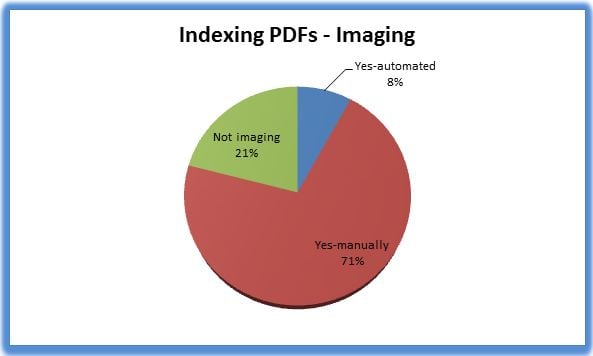
Many automation opportunities exist for the processing of PDF transcripts. Some examples are document import, indexing, and even content extraction. Automation can result in reduction of manual errors and potentially decrease processing time. Institutions are advised to identify automation opportunities that make sense based on their process and priorities.
BEST PRACTICE #6: Be familiar with processes for retention and data-mining of transcript data.
Third-party providers may offer various options for retention and data-mining. Those using third-party providers to send PDF transcripts should research these options and select those which best meet their specific institution’s needs and which align with applicable state and federal statutes. Such users should also request to be kept informed of any potential uses of that data.
Common Challenges
The survey respondents were asked, “If you could change your PDF sending (or receiving) process right now, what are the main changes you would like to implement?” The common responses were as follows:
| SENDING | RECEIVING |
| An increase in the number of institutions that accept PDF transcripts as “official” | A consolidated mailbox from which all inbound transcripts could be retrieved, regardless of the third-party provider |
| A consolidated common mailbox where all inbound transcripts could be directed, regardless of the third party provider being used; or a standardized process across third party providers | Increased adoption of PDF with embedded XML so data can be imported directly into SIS or Transfer Articulation System |
| Ability to embed XML | Currently processing XML files but would like to start receiving PDF |
| Reduced cost structure | Prefer to receive data file (EDI/XML) directly from the UT Server |
| My institution is not sending PDF transcripts, but would like to | Automation of PDF indexing for imaging |
Conclusion
The AACRAO SPEEDE Committee anticipates that these best practices and survey responses will provide some guidance to professionals in the Education Industry. As we all strive to find more efficient ways to serve our students we can learn from each other’s experiences and those of industry leaders. We appreciate the input and insight from survey respondents and are grateful for the opportunity to speak to Tom Black, Associate Vice Provost for Student Affairs and University Registrar at Stanford University, about his thoughts on the PDF transcript. Tom advocates for the secure exchange of electronic student information through his participation in AACRAO events and was recently featured in the AACRAO Connect Spotlight Roundup for the Groningen Declaration. Tom shared these words of wisdom that eloquently sum up the benefits of PDF usage:
Standards have their place: to ensure interoperability and service quality. It is a rare occurrence for a standard to spur innovation. The 2011 standard for PDF transcripts is one of those that will encourage changes in the way colleges and universities go about sending the official records. The intuitive nature of the standard makes it acceptable to officials in other nations as well. For a time, the PDF standard will serve us well as we adapt our services for the 21st century.
Standards require cooperation in order to succeed, therefore institutions must all work together to succeed in providing improved services to our students – simultaneously preserving the integrity of our institutions and student data while leveraging advances in technology.
As the PDF transcript technologies and processes continue to mature and additional questions arise, the AACRAO SPEEDE Committee welcomes any questions, comments and best practice updates at speede@aacrao.org.
AACRAO SPEEDE Committee Mission and Goals
The AACRAO SPEEDE Committee is a professional development committee within the AACRAO national organization. It was formed in the mid-1980s and has since remained active in the coordination, development, and implementation of international exchange standards in the United States and Canada by representing secondary and postsecondary education in collaboration with the standards-setting body P20W Education Standards Council (PESC). The Committee reports to the AACRAO Vice President for Information Technology.
The SPEEDE Committee’s mission is to develop, promote, and maintain standards for the electronic exchange of education records, in conjunction with appropriate national standards bodies, through:
- Standards Development and Maintenance
- Promotion and Education
- Training and Implementation Support
- Advisory and Oversight
The Committee aspires to foster and expedite the transition from paper to electronic sharing of education records in the higher education community
2013 Members of the AACRAO SPEEDE Committee
| Robin Greene, Chair | Senior Associate Director, CFNC Pathways University of North Carolina General Administration |
| Monterey Sims, Vice-chair | Director of Operations/Office of Admissions University of Phoenix |
| Matthew Bemis | Associate Registrar University of Southern California |
| Jerald Bracken | Office of Information Technology Brigham Young University |
| Tuan Anh Do | Assistant Director, Enrollment Management Technology San Francisco State University |
| Susan Dorsey | Assistant Registrar for Enrollment Services University of Colorado Boulder |
| Doug Holmes | Programmer Analyst III Ontario Universities’ Application Centre |
| Susan Reyes | Enrollment Services San Diego State University |
| Shelby Stanfield | Vice Provost and University Registrar University of Texas at Austin |
| John “Tom” Stewart | Registrar (retired) Miami Dade College |
In Fall 2021, AACRAO received a $1.2 million grant from the Bill & Melinda Gates Foundation. Part of this grant is to increase awareness and steward efforts in the use of post-secondary data in higher education to advance credit mobility and leverage data as a strategic enrollment management tool.
We have been exploring opportunities among AACRAO members utilizing the NSC Post-Secondary Data Partnership (PDP) and connecting with organizations equally focused on improving efforts for data exchange across institutions.
At the time the grant was awarded, nearly half of institutions who signed up had not yet managed to load their data into the PDP. In an effort to understand the issues institutions faced loading their data and to help institutions understand the barriers institutions face, AACRAO interviewed a large group of institutions and developed a report documenting these issues.
For those institutions that have successfully loaded data into the PDP, the next challenge is to leverage that data as part of their strategic enrollment management framework. AACRAO has two videos discussing how this is done from two different perspectives.
The first is an AACRAO webinar presented by the National Student Clearinghouse Using the Postsecondary Data Partnership (PDP) as part of your SEM Toolkit. This webinar focuses on the tools and data available in the PDP through dashboards and the Analysis Ready file.
The second presentation is an example of an institution using the PDP to inform their SEM activities. Northeast Lakeview College presented Decision Support Ecosystem: Student Success through a Culture of Care at the 2023 AACRAO Annual Meeting. The presentation, discusses the college’s efforts to improve student outcomes, highlighting the tools used with a focus on the PDP.
Due to a recording error, 3 slides were lost between 8:37 and 8:45 in the recording. The missing slides without narration can be found here.
As the PDP and institutional participation continue to evolve, we are creating an associated Community of Practice and we would like to identify members that are particularly interested in the use of post-secondary data as a strategic tool to advance the registrar and enrollment management profession. We invite interested AACRAO Members to join this Community of Practice and stay up to date on these efforts.
Resources
Report on Barriers to Postsecondary Data Partnership (PDP) Data Submission
An Enrollment Manager’s Guide to PDP Mastery Insights from the Trenches







share